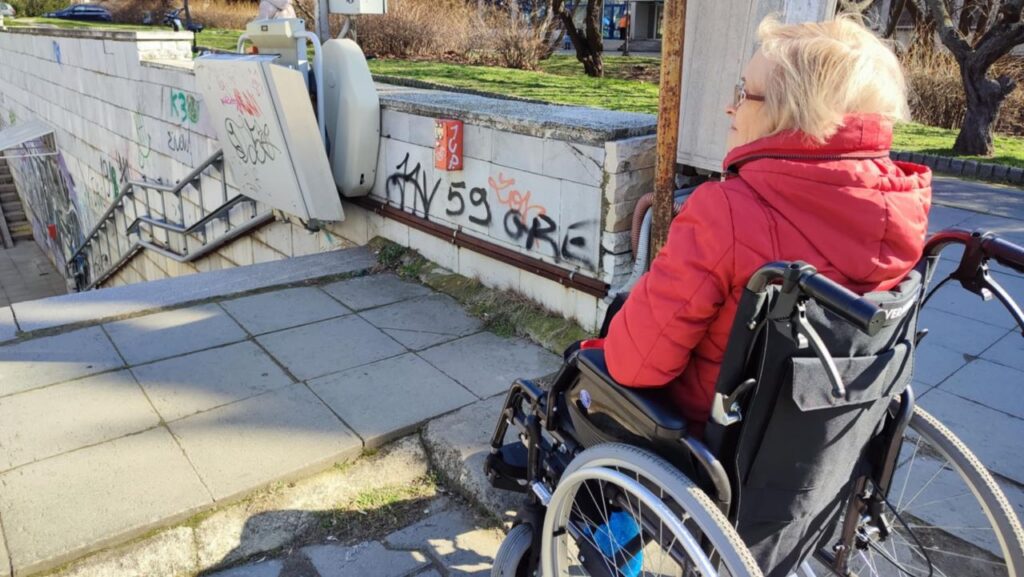
A non-functioning platform for disabled people, tied with a dirty cloth to a railing in an underpass and propped up with a car tire. This scene has become a symbol of the prison in which people with disabilities are forced to live in Varna. A year and a half after our first publication on the topic, the picture looks different only at first glance. The same wheelchair platform in the underpass of “Levski” Blvd. near the “Sportist” station is now free of unnecessary attributes. But it remains unusable and non-functional, just like during the previous mayor’s tenure.
In 29 underpasses in the city, a total of 55 stairlift platforms for people with disabilities are installed. Most of them were put in as part of the project for integrated urban transport in Varna, which cost about 78.5 million euros. And they have never worked. An inspection by the control authority in 2019 found that some of them are in disrepair, resulting in sanctions against the municipality. To this day, the stairlift platforms in the underpasses remain unused. However, Varna Municipality pays about 10,000 BGN monthly for their regular service. When including spare parts budgeted for repairs, the total amount jumps to nearly 200,000 BGN annually under the contract with the contractor company.
The mayors change, but the company remains the same.
The maintenance of the platforms in the underpasses is carried out by the company “KONE,” as indicated by the signs posted on some of them. The same situation existed during the previous administration of Varna municipality. The new contract with the contractor was signed in June last year for a term of 24 months. This is also the only company that submitted documents to participate in the competition within the legally mandatory deadline — by April 15, 2024. The decision to select the contractor was signed on April 24 by Deputy Mayor Diyan Ivanov. The total value of the contract is up to 326,040 BGN, excluding VAT.
We reported several non-functional platforms in different underpasses to the company’s national hotline. The operator was unable to locate the facilities in their system. We then checked the locations as recorded in the contract with the municipality — the underpass at Yavor station, the “NAP” underpass on “Eighth Primorski Polk” Blvd., and the underpass near “Sportist” station. After six minutes of searching, the woman concluded: “The municipality maintains them, we repair them.”
We called the Varna Municipality. The duty officer requested the exact names of the stops where the platforms do not work, the last name and phone number of the caller, and quickly concluded: “The request has been received.” A week later, there was no result.
According to data from Varna Municipality, the functioning, operational platforms for people with disabilities number 29. Although that is a little over half, our team checked several locations on “Eighth Primorski Polk” Blvd. and “Levski” Blvd. — and did not find a single one in working condition.
According to the contract with KONE, the response time for an emergency stop of the equipment for people with disabilities is up to 30 minutes, or up to an hour if there are no passengers to be evacuated.
For every 30-minute delay, the contractor is liable to pay a penalty of 0.1% of the monthly subscription fee for the respective facility, but not exceeding 5% of the contract value. The penalty does not release the contractor from the obligation to perform the services under the contract. The contractor commits to repairing the facility within five working days. If delayed, they owe a penalty of 1% of the repair cost for each day of overdue. In cases where service provision is interrupted due to their fault, the penalties amount to 10% of the total contract value.
Supervision of the implementation is carried out by the Municipal Directorate “Engineering Infrastructure and Beautification.” The Varna Municipality did not provide us with answers on whether any irregularities have been found or if sanctions have been imposed on the company since July last year.
Slightly over 26,000 people with permanent disabilities, including those using wheelchairs, live in Varna. The users of the social service “Assistive Support” provided through the Home Social Patronage number 389.
Before reaching the underpasses
However, before reaching the underpasses, these people must leave their homes. Over 90% of the apartment blocks built in the last century lack wheelchair ramps. In most of these buildings, the incline from the elevators to the ground floor is such that the only option is an electric stairlift platform, similar to those used in underpasses. The cost of such platforms, excluding design and installation, is around 30,000 leva, our research shows. Since 2019, a National Program for Accessible Living Environment and Personal Mobility has been adopted in Bulgaria to fund these structures. It allocates up to 100,000 leva for similar facilities.
We applied for the program to install a stairlift platform in a residential building in “Chaika” district. The first institution we visited to learn about the requirements was the office of the “Social Assistance” Directorate in the “Primorski” municipality district. The staff member seemed unaware of the program and asked us to wait outside. After 10 minutes, she came out with a note: “Until 15.05.2025, Sofia, Triaditsa street, No. 2, for property ownership; by mail or courier on site.” We already knew this information from the internet—the application deadline, the address of the Ministry of Social Affairs, and how to send the documents.
Institution No. 2 – “Primorski” Municipality
We asked for advice on what documents are needed to install a lift for disabled access on the staircase from the elevator on the first floor to the building entrance.
After visiting two departments in the architectural section of the municipality, we were directed to a larger city office for a permit and construction authorization. Besides project designers and dozens of documents, staff from the architectural department of Varna Municipality advised us to hire a supervision company. Otherwise, we would have to wait for an expert opinion, risking missing the program’s deadlines.
Installing a ramp or building a new block?
It turned out that installing a simple stairlift platform in a residential building requires an investment project with documents similar to those for a multi-unit building. The bureaucratic process is so extensive that it practically blocks any initiative. The homeowners’ association, in which a person with mobility issues lives, must submit 13 paper documents and 6 electronic files. They must conduct a “market survey of accessible environment equipment companies” to present three bids, including one from a Bulgarian manufacturer.
Starting the project
To begin designing, approval from the municipality is needed. The application process takes a month and costs 40 BGN. Then, project design, coordination of the electrical project with “Energopro,” and submitting a report from a supervision company are required. If no revisions are needed, it takes about 4 weeks for the building permit to become effective. Along with the project, the remaining 11 documents must be submitted both in paper and electronic form. The entire process and documentation costs are covered by the applicant, which should be the homeowners’ association—solidarily, all residents pay. In practice, however, the entire procedure and costs fall on the interested parties—people with mobility impairments in the building.
In the best case, fees for an architect, a civil engineer, and an electrical designer for the project range from 800 to 1,000 BGN. The supervision firm’s fee is around 500 BGN. On top of these, municipal, state, and notary fees apply. But the biggest problem isn’t money. Just like in the urban environment, there is a lack of “paved paths” or accessible routes guiding wheelchair users and their families on how to make their lives easier.
Only 8 projects in 2 months
The entire period when the program opens once a year is four months. This year, the deadline is May 15. Halfway through, only 8 proposals have been submitted—by Pleven, Sofia, Razlog, Dupnitsa, and Ruse, and none from Varna.
Last year, within the “Accessible Living Environment” component, 65 facilities were financed across 54 residential buildings, housing 73 people with disabilities, at a total cost of just over 2 million BGN.
Over the entire lifetime of the program, only a few buildings in Varna have received funding. The main reasons are bureaucracy and lack of capacity. People with disabilities—the primary stakeholders—rarely have the physical ability to actively work with homeowners’ associations to implement projects. Therefore, in Burgas, the municipality takes over this role, initiating procedures and document preparation when owners express interest.
However, as our check shows, this does not happen in Varna, despite the fact that 20 years ago, the City Council adopted a Regulation for creating a accessible environment. According to Article 4, it is ensured that the urban environment allows mobility for all population groups, including people with disabilities, along streets and pedestrian zones, on stairways connecting different levels, and through underpasses and overpasses.
“The environment for people with disabilities is not only inaccessible but I now also consider it hostile. On days when it is very cold and icy, I am effectively confined at home. This affects all the tens of thousands of people in wheelchairs in Varna and children. The platforms don’t work, the elevators are terrible. Often, people have to walk on the roadway. This is dangerous and must not continue like this,”
These are the words of Kalina Tacheva, who for several years can only leave her home with the help of relatives and friends, using a wheelchair. The few steps from the elevator to the apartment building’s entrance remain a huge barrier—some for whom it’s insurmountable.