Fruit and vegetable producers have taken to the streets across the country to protest against low farm-gate prices, a lack of market access and growing pressure from imported produce. Farmers from the Plovdiv region joined protests by their colleagues in Haskovo and Lyubimets and, days ago, dumped watermelons onto the asphalt. The reason: farm-gate prices have fallen below 10 cents per kilogram, while some of the harvest could be left to rot in the fields.
“We have produce, but traders are not coming to buy it,” said a farmer from Popovitsa. Another producer said he was being offered prices that made it impossible to cover his costs. “They are offering me between 8 and 15 cents, which is not viable for me. Traders make several times more. In Plovdiv, watermelons are selling for between 60 and 70 cents,” the farmer said. Together with their colleagues, they say they are dissatisfied with what they see as a lack of effective government measures.
Vegetable growers are also protesting over low farm-gate prices and imports, which they say are squeezing domestic production out of the market. They argue that the prices they can obtain for cucumbers no longer even cover their production costs. According to the farmers, growing imports from neighbouring countries are driving prices down, while intermediaries are buying increasingly smaller quantities of Bulgarian produce.
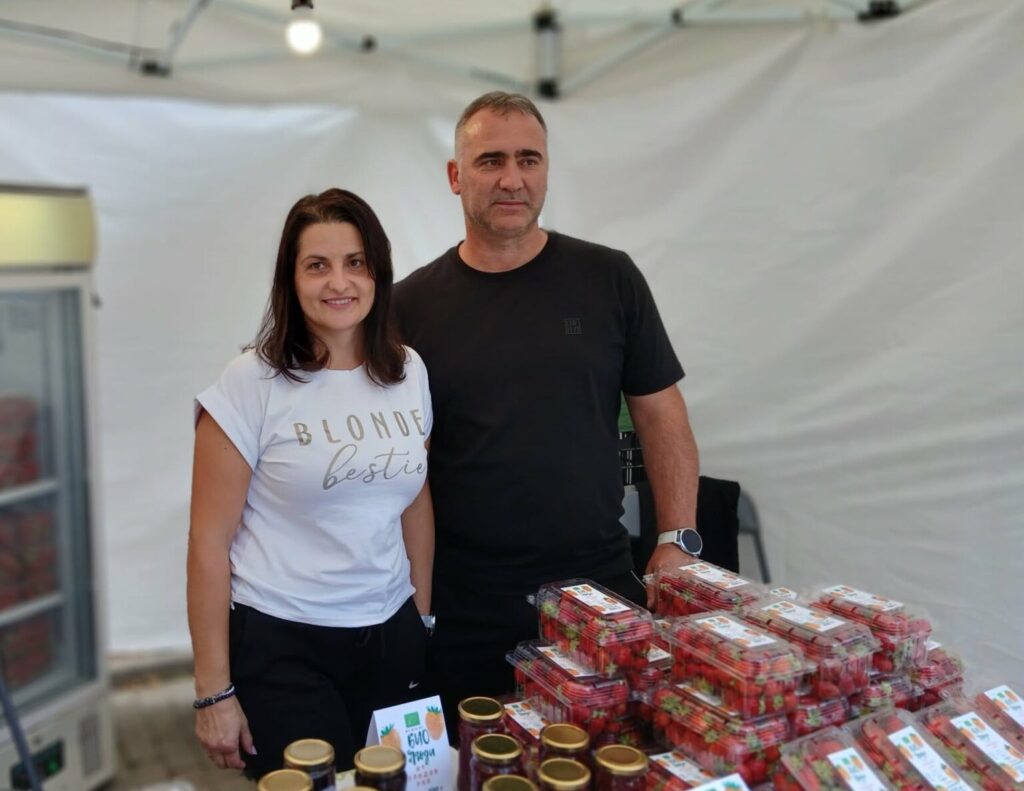
Some growers have therefore tried to bypass intermediaries by selling directly at farmers’ markets or negotiating deliveries to shops. But they say this is proving difficult.
“We sell our produce by the roadside so that we can sell at least some of it and recover part of our costs,” said a family from Kaloyanovo. They added that their children have been trying to negotiate with several supermarkets in Plovdiv to sell the tomatoes and cucumbers they grow.
Some farmers in the Plovdiv region describe this season as one of the most difficult in recent years.
Agricultural expert Krasimir Kumchev has also commented on the situation. He argues that the fundamental problem is not a lack of production, but the weakened market position of Bulgarian farmers. In his view, producers have increasingly been forced to sell below cost in recent years, while the added value generated along the supply chain remains outside the farms.
“Bulgaria was made to stop producing,” Kumchev said.
In an analysis, he cites figures showing that the number of agricultural holdings in Bulgaria has fallen from around 370,000 in 2007, when the country joined the European Union, to approximately 69,000 in 2025. He also says the area used for vegetable production has shrunk from around 700,000 decares to approximately 340,000 decares.
At the same time, Kumchev points to the expanding presence of major retail chains. As an example, he cites one chain that increased its number of stores from 14 in 2007 to nearly 140 in 2026. In his view, this transformation has created a significant imbalance in bargaining power between producers and retailers.
Other experts in the sector have also said that pressure on suppliers has gradually eroded the profitability of domestic production in recent years.
As a result, an increasing number of producers are calling for agricultural policy to focus not only on subsidies but also on creating fairer conditions throughout the food supply chain – from the field to the supermarket shelf.
Against this backdrop, Bulgaria’s Ministry of Agriculture has focused on financial support for farmers engaged in organic farming. The government says organic agriculture is emerging as one of the options for generating higher added value in Bulgarian agriculture.
The latest example is financial assistance paid under an eco-scheme for the environmentally sustainable management of permanent crops. Under the scheme, Bulgaria’s State Fund Agriculture transferred more than €6.3 million to 5,251 farmers under the 2025 campaign. The payment amounts to €168.93 per eligible hectare.
According to the Agriculture Ministry, farmers can meet the scheme’s environmental requirements by sowing cover crops between rows of permanent crops, maintaining natural vegetation or using mulching, without applying plant protection products or artificial fertilisers. Another requirement is that mowing must be carried out outside the bird nesting season.
The payments are also subject to a 1.5% deduction for a mutual assistance fund.
For many farmers, however, subsidies have failed to offset the economic problems that have accumulated over the years. Administrative requirements are another obstacle, making it difficult for some producers to access even the available support.