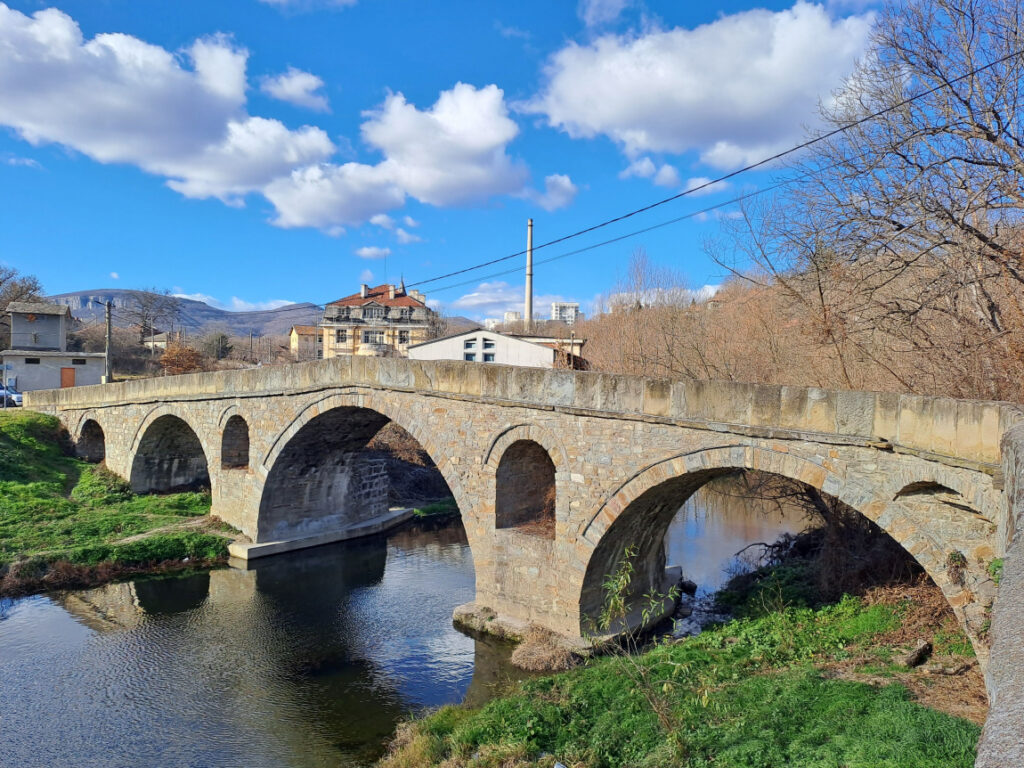
Dryanovo Municipality has launched a procedure to select a contractor to carry out repairs and conservation-restoration works on Kolyu Ficheto’s bridge over the Dryanovska River. The estimated value of the works is nearly €173,000, but at the time the procedure was announced, no funding was available. The contract with the potential contractor will therefore be concluded under what is known as deferred execution.
Kolyu Ficheto’s bridge in Dryanovo is in good structural condition, despite being affected by the floods in May this year. Signs of interventions and repairs carried out over the decades are still clearly visible, along with problems caused by prolonged exposure to weather conditions.
This is stated in the technical specification for the conservation and restoration project for the landmark structure.
The document provides detailed requirements not only for what must be restored, but also for how the work must be carried out. Specific techniques are prescribed for cleaning, strengthening and restoring the stone masonry, cobblestone paving and parapets, with an explicit requirement to preserve the original stone and authentic elements.
The condition of the bridge
Wide concrete footings can be seen around the foundations of the columns, indicating interventions carried out over the years.
Signs of previous repairs are visible throughout the bridge, particularly in the joints between the stone blocks of the structure and parapets, as well as on the paving.
In some places, the original mortar appears to have been replaced with a cement-sand mixture. Modern cement-based material has also been used on parts of the cobblestone surface.
Originally, the cobblestones had no grouting between them. Today, however, grass and other weeds have grown through the gaps.
Moisture has also left its mark on the structure.
According to the documentation, the systematic penetration of water into the masonry, followed by freezing and repeated temperature fluctuations, has caused salt deposits to form on the arches. These deposits are particularly pronounced on their lower sections.
The stone masonry and parapets are heavily soiled. The stone blocks are covered with deposits of lichens, moss and algae.
The existing joints are in poor condition and are missing in places.
Another problem is uncontrolled vegetation — grasses, creeping plants and shrubs. Their roots can damage the masonry, while the organic substances they release can contribute to erosion of the binding material.
The bridge also has an old electrical installation for lighting which is no longer operational.
The joints will be removed by hand
The existing joints in the stone masonry are to be removed manually and replaced with new ones using a special formula determined by a conservator.
The same principle applies to the cobblestone paving: only secondary, later-added joints are to be removed.
Where necessary, the joints between the stones will be filled with coarse river sand.
All stone masonry must be cleaned, with vegetation removed carefully and without damaging the structure.
No aggressive cleaning of the original stone
The technical specification describes several successive cleaning methods.
The first is mechanical cleaning, to be carried out using appropriate hand tools such as chisels, scrapers, scalpels and dry brushes.
These are to be used to remove soil, vegetation, hard deposits, lichens, moss, salts and deteriorated joints.
Particular importance is attached to the requirement that the original stone must not be damaged during the process.
Not all difficult-to-remove deposits necessarily have to be eliminated.
The specification states that some may be left in place in order to preserve part of the patina of the historic material.
After mechanical cleaning, wet cleaning with water or steam may be applied, but only at adjustable pressure adapted to the particular section.
Where salts are present, chemical cleaning using poultices with suitable agents is also envisaged. The specification expressly requires preliminary testing before the specific product is selected.
Vegetation will be treated before mechanical removal
Grass, creeping plants and shrubs are to be treated with a systemic herbicide before being removed mechanically.
Lichens, moss and algae on the stone blocks must be treated locally with a biocidal product.
The treatment is to be carried out twice — during the cleaning process and before the subsequent conservation treatment.
Damaged stones will not simply be replaced
The project provides for conservation and structural strengthening of stone elements where they have cracks or where cavities have formed within the masonry.
Cracked stones may be bonded using a specialised material, while deeper cracks and cavities in the masonry are to be filled by injecting a binding material under low pressure.
Where sections of masonry have collapsed or stones are missing, original stone is to be used if any is available on site.
If not, an analogous stone must be selected, matching the size and shape required for the particular location.
This is a key requirement given the historical value of the structure, the technical specification states.
Protection of the stone after cleaning and conservation is also envisaged. This includes hydrophobisation of the stone surfaces, which may be applied both to the cleaned original stone and to the new joints.
Metal brackets must be restored according to the original design
U- and L-shaped metal brackets are installed on the parapets and between individual stone elements. Some are missing.
The existing fastening elements are to be conserved, while missing ones are to be restored.
The new brackets must replicate the size and shape of the originals and be installed in their existing locations.
Every stage must be tested beforehand
One of the most specific requirements in the technical specification concerns the method of work.
Before each stage of the restoration, a small test section must be completed.
It must be approved by the lead conservator, who will use the test to determine the appropriate concentration of the solutions for the specific conservation treatment.
This means that the prescribed methods and materials should not simply be applied mechanically across the entire bridge without first being tested on a small section of the historic material.
The conservation-restoration work must be carried out by persons, or under the methodological supervision of specialists, registered in the Ministry of Culture’s register under the Cultural Heritage Act.
All materials used must be accompanied by technical data sheets and declarations of conformity, while the works must be carried out in a strict sequence and in accordance with the specified technological requirements.
The project also provides for the installation of new façade lighting, as the existing electrical lighting system is no longer functional.
The bridge over the Dryanovska River was built by Kolyu Ficheto in the mid-19th century.
It was one of the master builder’s early hydraulic engineering structures, in which he developed his ideas for the traditional Revival-era “humped” (Roman-style) bridge.
To this day, it is the only one of his bridges that has survived in its full original form.
The bridge is 38.50 metres long, while the carriageway and footpaths are five metres wide.
It has four arches of different spans, supported by three massive stone piers.
The deadline for submitting bids under the public procurement procedure is September 21, 2026.