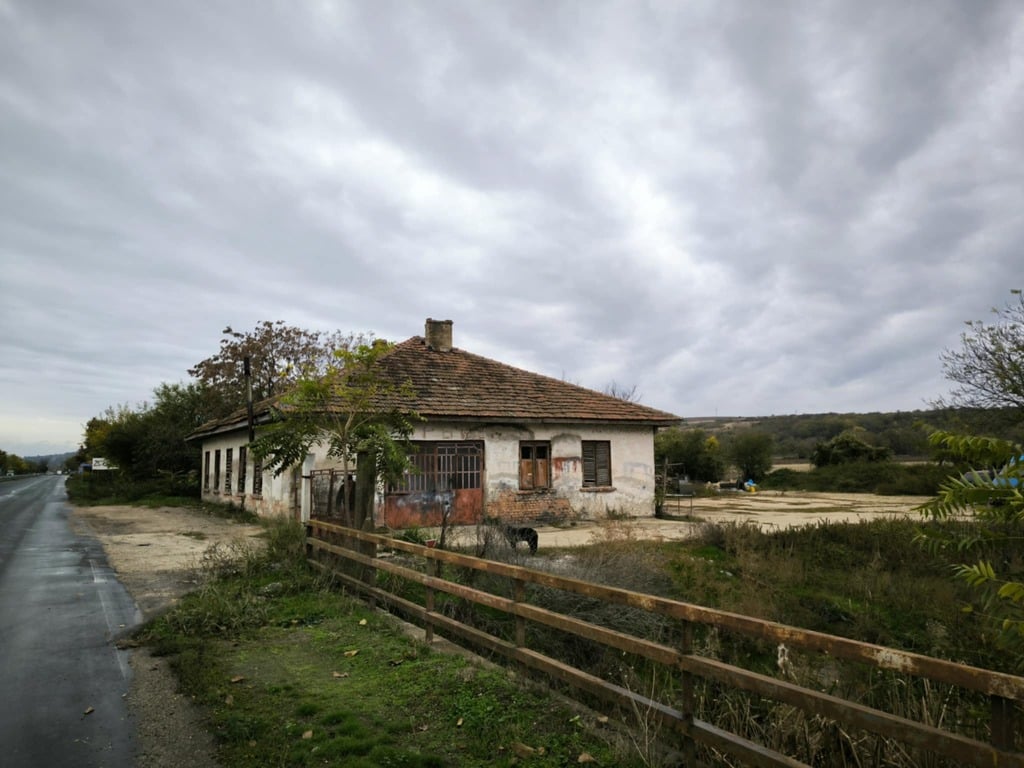
At the latest meeting of the Silistra Municipal Council, a decision was adopted to exchange municipal property for privately owned property, with an additional payment. The deal sparked considerable controversy, both because of the way it was approved and because of the person with whom the municipality intended to conclude it.
The proposal involved exchanging a 185 sq m municipal building, which is part of a municipal property covering slightly more than 1,000 sq m, for a privately owned 120 sq m plot on which a bus stop is located. On the face of it, the exchange was justified by the municipality’s need for a bus stop that would serve the future industrial park in Silistra’s industrial zone.
Before this decision was reached, however, an initial proposal was submitted in November 2025 to change the status of the municipal property from public municipal property to private municipal property. Based on previous practices, suspicions arose even then that the property was being prepared for disposal and that the decision could be part of a scheme for its subsequent acquisition by someone who had already expressed an interest.
At a meeting of the municipal property committee, Petya Varbanova, chief specialist for “Property Registration and Registers” at the municipal administration, insisted that no such interest had been expressed and explained that the status was being changed “because it [the building – editor’s note] no longer has the characteristics of public property and we are required by law to change it”.
Until then, the building had been managed by the Vocational School of Agriculture but had been rented out as a workshop to a private individual. The school’s director had stated in a report that the school was unable to maintain the building and therefore wanted it transferred to the municipality.
The proposal was not approved by the Municipal Council at its October 2025 meeting, but the mayor subsequently submitted it again in November, when it was adopted. The persistence in resubmitting the proposal was another red flag suggesting that the property might be being prepared for someone.
When the proposal was submitted for the second time to the municipal property committee, Petya Varbanova again stated: “If we do not change the status of the building from public to private property, we will have to have the building declared unsafe and demolish it. That is why we are submitting it again.”
In response to questions from municipal councillors about whether there was any investment interest in the property, officials said that no such interest had been expressed at that point and that the municipality had no intention of disposing of the property, but instead intended to retain and renovate it.
Before the Municipal Council session in July this year, however, a report was submitted proposing an exchange of the property, under which the municipality would receive a 120 sq m plot together with the bus stop built on it. Once again, the proposal was not justified by reference to anyone’s investment interest, but by the municipality’s interest in using the bus stop on the road to the future industrial park in Silistra’s industrial zone.
It turns out there was investment interest – and not from just anyone
The property on which the bus stop stands is part of a larger property owned by Mihail Trendafilov Mihaylov, the brother of Silistra Municipal Council chairman Dimitar Trendafilov.
As it turned out, Mihail Trendafilov had expressed an interest in acquiring the municipal property as early as 2025. He himself had used the building for years, although according to municipal records it had been rented to another tenant for the past 20 years.
According to Mihail Trendafilov, he had been managing the property throughout those years. Although the official tenant was someone else, he claims that they shared the rent and that he had made improvements to the property.
In 2025, his brother, Dimitar Trendafilov, chairman of the Municipal Council, called him to say that the municipality had a report recommending the demolition of the building. He then decided to look for a way to acquire the property. This eventually led to the proposed exchange.
Under the proposal, Mihail Trendafilov Mihaylov would transfer to the municipality a 120 sq m property on which a permanent bus shelter has been built. He had acquired the property containing the bus stop from the municipality around 20 years ago under a sale and purchase agreement.
In exchange, he would receive a permanent building measuring 185 sq m and a building right over a 1,045 sq m plot. He would also pay the municipality €21,920, while the municipal property has a tax valuation of €12,667.60.
In practice, following the exchange, Mihail Trendafilov would receive not only the building but also the use of the surrounding plot, meaning that the property at his disposal would effectively cover 1,045 sq m. It is an attractive property on a main road between the village of Aydemir and the city of Silistra, about one kilometre from the future industrial park.
The way the municipal administration handled the procedure – first changing the property’s status in 2025 from public municipal property to private municipal property, while stating that there was no declared interest, and then submitting a proposal to dispose of it – provoked anger among some municipal councillors and members of the public. This was reflected in the debate before the vote.
“The reasoning itself contains nonsense. This bus stop has nothing to do with our industrial park… Personally, I think this proposal belongs in the rubbish bin,” said architect Maria Ilcheva, a municipal councillor from the PP-DB group.
Members of the public attending the meeting also reacted strongly, calling out from their seats. Councillors from the group supporting the council chairman, meanwhile, backed the proposal.
The exchange was controversial – and so was the way it was voted through
Approval of the exchange required a two-thirds majority of the entire Municipal Council. With 33 members, this meant that at least 23 votes were needed.
After lengthy debate, the proposal was put to a vote by deputy council chairman Stoyan Uzunov, who was chairing the meeting in place of Dimitar Trendafilov because the latter had a conflict of interest.
Uzunov, however, could not vote through the electronic system because he did not have his laptop with him.
The video recording of the meeting showed that the electronic board in the chamber registered 21 votes in favour. Uzunov, however, counted 22 votes in favour, apparently including his own vote, even though he had neither declared it by name nor raised his hand. Naturally, his vote did not appear on the electronic board.
At the same time, another municipal councillor, Yordan Stoyanov, also did not use the electronic voting system, as was evident from the board, where no vote was registered next to his name. The video shows him raising his hand after voting had ended, although it is unclear why. He did not object after the vote when his ballot was not counted.
The proposal was therefore initially declared rejected, after which a recess was announced.
After the recess, municipal councillor Georgi Gaydarov, a member of the group that had nominated council chairman Dimitar Trendafilov, argued that the proposal should have been declared adopted. He said the electronic system had registered 21 votes in favour but that two additional councillors had voted in favour by raising their hands without their votes being recorded.
He was referring to Yordan Stoyanov and Stoyan Uzunov.
During Gaydarov’s statement, Yordan Stoyanov said: “Let the video be reviewed,” but did not specify whether he had voted in favour, against or abstained.
Stoyan Uzunov then took the floor and said that neither his vote nor Yordan Stoyanov’s had been counted. According to Uzunov, neither had voted through the electronic system, but both had raised their hands. He said that he had voted in favour and that Yordan Stoyanov had also voted in favour.
Yordan Stoyanov himself made no such statement.
Uzunov, who was temporarily chairing the meeting, then declared the decision adopted.
“It wasn’t morally right, but I supported it because it was beneficial to the municipality.”
Yordan Stoyanov said this in response to questions from Za Istinata after the decision was adopted with what became his decisive 23rd vote. A video of his response, shared on Facebook, attracted numerous negative comments because of the confused explanations he gave.
Was the vote valid?
Article 27(1)(5) of Bulgaria’s Local Self-Government and Local Administration Act requires a roll-call vote for decisions involving the disposal of municipal property.
In this case, voting through the electronic system is considered a roll-call vote because the system automatically records the councillor’s name and how they voted.
When the system is not used, as happened with these two councillors, the names of the municipal councillors must be called out during a roll-call vote, with each councillor explicitly stating whether they vote “for”, “against” or “abstain”.
In this case, the two councillors did not use the electronic system, nor did they follow the procedure requiring them to state their vote explicitly as required by law. Stoyan Uzunov subsequently did so, but he not only stated how he himself had voted; he also stated how another municipal councillor, Yordan Stoyanov, had supposedly voted. Stoyanov himself said nothing.
In other words, the legally required roll-call voting procedure was not applied to them. Their votes were counted solely on the basis of gestures.
Moreover, Uzunov effectively added two votes after the result of the vote had already been announced, which is not permissible.
Under the Rules on the Organisation and Activities of the Silistra Municipal Council, municipal councillors vote openly unless otherwise provided by law. Open voting can be conducted in several ways: by raising a hand; by standing when called by name and answering “for”, “against” or “abstain”; by signing in person; or through the electronic voting system, which also constitutes a roll-call vote.
The two councillors claim that they voted by raising their hands, a method that is not applicable when a roll-call vote is legally required. There is also no indication that they signed special voting lists.
If none of the legally recognised forms of roll-call voting was used to clearly express their votes, the two votes could prove invalid, meaning the decision may have been adopted without the required 23 votes in favour.
In that case, the decision could potentially be deemed null and void due to the absence of a valid expression of will by the collective body and because of a substantial breach of the administrative procedure governing the adoption of the act.
The decision, as voted, is now due to be sent to the regional governor, who may return it to the Municipal Council for reconsideration and a new vote or challenge it before the Administrative Court.
The public in Silistra is now awaiting the decision of the supervisory authority.