Photo and video: Venelina Popova
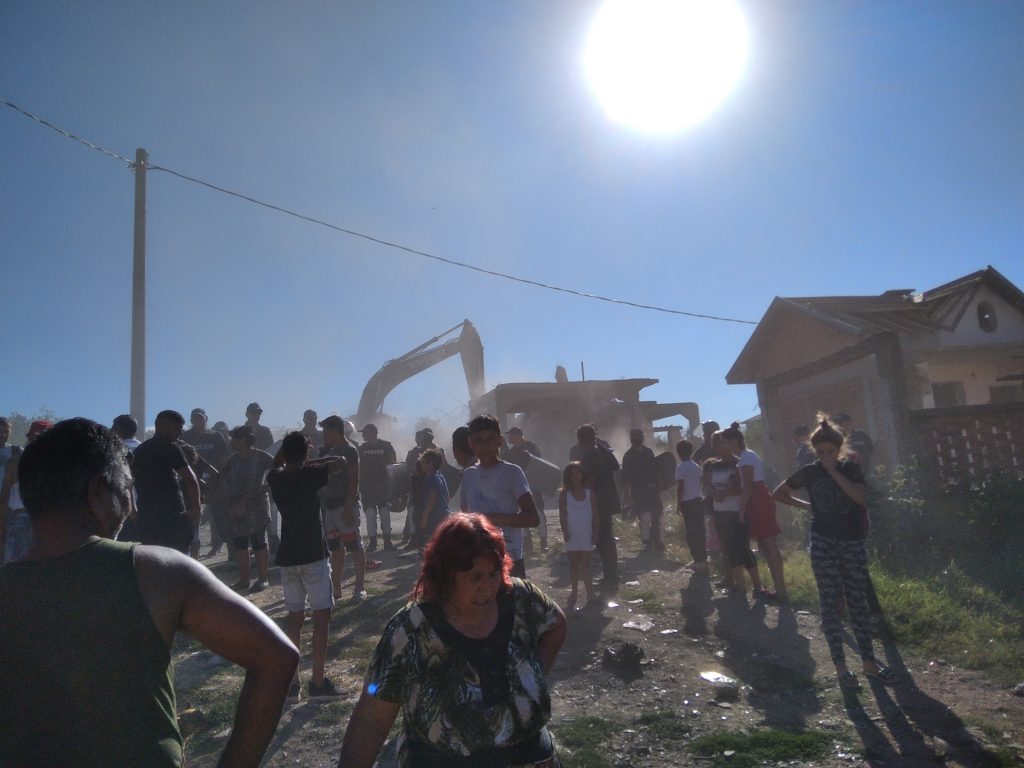
The next action of the Mayor of Stara Zagora for demolition of illegal Roma houses in the “Lozenets” neighborhood started this morning, and the news shifted the attention from the protests against Prime Minister Borissov and Chief Prosecutor Ivan Geshev.
The removal of the first of the planned houses began shortly before 9 am this morning, this time, unlike previous actions, without excesses on the part of their owners, who stood with their children in front of the excavators. Young Roma people, mounted on the roof of an unfinished massive two-story house with a living area of about 200 square meters, hurried to save at least the new roof tiles from the approaching excavator. Homeowners who are not currently scheduled for removal,
shouted at the journalists who were filming them, calling them “paparazzi” and threatening them that there was a coronavirus in the neighborhood.
Before “Pro Veritas”, Dipl. Eng. Angel Stomanyarski – Head of the “Construction Control” Department in the Municipality of Stara Zagora announced, that in a demolition procedure under Art. 223 of the Spatial Planning Act (SPA) there are 97 houses in the Lozenets neighborhood, 19 of them have passed through the Administrative Court, 5 are in the Supreme Court of Cassation. The municipal administration expects the Supreme Court of Cassation to rule in November, until then the houses will not be removed. The buildings to be demolished are in a green zone and out of regulation.
Dipl. Eng.r Stomanyarski could not give a meaningful answer as to how all these buildings over the years have been supplied with electricity and water.
According to him, private companies such as EVN have pursued their interest and connected illegal houses to the electricity grid. The answer sounds, to put it mildly, strange from the point of view of the law, because every connection to the grid is done according to a certain procedure and against the submission of some corresponding documents. Moreover, the question arises, if a private company has pursued its interest, has this in any way violated Bulgarian law? And where was the Municipality that owns the illegally built plots in the green zone?
Garbage containers could be seen in front of the houses, because according to Angel Stomanyarski, garbage collection takes place throughout the city. But that means that
the owners of the illegal houses would have to pay a corresponding “garbage” fee, otherwise it turns out that they had an advantage over the other taxpayers.
Roma citizens from the neighborhood said that there were financial tycoons in their community who bought cheap land plots for construction in the neighborhood and then offered them at ten times higher prices, as claimed loudly a young Roma guy in an attempt to attract the attention of a television.
Stomanyarski mentioned “half-heartedly” that he knew about one of these tycoons, but he was embarrassed to say his name, why he?
According to him, the plots in the neighborhood are being sold at an auction in which anyone can participate and are offered at preferential prices to the Roma population, so that more of them can buy plots for construction. For example, a land plot of 250-300 square meters could be purchased for BGN seven thousand.
Only a very small part of the owners of the houses to be demolished have submitted applications for accommodation in municipal housing and will participate on an equal basis with all others. The Municipality of Stara Zagora has adopted a long-term program for the removal of illegal buildings in the Roma neighborhood of Lozenets.
In the previous terms of Mayor Zhivko Todorov, 202 houses were demolished. Today the second stage of this program begins, in which 97 more buildings will be demolished.
There are about two hundred others left, built on “Carmen” Street, which are also subject to be demolished by the end of the third term of one of the most successful, according to GERB, mayors of the party and a member of the Executive Committee of the ruling party.
However, the most important question – whether Zhivko Todorov complies with the European Convention for the Protection of Human Rights and what problems of the Roma community in Stara Zagora he solves with these actions, remains unanswered. And now what!