The expiry of the 60-year agreement between Bulgaria and Greece on the use of the waters of the Arda River has brought into focus the question of how Bulgaria should manage one of its most valuable natural resources.
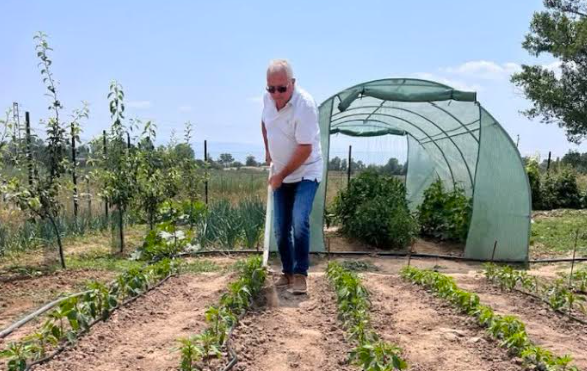
Plovdiv-based farmer and agricultural expert Krasimir Kumchev, known for his proposals for a long-term strategy for Bulgarian agriculture, spoke to “Za Istinata” about his ideas for managing the water sector and addressing the country’s irrigation problems.
“If you offer them gold or water, I have absolutely no doubt they would choose water,” Kumchev said of the agreement between Bulgaria and Greece on the Arda River, urging the government not to rush into signing another long-term contract.
In his view, water is becoming the most valuable strategic resource of the 21st century, and Bulgaria should first guarantee sufficient water for its own irrigation needs before agreeing to supply water to neighbouring countries.
Kumchev recalled that in 1964, when Bulgaria was facing serious financial difficulties, it signed a 60-year agreement under which it committed to providing Greece with water from the Arda, Struma and Maritsa rivers.
According to him, the agreement expired around a year and a half ago and Athens is seeking a new long-term contract to guarantee irrigation for agricultural areas in northern Greece.
Kumchev stressed that he is not opposed to cooperation between the two countries, but believes Bulgaria must first protect its own interests.
“I have nothing against it, provided we solve our own problem first. Second, if there is anything left. We invested huge amounts of money back in the 1960s in reservoirs such as Ivaylovgrad and Kardzhali. We cannot have built this infrastructure and then allow someone else to decide when and how much water we release,” he said.
For Kumchev, water is Bulgaria’s equivalent of oil.
According to him, the country possesses a natural resource that will become increasingly sought after over the coming decades.
“Countries that have oil sell oil. We have water. Greece and Turkey are in acute need of water. We have to find a way to benefit economically from this resource,” Kumchev said.
But profit, he stressed, should not be the first priority.
“Before we get to profit, we have to secure irrigation water for our own land,” he added.
A 15-year national water strategy
Kumchev is proposing the development of a national strategy for managing Bulgaria’s water resources to be implemented over the next 15 years.
In his view, the process should begin immediately with a comprehensive assessment of the country’s water potential.
“We need to bring together hydraulic engineers, survey all Bulgarian rivers in February, March and April, when they have the highest water levels, and build a system of numerous small reservoirs,” he said.
“We do not need more large reservoirs – we already have enough. We need to capture the spring runoff so that it can be used for irrigation in July and August rather than flowing into Turkey and Greece.”
The other key element, according to him, should be the construction of a modern underground irrigation network.
Kumchev argues that this should not be achieved by restoring the open canals operated by the state-owned Irrigation Systems company, but by laying pipes underground.
“The routes already exist. Pipes simply need to be installed along them. That would eliminate evaporation, prevent water theft and solve the irrigation problem,” he explained.
He compared the scale of the proposed project with the construction of a nuclear power plant, but stressed that its benefits would be long-term.
Water infrastructure as an investment in food security
Kumchev is convinced that investment in water infrastructure is an investment in the future of Bulgarian agriculture.
“If we solve this issue, we can secure food security for the next 200 years. Things are moving in that direction – whoever has water will have food and will not go hungry,” the agricultural expert said.
He also pointed to declining groundwater levels as a worrying sign. In his view, they indicate that climate change is already affecting Bulgaria’s water resources.
Kumchev estimates that the proposed infrastructure programme would cost around €10–15 billion.
Spread over time, however, he considers the amount manageable.
“If around €700–800 million is invested annually and construction work is planned region by region, it is possible to implement this strategic project. We are spending two billion on building renovations. To think that renovating buildings is a more important priority than water is foolish,” he said.
For him, the most important step is to begin designing the system now and develop a national plan, even if implementation takes longer than one or two government terms.
Kumchev has also addressed the issue on social media, where his position has generated significant public interest and his proposals have attracted support.
“My idea with this post is to draw the government’s attention and urge it not to rush into an agreement with the Greeks, because a long-term agreement, such as the one sought by the prime minister of our southern neighbour, Kyriakos Mitsotakis, could lead to a disaster a hundred times greater than the BOTAS deal,” Kumchev said.