The most sought-after job in Plovdiv region this year is agricultural crop worker. At the same time, vocational agricultural schools are struggling to fill even their minimum enrolment numbers. As a result, the sector facing the most acute labour shortage is failing to attract enough future specialists.
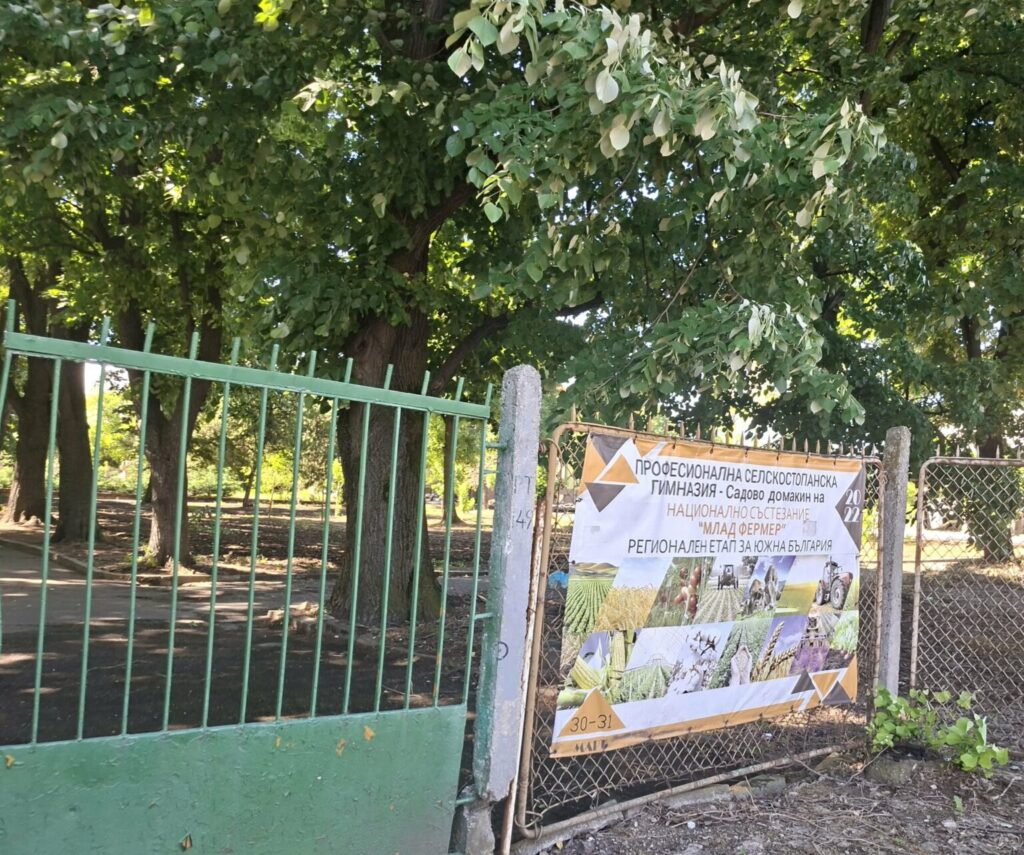
The situation is particularly telling at the Vocational School of Agriculture in Sadovo, Bulgaria’s first agricultural school, which is marking the 140th anniversary of its founding this year.
The school laid the foundations for modern agricultural education in Bulgaria. Today, however, it is fighting not for quality, but for survival.
Despite its long history, its distinguished alumni – including Alexander Stamboliyski, who served as Bulgaria’s prime minister from 1919 to 1923 – its modern facilities and links with businesses, student interest in agricultural specialisations remains low.
Some classes are difficult to fill, while in some years enrolment has been close to the minimum required for a class to be formed.
The reasons are complex: demographic decline, migration to larger cities and the persistent perception that agriculture is a hard and unattractive profession.
Of the school’s three specialisations – Agricultural Machinery Technician, Agrochemistry and Plant Protection, and Farming – only the first two reached the minimum number of students after the first round of admissions.
So far, only seven students have enrolled in the Farming programme.
“Overall, interest is not high. We are waiting for the next rounds of admissions,” school principal Dimitar Yordanov said.
According to him, the trend has persisted for more than five years.
“Students from our municipality tend to choose schools in Plovdiv and Asenovgrad. Agriculture is not seen as an attractive or desirable profession. They want to become barbers, pastry chefs or study electronics. Location and the opportunity to be in a big city have become more important than the profession itself,” Yordanov said.
While student interest is falling, employers are reporting a serious shortage of workers.
According to a survey of labour-market needs, more than 2,000 agricultural workers are currently needed in Plovdiv region.
There is also a shortage of technical specialists, operators and machine workers.
Employers are finding it increasingly difficult to recruit adequately trained staff. More than 80% consider self-control and discipline essential, while a similar share prioritise the ability to work in a team. Three-quarters expect good communication skills.
At the same time, employers report a shortage of qualified candidates and low motivation to work.
Free driving licences and modern technology
In an attempt to attract more students, the Sadovo school offers a series of practical incentives.
All students can obtain a category B driving licence free of charge, as well as a TVK qualification allowing them to operate tractors and attached agricultural machinery.
Through a project to modernise vocational education, the school now also has two drones for training in modern agricultural technologies.
Just a month ago, 19 students returned from a three-week placement in Italy under the Erasmus+ programme, where they studied organic viticulture and winemaking.
Despite all these opportunities, however, the school principal admits that they are still struggling to motivate young people.
“We offer free category B and TVK licences, modern equipment and international placements, but we cannot even motivate students to get their diplomas. The diploma does not seem important to them because they do not see a clear path to employment afterwards. They go back to working in agriculture, while some leave the country for Greece, Spain or the Netherlands,” Yordanov said.
In his view, the main problem lies not with the school but with state policy.
Agriculture education as a condition for EU funding?
Yordanov points to France and Portugal, where agricultural education is a prerequisite for farmers applying for national and European funding.
“If you do not have a diploma in agricultural education, you cannot apply for European funding. That motivates both students and parents. We have been waiting for a similar decision since 1991. Unless such a requirement is introduced, the number of young people interested will continue to fall,” he said.
“Everything that is new in agriculture, we are already doing. We are waiting for the state to tell people working in agriculture that company owners should have agricultural education in order to operate and benefit from national or European funding. That is what is missing here.
“In Portugal, for example, state and private schools accept only 40 students a year for agricultural training. Demand is high because only those who have completed secondary agricultural education are eligible to apply for funding programmes. Nobody else is. That is the incentive and the personal interest that motivates students and parents to study. Unless something similar is introduced here, there will be no demand for these programmes,” the principal said.
Seasonal work abroad offers better earnings
According to students and parents, seasonal work abroad offers better earning opportunities.
Daily wages are considerably higher and employment is more secure. Their experience shows that several months of agricultural work abroad can generate income that would be difficult to earn in the same period in Bulgaria.
“We are not against agriculture. Quite the opposite – this is what we do. But when we can save enough money during six months abroad to renovate our home or secure our children’s future, the choice is easy,” said a parent of a student at the school.
Another parent said the minimum wage was €8 an hour, with accommodation and food provided.
Eleventh-grade students say that after graduating they would consider building their careers outside Bulgaria because they expect higher wages, more secure employment contracts and better social security.
In their view, the difference in working conditions is a major reason why young people leave Bulgaria’s agricultural sector – even though agriculture remains one of the most in-demand areas of the labour market.