



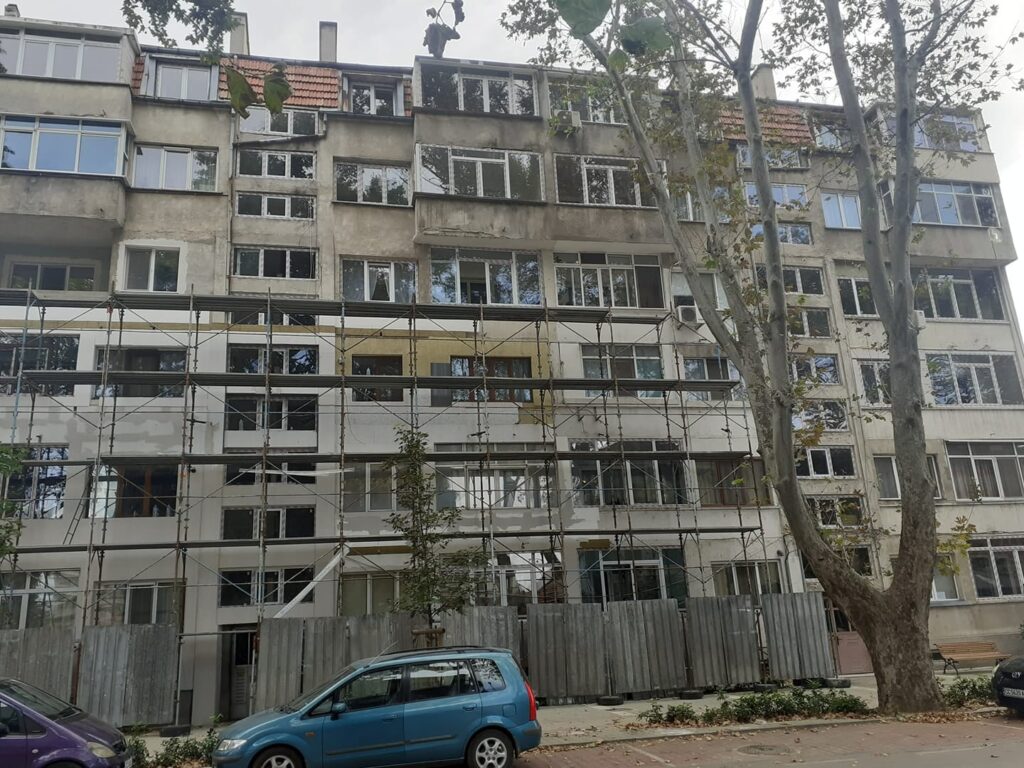
You might recall the satirical Bulgarian film from 1978, “Toplo.” In its plot, a group of craftsmen makes an agreement with the residents of an apartment block to re-pipe the heating system, leading to various troubles for the inhabitants. A similar situation arises with one of the blocks included in the energy efficiency program in Silistra.
The project “Energy Efficiency for Clean Air in the City of Silistra” under the Operational Program “Regions in Growth” 2014-2020, with a total value of 1,609,217.07 BGN, involves the execution of engineering for the energy renovation of six multi-family residential buildings. The public procurement for this project was initiated by the Municipality of Silistra in December 2018 and completed in mid-2019. A total of 21 companies participated in the open procedure, some of which were local. Through this process, four firms were awarded contracts to execute work on the six blocks located on several streets in Silistra: Blocks 4, 6, 8, and 15 on Simeon Veliki Street, Block 6 on Hristo Botev Street, and Block 35 on Dobrich Street.
The small Block 6 on Simeon Veliki Street, with a built-up area of 271 square meters and a gross floor area of 1,112 square meters, was awarded for execution to a company owned by a municipal councilor.
This refers to the deputy chair of the Municipal Council in Silistra, Ivanka Tasheva (ABV). She has been involved in this business for a long time and has won contracts for similar projects. The company “Galaxy Stroy” is registered in the name of her son.
However, the two largest projects—Block 4 on Simeon Veliki Street, with a built-up area of 364 square meters and a gross floor area of 2,592 square meters, and Block 35 on Dobrich Street, with a built-up area of 406 square meters and a gross floor area of 2,249 square meters—were awarded to the company “Drastar Engineering” EOOD, managed by Dimitar Nedialkov. The firm was established in 2018, the same year the procurement was announced, and is registered under the name of his father, Atanas Nedialkov. It has become a major contractor for construction projects in the municipality. Dimitar Nedialkov does not hold any positions in power but is a close friend of the regional coordinator and GERB MP Todor Stamатов, who is also his godfather. For the local elections in 2019, Dimitar Nedialkov and his wife, Maria Nedialkova, openly supported the candidacy of Elitsa Todorova—Todor Todorov’s wife—for municipal councilor on social media. And there’s a reason for this support. After the local elections, Maria Nedialkova was appointed as the Deputy Mayor for “Humanitarian Activities” in the municipality,
while her husband continues to secure contracts vigorously.
In the mentioned procurement, the newly established “Drastar Engineering” received the highest overall score of 100 for another large project—the block at 6 Hristo Botev Street—but due to the restriction in Article 46, paragraph 5 of the Public Procurement Act, which limits a single participant to the maximum possible execution of only two projects, they were not allowed to qualify. This opened the opportunity for the Sofia-based company “Kiltax” EOOD to win the contract for the project at a price of 269,100 BGN, including VAT. Another company that managed to win two projects was “Setatech,” but the total price for the execution of both projects amounts to 260,000 BGN, including VAT.
According to Article 63, paragraph 1, item 5 of the Public Procurement Act, the contracting authority may require the candidate or participant “to have personnel and/or management staff with specific professional competence for the execution of the contract, provided that the requirement is not used as an evaluation criterion for the offers.”
One of the disqualified participants, “Zadgranishno Stroitelstvo” EOOD, appealed its removal from the procurement process for the project at 4 Simeon Veliki Street, which was won by “Drastar Engineering,” before the Commission for Protection of Competition (CPC). The company was removed because it failed to document that it met the procurement criteria and did not have the personnel and team of specialists necessary for construction. In contrast, the contracting authority—the Mayor of Silistra—accepted that “Drastar Engineering” fully met the criteria and conditions. The CPC also found no violation in the removal of “Zadgranishno Stroitelstvo” EOOD and ruled that there was no deliberate discriminatory treatment towards it by the contracting authority, thus dismissing the appeal as unfounded. Consequently, the execution of the contract remained with the documented personnel of “Drastar Engineering.”
The procurement included measures to enhance the energy efficiency of the buildings involved in the project, such as replacing windows, installing thermal insulation on the walls, and repairing roofs, with the goal of achieving an energy consumption class of “C.”
The construction and installation work on the project began in October 2020 and was supposed to last 90 days; however, in Block 4, the timeline was delayed due to issues with the construction permit, as reported by the residents. Subsequently, complications arose during the execution.
The contractor began renovating and insulating the building from the bottom up, rather than from the roof down. This raised concerns and suspicion among the residents, leading to disputes with the contractor over the roof repairs.
According to the contract, oversight during the execution may be conducted by an authorized representative of the homeowners’ association, the mayor, and a consulting firm. The contractor informed them that the price of 249,000 BGN (299,000 BGN including VAT) did not include roof repairs or the replacement of tiles, and he would not undertake this work. Bargaining began in the style of a traditional master builder, with claims that “the money is not enough.”
Mikhail Nikolov, the representative authorized by the homeowners’ association to oversee the execution, claimed that he requested the project documentation to monitor the implementation and see exactly what activities were included in the project, but no one provided him with such documents during this time, and they were not aware of what activities were actually planned.
According to the description provided by the contracting authority in the documentation published on the Silistra Municipality website, the roof of the building is a sloped, cold type with a wooden roofing structure. The finishing coverage consists of ceramic tiles mounted on a wooden sheathing.
In the requirements for the execution of the project for 4 Simeon Veliki Street, as specified in the Full Description and Technical Specifications, it is stated in the Structural section:
“It is mandatory for the renovation of the building to begin with a complete and quality replacement of tiles, gutters, downspouts around the perimeter of the roof, and flashings around chimneys and skylights to prevent leaks from the roof.”
Thus, not only should the roof be repaired by replacing the tiles, but it should specifically begin with this action. Furthermore, it should be done competently to ensure there are no leaks.
Due to the contractor’s refusal to repair the roof, the homeowners turned to the mayor to resolve the dispute.
The mayor ordered an additional allocation of 30,000 BGN for roof repair and insulation activities. This raised the total amount of the procurement to 330,000 BGN. It is unclear where these additional funds came from and on what basis, given that a contract for execution had already been signed, and “Drastar Engineering” won the bid in competition with other companies precisely because of its most financially advantageous offer.
After the financial intervention ordered by the mayor, roof repairs were included in the activities, although these were stipulated as requirements of the execution contract. The question now was how this would be carried out.
It was decided to remove the old ceramic tiles, but instead of replacing them with new tiles of the same type, they opted for “metal tiles” (perhaps for ease and speed), and, finding themselves in a difficult situation, the residents agreed. The old wooden supporting structure of the sloped roof was relatively intact and was not replaced; instead, 80% of the old construction with battens and beams above it was utilized. As a result, sheets of metal tiles were placed over the old, unchanged battens, the unchanged old beam structure, and the unchanged plywood that had been there for over 30 years.
However, the contractor’s price proposal states otherwise.
In the appendix to the execution contract, section 5.1 states that the following activities regarding the roof will be carried out: delivery and installation of new wooden cladding, batten structure, vapor barrier membrane, and new tiles, including the cleaning of the existing tile coverage, construction debris, and their removal. All these activities were priced at 22,504.00 BGN for 388 square meters, or 58.00 BGN per square meter, excluding VAT. The price proposal with which the contract was won was signed by Atanas Nedialkov.
However, the only actual renovation carried out was the installation of metal sheets over the old wooden structure. A vapor-permeable membrane, which would prevent water from the outside and allow moisture from the inside to escape, thus making the roof “breathable,” was not installed. Moreover, the retention of the old plywood underneath renders the installation of a vapor-permeable membrane pointless, as the plywood is impermeable to vapor and leads to decay and mold, which has subsequently occurred.
The project, for which the approved price is 249,000 BGN (or 299,000 BGN including VAT), not only includes the replacement of the woodwork and tiles of the roof with new ones but
also stipulates the installation of 100 mm mineral wool thermal insulation batts OVER the ceiling of the attic space.
The cost of this service is recorded in the contractor’s quantity assessment as 28,800.00 BGN excluding VAT, with a unit price noted as 80.00 BGN for 360 square meters.
However, the ceiling remains bare cement. There are no mineral wool batts worth 30,000 BGN on the floor; instead, the insulation has been placed on the roof in the attic space—underneath the old plywood and old battens and beams. According to the residents, this insulation is half as thick, further reducing the implementation cost. The insulation is secured to the roof beams with fabric rather than cross battening for stability, which has caused it to sag along with the insulation.
To summarize:
For the roof activities, the quantity assessments in the price proposal recorded 55,000 BGN—22,000 BGN for laying metal tiles over the old unaltered cladding, 30,000 BGN for the installation of thermal insulation batts on the ceiling (which are not present on the floor but rather on the ceiling), around 3,000 BGN for other roofing activities, and an additional 30,000 BGN provided by the mayor. This totals 85,000 BGN excluding VAT. It seems quite excessive for a roof the size of an average house, which the contractor claims was not included in the activities at all.
Presented in this manner, the situation suggests many activities that were specifically costed but either were not performed or were only partially completed. The key question is what difference was formed and where did it go?
We contacted a company in the industry that specializes in roof repairs and requested a quote for a sloped roof with an area of 400 square meters. The parameters we set included activities similar to those carried out on the roof of Block 4 on Simeon Veliki Street: installation of metal tiles, construction of a wooden framework and batten structure, installation of a vapor-permeable membrane, removal of the plywood and tiles, placing insulation in the attic space secured with nailed battens rather than fabric, and the installation of gutters.
The price we were quoted was approximately similar—51,000 BGN including VAT. However, this figure pertains to actual work performed. It is also important to consider the significantly increased prices in November 2021 compared to mid-2020. And, of course, this quote reflects a quality job done properly.
And what is the quality of the work done on Block 4?
Due to the incorrectly installed metal roof and the thermal insulation underneath it, leaks have developed; no vapor-permeable membrane was installed to prevent water infiltration. Owners are currently placing trays, pots, and tubs under the leaking areas to collect the water. The plywood is accumulating mold and rotting, and the roof is not breathing.
Another problem is that not a single lightning rod has been installed on the building, which is mandatory for a metal roof and a building with a height of up to 25 meters. Such a lightning rod has been installed on a distant high building (Albena Dormitory), but Block 4 is outside its protective range, thus failing to comply with the requirements of Ordinance No. 4 from 2010 regarding lightning protection for buildings, external facilities, and open spaces. In this situation, residents are advised not to use telephones, handle knives, forks, or any metallic objects.
A persistent issue during the execution was the chronic shortage of workers on the site, which was noticed by the residents of the block. Workers would be absent for days, leading to a halt in work, which jeopardized the project’s completion. In fact, the majority of the workers were simultaneously engaged in intensive work on another large project that had been won—the Block 35 on Dobrich Street—to meet the deadlines of the awarded contract. Ultimately, the finishing touches on the project at 4 Simeon Veliki Street were taken over by workers from the company owned by municipal councilor Birol Mehmed from the DPS party, who regularly wins small construction contracts.
However, the procurement documentation does not specify any subcontractor for part of the work, which should have been declared in advance to assess whether the company has the capacity to execute the construction quality and on time—a basis that could lead to disqualification from the competition (one participant was removed on such grounds). Furthermore, in the procurement documents/protocols, Nedialkov’s company declared to the municipal commission that it would not use the capacity of other entities to meet the selection criteria and would not subcontract any part of the work to third parties.
According to the contract, the executing company also submitted a detailed linear schedule with a diagram of the workforce, corresponding to the proposed timeline in the bid for the execution of the procurement, with an hourly labor rate of 7.24 BGN, which is a key pricing element for the activities.
Residents from the block at 35 Dobrich Street, whom we contacted, report that the scheme with subcontractors also played out on this project—some parts were handled by crews from Dulovo, while other parts were again executed by the workers of Birol Mehmed. They faced similar issues with the cancellation of activities and leaks during the execution (one of the apartments was flooded but did not receive any compensation).
On paper, everything seems to be in order, but in reality, something else happened, leading to real negative consequences that the owners had to deal with afterwards.
After the completion of the project, the owners of Block 4 filed a complaint listing 26 points regarding the poor quality of the work performed, addressing it to the contracting authority—the Mayor of Silistra, Dr. Julian Naydenov. The complaint indicated that the metal roof has a significant sagging dent that collects water and causes leaks, along with leaks from gaps and other areas on the roof, and the absence of a lightning rod poses a threat to their lives, among other issues.
Throughout the process, the mayor played a passive-distributive role, making appearances at the site at certain moments for PR coverage of the project’s progress. He forwarded the residents’ complaints to the contractor—”Drastar Engineering” EOOD. Dimitar Nedialkov, on his part, did not show up but sent workers to seal some gaps and openings in the roof where leaks had occurred, using some sort of “eternal mix,” as explained by the workers to the residents, expecting that this would resolve the issues because everything was going to be “top-notch.” However, while filling in the holes, they further crumpled and bent the metal sheets of the roof.
However, the leaks continue to this day, and the residents have metal trays, pots, and tubs placed beneath them to collect the water.
They even joke about attracting lightning for good luck… and warmth.
Throughout the entire construction process for implementing energy efficiency measures, construction supervision was conducted by a firm selected through a different public procurement, for which a sum of 4,200 BGN excluding VAT was paid for this project.
Regarding the manner of execution and the complaints from the residents of the block, we sought a comment from the technical supervisor of the project from the municipality, Eng. Vesela Todorova. She explained that the project did not include the repair and insulation of the roof. It was established that the roof was old with outdated tiles, and addressing this would incur significant costs and effort, which is why it was not included. According to her, the designer made a mistake by not following the guidelines from the managing authority of the Ministry of Regional Development and Public Works (MRDPW), which specifically indicated that roof repair and insulation were not part of the project.
However, the entire documentation available in public registers indicates that roof repair and insulation were indeed planned and required by the contracting authority, which is presumed to have adhered to the guidelines of the managing authority. Vesela Todorova confirmed that an additional 30,000 BGN was paid by the municipality for these activities, as claimed by the residents. She explained that a vapor-permeable membrane was not installed under the tiles because insulation was placed in the attic space. If the insulation had been laid on the floor, then a membrane could have been installed on the roof. Nevertheless, according to her, the managing authority approved the expenditures as made.
Yet, even if roof activities were not initially planned and changes occurred in the parameters of the contract after it was awarded to the company, the question of quality execution remains.
And what about the money that was spent if the activities were dropped? If tasks were later omitted, it would logically follow that the execution price should decrease, rather than increase by an additional 30,000 BGN.
Right from the start of the procedure, detailed documentation was provided and published in the public procurement announcement, which outlines the history of the building. It was constructed in 1964, expanded in 1988, and it is clear that the roof is old, over 30 years old, making these conditions fundamental for signing the contract and determining the prices. Consequently, the price proposals included activities for rejuvenating the roof at a very high cost.
On March 15, 2021, the Municipality of Silistra reported the activities related to the project and the project officially concluded on April 12, 2021, with a warranty period of six years. It is unclear exactly what has been compensated to the contractors, as the residents of Simeon Veliki Street claim they refused to sign and accept the execution, while the municipality has stopped addressing the issue. They are pessimistic about the possibility of a real resolution to the defects due to the demonstrated indifference from the contractor, Dimitar Nedialkov, and the actual non-fulfillment of fundamental activities that cannot be rectified later if they were not addressed initially.
In the final scene of the film “Toplo,” the fraudulent craftsmen face consequences and end up “in the hot seat” in prison, later being brought out to fix the shoddy work they did. In this case, will anyone hold the builders of Block 4 on Simeon Veliki Street accountable, who, instead of facing consequences, continue to secure contracts? The project is funded by European money, and perhaps it will be necessary to involve the European Prosecutor to seek accountability from both the contractor and the contracting authority.






