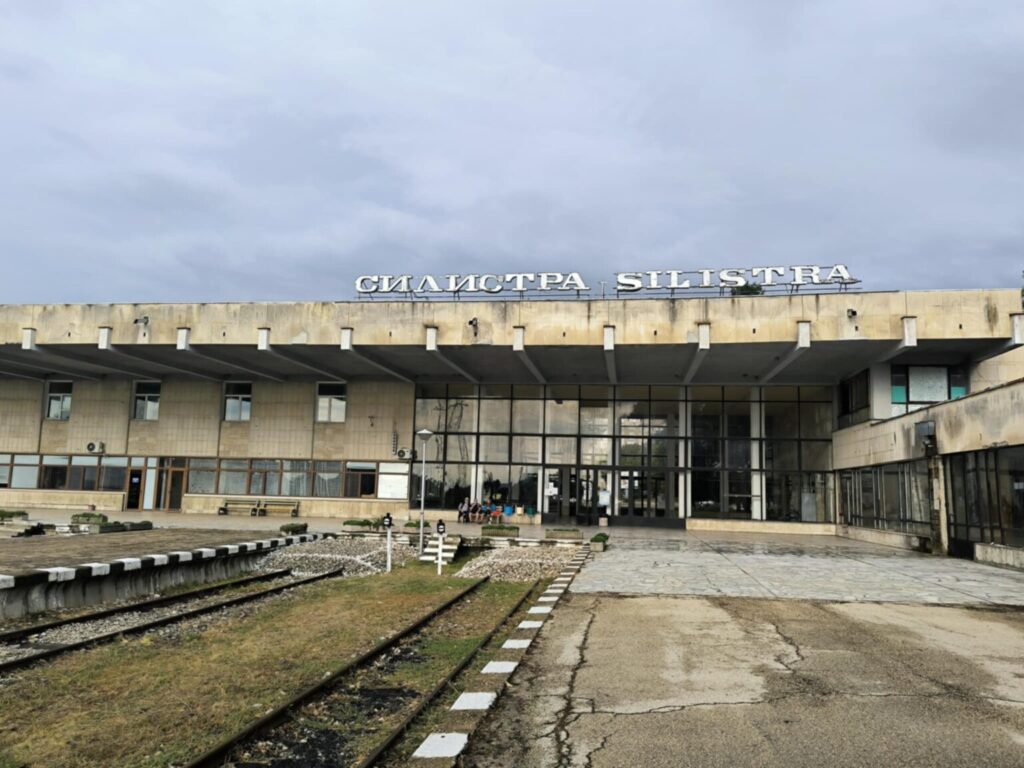
Photo: “Za Istinata”.
“Eleven and a half hours by train between Sofia and Silistra is a little more than it would take to get from Istanbul to Japan.” This statement was made by Transport Minister Grozdan Karadzhov in response to questions from journalists in Silistra about transport connectivity issues. Karadzhov was in Silistra on September 12 for an information meeting on the introduction of the euro, but he also visited local transport infrastructure sites and the post office.
According to Karadzhov, in order to make rail transport in Bulgaria faster, more funds will have to be invested in rail infrastructure.
“At the moment, the railway has not been upgraded for a long time and does not allow high-speed traffic,” he said.
In addition to being slow, rail transport in Bulgaria is not connected to other modes of transport that serve border areas such as Silistra, for example.
“Bus transport, as it is currently structured, requires regional governors and mayors to develop their own inter-city transport schemes, which are often not connected to rail transport schedules. This results in cannibalization—one type of transport tries to eat up the other.”
This is how the minister figuratively described the situation with transport connectivity in the region.
According to him, this problem will be overcome by investing in rail transport. When rail transport becomes the main mode of transport, its timetable must be linked to the National Transport Scheme so that every settlement has some form of feeder transport that fully covers the train timetable. This is also laid down in a new draft law on public transport, which is to be submitted to the Council of Ministers and the National Assembly within a month.
The minister also touched on another pressing transport issue, namely the construction of another bridge over the Danube near Silistra, an idea that is often exploited by political forces during election campaigns. As reported by “Za Istinata”, a memorandum was signed in Silistra a few months ago to lobby at a high level for the construction of such a facility.
Karadzhov stated that he supports the idea of building two more bridges—in addition to the existing two at Vidin-Calafat and Ruse-Giurgiu and the planned third one again at Ruse-Giurgiu, the next one to be built at Silistra. At the ministerial level, however, the idea did not meet with understanding and support from the Romanian side.
Another idea that has been discussed with the Romanian side is to build a transport link to divert heavy goods vehicle traffic through the town of Silistra. Currently, there is a ban, introduced by a decision of the Silistra Municipal Council, prohibiting heavy goods vehicles from passing through the city on their way to Romania. As reported by “Za Istinata” at the beginning of the year, after Bulgaria joined the Schengen area, the mayor of Silistra submitted a proposal to the municipal council to resume truck traffic through the city, which was rejected by municipal councillors following protests by citizens.
Karadzhov stated that he supports the idea of building two more bridges—in addition to the existing two at Vidin-Calafat and Ruse-Giurgiu and the planned third one again at Ruse-Giurgiu, the next one to be built at Silistra. At the ministerial level, however, the idea did not meet with understanding and support from the Romanian side.
Another idea that has been discussed with the Romanian side is to build a transport link to divert heavy goods vehicle traffic through the town of Silistra. Currently, there is a ban, introduced by a decision of the Silistra Municipal Council, prohibiting heavy goods vehicles from passing through the city on their way to Romania. As reported by “Za Istinata” at the beginning of the year, after Bulgaria joined the Schengen area, the mayor of Silistra submitted a proposal to the municipal council to resume truck traffic through the city, which was rejected by municipal councillors following protests by citizens.
*The flight between Istanbul and Tokyo takes 11 hours and 20 minutes.