Photo: Ekaterina Kyuchukova
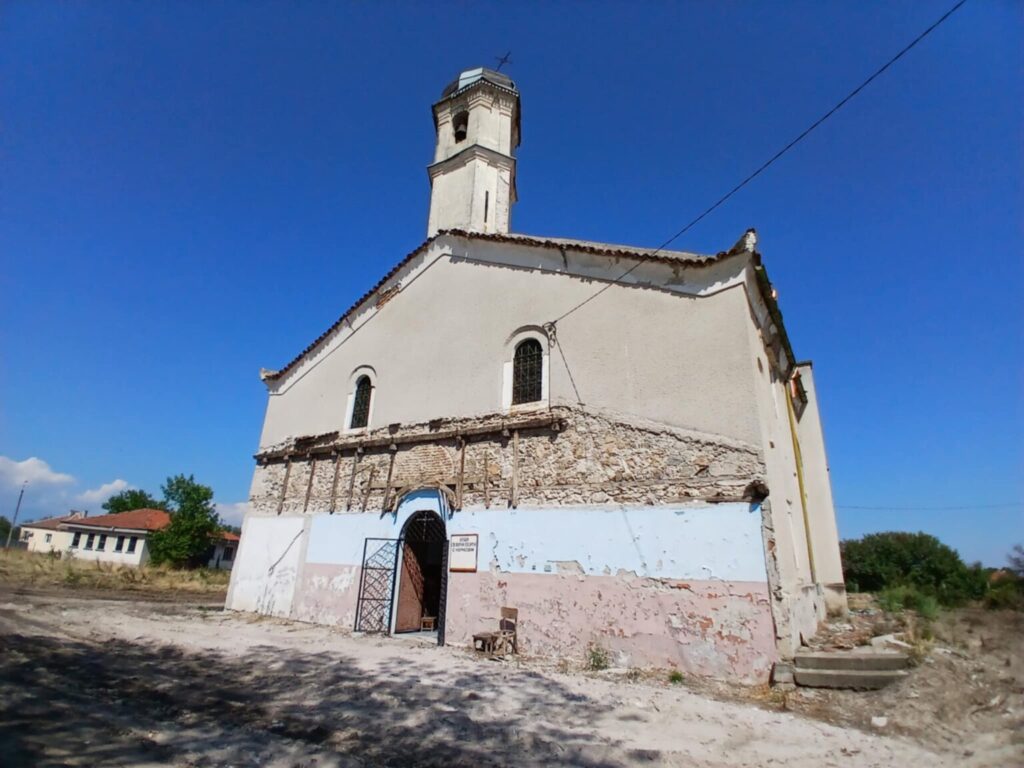
The Church – a Cultural Monument in Cherven Zemel village, Plovdiv region, has been falling into disrepair for 10 years after losing European funding.
The Orthodox church “St. George the Victor” was built in the village over 170 years ago and is known for its valuable frescoes. The icon of Jesus Christ inside the church was created by the renowned master Georgi Danov-Zograf, a close collaborator of Vasil Levski and the author of one of the most accurate portraits of the Apostle.
In 2013, the local authorities in Kaloyanova municipality developed a project for the complete restoration of the church and secured funding under the Rural Development Program worth over 750,000 BGN. However, the renovation never started because the Plovdiv Metropolis requested a reduction in the amount, claiming that the project funds were inflated. Ultimately, the deadlines for the European project were missed, and the funding was lost.
According to architect Svetoslav Faskov, head of the church restoration and reconstruction project, this cost is fully justified due to the necessary reinforcement of the building. Hydrogeological studies have established that an underground river runs beneath the church, requiring complex reinforcement work at a considerable depth. The entire project documentation was approved by the National Institute for Immovable Cultural Heritage (NIICH), but the Plovdiv Metropolis stopped it on the grounds that the church is a cultural monument and cannot be altered. All documentation for the project was approved by the National Institute for Immovable Cultural Heritage (NIICH), but the Plovdiv Metropolitanate stopped it on the grounds that, in their opinion, the costs were inflated by BGN 120,000.
Thus, despite the warnings of experts, the repairs did not begin, and in 2016, the church porch collapsed. The temple was closed, and its condition continued to deteriorate. The then mayor of the municipality of Kaloyanovo, Georgi Georgiev, submitted a report to the interdepartmental commission for disasters and accidents at the Council of Ministers, insisting on urgent funding, but his request was unsuccessful.
In 2018, the then mayor of the village of Chernozen, Tonya Hristozova, commented angrily to the Plovdiv media that the problem with the crumbling church was only being passed between institutions, and that the temple needed urgent repair.
“For five years now, we have only witnessed the shifting of blame. And it hurts me even more because in 2007, when I became mayor, my first task was to enter the church and see what condition it was in. I called in builders, who estimated that the repairs would cost around BGN 100,000 in 2007. Even then, it was clear that the church was starting to fall apart and its condition was becoming critical. Now, the repairs will cost at least BGN 300,000. Europe was prepared to provide 740,000 leva for the renovation of the church. If the priest had signed the contract for the project, we would now have the most beautiful church in the region. The church deserves it,” Hristozova told Focus Radio Plovdiv.
In 2020, another expert from the Ministry of Culture (MC) visited the church in Chernozen and found that the destructive processes in the temple were everywhere – destroyed plaster, damaged frescoes and icons, massive cracks in the walls, and the altar in extremely poor condition. The expert held meetings with the municipal authorities and insisted that urgent restoration measures be taken, but these were not implemented, according to the villagers.
Today, the people of Chernozen have decided to take matters into their own hands and have started a fundraising campaign to save their church.
A local farmer, who insists on remaining anonymous, has donated funds for the repair of the badly damaged roof. Meanwhile, the Ministry of Culture has drawn up a new restoration project after the church was examined by specialists from the French Institute for the Preservation of Cultural Heritage and the National Institute for Cultural Heritage. The experts conducted a comprehensive survey—from the iconostasis and icons to the architecture and bell tower—and prepared a design for the reconstruction of the unique temple.
Now the people of Chernozen hope that through joint efforts they will be able to save their spiritual and historical shrine.