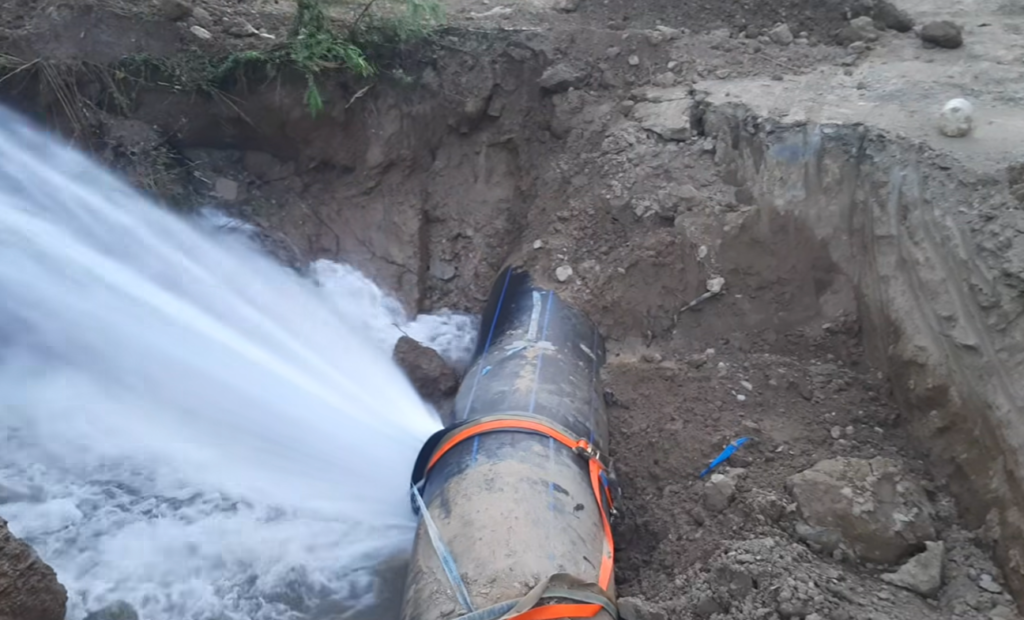
After almost BGN 70 million was spent on a new water pipeline and its construction dragged on for five “epic” years, Shumen has once again been forced back onto the half-century-old pipeline from Ticha Dam. The reason: on 18 May, the new pipeline “burst” yet again – in the same area where a major failure occurred last summer.
To prevent water supplies to Shumen, Targovishte and Veliki Preslav from being cut off, the Shumen water utility decided to create a bypass to the old pipeline. For a second day, thousands of people in the region have water thanks to the “old Todor Zhivkov-era pipeline”, as some Shumen residents have sarcastically called it on social media.
The latest failure occurred after Omurtagov Bridge, along Lot 1 of the project, which runs from Ticha Dam to the Targovishte inspection chamber. The other two sections run from the Targovishte chamber to Veliki Preslav and to Shumen.
Lot 1 had a projected cost of BGN 21.3 million and was built by the Ticha 2020 consortium, made up of Building Comfort, Vodstroy VT and Set Engineering. Crucially, this section of the pipeline still does not have an Act 16 – the final permit certifying that a construction project can be put into operation.
The first failure
On 21 July 2025, just eight months after the new pipeline was officially commissioned, it failed, leaving thousands of people without water in the summer heat. Two major breakdowns occurred on the pipeline within two days, first cutting off Veliki Preslav and then Shumen.
A video posted on social media showed a powerful geyser of water erupting from the pipeline. The Shumen water utility initially said the problem had been caused by a damaged shut-off valve. The following day, another section of the pipeline “burst”. This time, the utility blamed a failed weld.
The Ticha 2020 consortium, the contractor, responded that there were more than 1,200 welds along the route, creating the possibility of human error.
The new main pipeline from Ticha Dam to Shumen is 26km long and was part of a major EU-funded water-sector project signed in 2020. The overall project was worth BGN 126 million and was intended to address two of Shumen’s biggest water problems: a new BGN 68 million pipeline from Ticha Dam and the construction of a BGN 26 million drinking-water treatment plant.
All the work was supposed to be completed within two and a half years. In reality, the facilities became operational five years after the project began.
The commissioning of the new pipeline turned into a nightmare for Shumen residents.
The 26km pipeline was divided into three lots and built by two contractors – GP Group and the Ticha 2020 consortium – selected through public procurement procedures by the Shumen water utility.
GP Group built the section from Veliki Preslav to Pumping Station 1300 in Shumen, winning the tender with a bid of BGN 19.3 million excluding VAT.
The other sections, from Ticha Dam to the Targovishte inspection chamber and from there to Veliki Preslav, were awarded to Ticha 2020 for BGN 21.3 million and BGN 15.6 million respectively, excluding VAT.
Warnings that were dismissed
There were already suspicions of poor workmanship when the new pipes were being laid, but the contractors and construction supervisors dismissed the concerns as “untrue”.
In 2023, environmental activist Krasimir Minev from Veliki Preslav published photographs showing the new pipes being laid in deep trenches directly onto the soil and covered without proper compaction or bedding.
A reporter from Za Istinata inspected the site and confirmed what the photographs showed.
More than that: the inspection found that the new pipes were filled with soil and stones.
Following the publication, the project’s construction supervisor temporarily halted work over concerns about poor construction quality, but later announced that everything was in order.
Meanwhile, public broadcaster Radio Shumen disputed the report about problems with the pipeline, relying on the project supervisor’s response rather than conducting an on-site inspection.
“It is not true that there are violations in the construction of the new pipeline from Ticha Dam to Shumen,” the radio announced in a special fact-checking segment aimed at creating a “more reliable media environment”.
But Nadеzhda Petkova, head of the unit managing the EU-funded project, acknowledged that there had been “minor issues with the trench and compaction and the contractor corrected the work”.
Despite that, the public broadcaster concluded that claims suggesting there were violations in the construction of the new main pipeline, or that the pipes were being improperly installed, were “FALSE”.
The “false” claims become reality
A year later, the allegedly “false” claims were turned into facts when the new pipeline was commissioned on 4 November 2024.
As water was introduced into the system, a pump at Shumen’s main pumping station failed – reportedly because the pipeline was full of soil and stones, as the water utility later acknowledged.
After the pump was replaced, water from the new pipeline eventually reached household taps, where brown liquid began flowing.
Health authorities declared the water unfit for consumption. The ban remained in place for a week as failures at the ill-fated pumping station continued, with pumps repeatedly breaking down because mud and stones were being carried into the system from the new pipeline.
In 2025, the new pipes began to “split” because of faulty welds, according to the contractors.
Since the pipeline is still under warranty, repairs are being carried out by the contractors responsible for that section – the Ticha 2020 consortium.
Meanwhile, the old pipeline keeps coming to the rescue whenever the new one fails, prompting an obvious question: why was almost BGN 70 million spent on a new pipeline instead of maintaining the old one?
Environmental activist Krasimir Minev put it bluntly on social media:
“This shows we were right and the old pipeline will last another 100 years, as long as some earthly or extraterrestrial force had managed to persuade Pushkarov [the head of the Shumen water utility] to maintain it.”
The construction supervision company has offered no explanation for the repeated failures of the new pipeline.