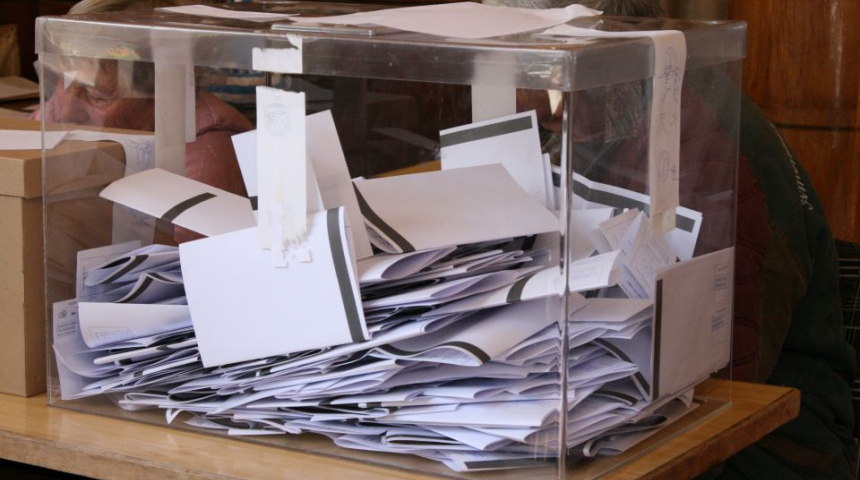
The ballots, which are at the center of the case in the Constitutional Court (CC) following complaints from several political parties after the last parliamentary elections in Bulgaria, have sparked institutional tensions between the CC, the Central Election Commission (CEC), and “Information Service.”
This tension has arisen precisely at the final stage, when the CC is expected to issue its final ruling. Additionally, the intervention yesterday by the Sofia City Prosecutor’s Office has made the case even more complicated and notably more alarming, especially following the extraordinary statement by the CC chairwoman on Bulgaria National Television (BNT) after the evening news at 8 p.m.
The re-counted ballots, according to experts appointed by the CC, come from 2,204 polling stations across the country, with about 90 of them from the 27th Stara Zagora electoral district. As announced yesterday, 780 votes from seven stations have been declared invalid; in two of those stations’ ballot bags, there were no ballots at all, which led to the results for all parties being nullified. One of these stations—Station 16—is located in the village of Obruchište, in the Gŭlŭbovo municipality.
According to the data entered into the Central Election Commission’s (CEC) system, out of 329 valid ballots, 210 — or two-thirds of all votes cast — are for the party “DPS – New Beginning.” In the fourth polling station in Gŭlŭbovo, more than one-third of the votes recorded in the protocol are also for the party of Delyan Peevski.
In a comment to Radio Stara Zagora, the deputy mayor of Gŭlŭbovo, Plamen Barakov, stated that the Constitutional Court (CC) had requested the full documentation for two polling stations in the municipality — Station 04 in Gŭlŭbovo and the mentioned Station 16 in the village of Obruchište — which had been submitted in accordance with the law to the regional administration in Stara Zagora on December 3 last year. He explained that on January 23 of this year, the CEC again asked for documents related to the 16th station, which they had already provided but which are no longer with them.
The regional governor of Stara Zagora, Metodi Markov, assured Radio Stara Zagora that the administration had fulfilled its legal obligations. He added that the ballot bag from Gŭlŭbovo, without specifying whether it was from the 4th or 16th station, was received sealed but without a control tape. He commented that such paper tapes are unreliable because they are difficult to secure and often fall off.
If the tapes fall off, it becomes a matter for the state, since they are supposed to be sealed with a rubber stamp to ensure the integrity of the voters’ choice. However, so far, there is no public information about other similar cases, although members of the regional election commissions have testified to all sorts of irregularities with these bags, including bottles of water being left inside, which has leaked and damaged the ballots.
The regional administration should have a protocol documenting the condition in which the ballot bags were received, and “Za Istinata” (For the truth) will request this under the Law on Access to Public Information (LAPI).
Maria Aleksieva, secretary of the regional administration, refused to provide information on the case, citing that she does not have permission from the regional governor Metodi Markov, whose appointment to the position was previously reported by “Za Istinata” (For the truth).
It is obvious, however, that the sack which contained no ballots was not empty—otherwise, it could not have been accepted into the regional administration and transported under police escort to the Constitutional Court. Is it possible that the sack was opened at the regional administration, where it should have been stored in a secure room with CCTV and sealed with signatures from official personnel? This question should be addressed by the relevant investigative authorities, but what was inside that sack instead of ballots is certainly known to the Constitutional Court.
Following the re-count of the ballots, the experts at the CC recorded zero votes from the paper ballot in one of the six sections at the 13th Primary School “St. P. Hilendarski” in the Kazanski neighborhood, despite the protocol of the Central Election Commission listing 145 ballots. Meanwhile, in one section in Chirpan, it was found that the votes from the machine count, which the CEC states were exercised by 99 voters, were missing. For these discrepancies, “Information Service” has requested additional instructions from the CEC. Today, a letter to the Central Election Commission has been published on their website, stating that:
“they have not provided the protocols sent from the Constitutional Court, nor their copies, to the Sofia City Prosecutor’s Office.”
The company has returned all original documents received from the commission, which had been provided by the Constitutional Court. In the same letter, it is also stated that on March 10 of this year, “in accordance with a prosecutor’s file and in response to received correspondence, the Sofia City Prosecutor’s Office (SCPO) requested that the Information Service provide all materials related to the computer processing and data entry from the protocols, which were sent from the Constitutional Court (CC) via the Central Election Commission.”
Bulgaria is on the brink of an institutional crisis, so the Constitutional Court and the Central Election Commission need to publicly reveal the truth about these elections as soon as possible. Even without the re-counting of ballots in over 2,000 precincts, a large portion of society has witnessed blatant extortion, manipulation, threats, and vote-buying—especially in smaller feudal-like municipalities and particularly where mayors or deputy mayors associated with Peevski were at the top of the DPS-“New Time” lists.
In the 27th Scottoza District, candidates placed second and third after the leader Halil Letifov were Nikolay Tonev, mayor of Glyabovo, and Shendouan Khaled, deputy mayor of Pavel Banya. The former pulled votes for his group and remained in the mayor’s seat, while the latter was sworn in as a Member of Parliament in the 51st National Assembly.
After the split of DPS, the Stara Zagora region remained entirely under the influence of Delyan Peevski, and perhaps is the second strongest area in the country after Blagoevgrad where his behind-the-scenes influence is so strong that it extends even to places without ethnic Turks and Muslims.