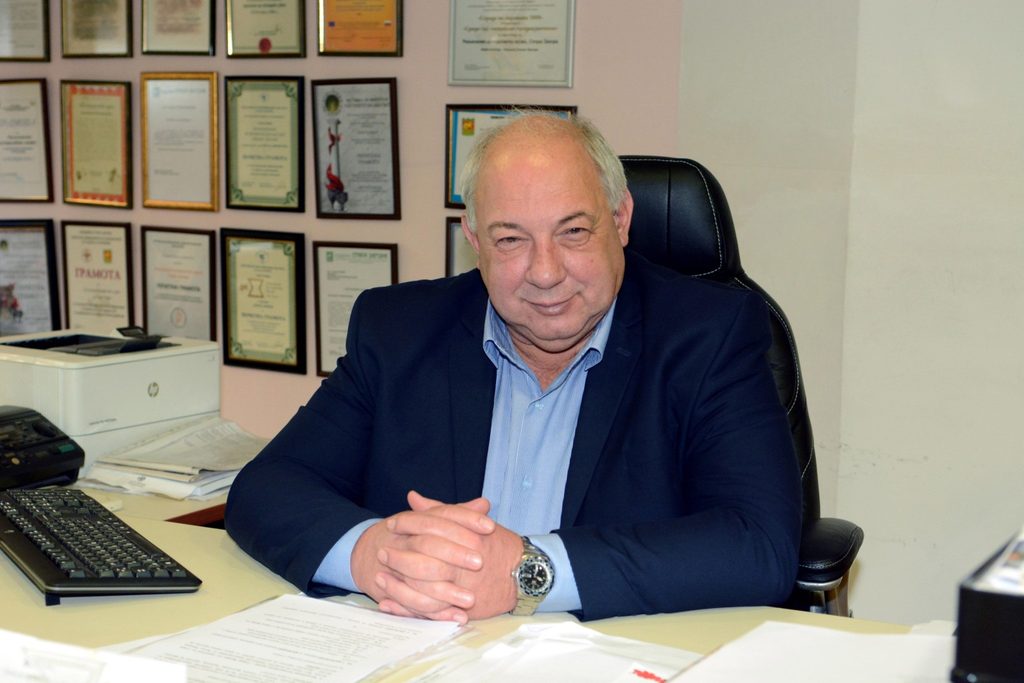
Petar Kalchev, Director of the Regional Historical Museum in Stara Zagora, is among the nominees for the “Golden Age” award. I came across this news quite by chance—which prompted me to wonder: what exactly has this 71-year-old historian from Stara Zagora contributed to the development, advancement, and promotion of Bulgarian culture?
This is no trivial matter. The “Golden Age” is one of the highest honors the state bestows in recognition of cultural achievements. Even those in Stara Zagora with little connection to opera or ballet are familiar with names like Veselina Katsarova or Silvia Tomova—both of whom have received this award. It is only natural, then, to ask: what specific contribution justifies the nomination of the Stara Zagora museum director?
A Nomination Without a Clear Source
I set out to discover who had put forward Petar Kalchev’s candidacy. Finding the answer took nearly two days.
Prof. Vasil Nikolov, chairman of the selection committee responsible for choosing the award recipients, declined to confirm whether the director of the Stara Zagora museum was among the nominees, or who had submitted the proposal. It turned out that the nomination did not originate from the museum’s own staff, nor from the “Bulgarian Museums” association, nor from the Bulgarian National Committee of the International Council of Museums (ICOM). According to information from sources I trust, the nomination was made by the Mayor of Stara Zagora, Zhivko Todorov—in other words, by Petar Kalchev’s employer. At the Municipality, my question caused visible discomfort for Diana Atanasova, Head of the Culture Department—a long-serving employee who is well past retirement age. Milena Zheleva, the Deputy Mayor in charge of the sector, did not even deign to respond to my phone calls. Mayor Zhivko Todorov—from whom I sought to hear the reasoning behind his proposal—did the same.
This collective silence is strange. A nomination for a high state honor is not a personal gesture; it is a public act intended to recognize cultural contributions. Therefore, it should not be met with silence.
Before such a nomination is made, it ought to be discussed—if not publicly, then at least with the staff of the Regional History Museum and with respected historians who are familiar with, and capable of evaluating, the work of its director during his two terms: 1998–2006 and 2019–2026.
What is the achievement being recognized?
The awarding of the “Golden Age” distinction to Petar Kalchev is likely to elicit mixed reactions within academic circles and the cultural community. It could cause bewilderment and a sense that the award is being devalued, should it be perceived as a purely expedient or politically motivated gesture.
Petar Kalchev began his professional career at the museum as an archaeologist in the Prehistory Department. In 1999, he attained the rank of “Research Fellow, 1st Class”—a position equivalent at the time to the academic rank of “Chief Assistant Professor.” According to the Act on the Development of the Academic Staff in the Republic of Bulgaria, he was required to obtain the educational and scientific degree of “Doctor” (PhD) within four years of the Act’s entry into force. Since this did not happen, his position was reclassified as “Assistant”—a rank he held until reaching the age of 70 at the end of last year.
This remains the case, even though Deputy Mayor Milena Zheleva occasionally refers to him publicly as “our professor.”
His biography lists only one sole-authored monograph: A Two-Story Early Neolithic Structure at the “District Hospital” Settlement Mound in Stara Zagora, published in 2013. His contributions as a co-author to other works, along with his remaining publications, catalogs, and monographs, are for specialists to evaluate; I lack the expertise to do so. A more significant question arises: what are Petar Kalchev’s measurable achievements regarding the excavation, research, restoration, and public presentation of Stara Zagora’s rich archaeological heritage?
After all, a high honor should be awarded for the director’s specific contributions, not for the city’s heritage itself.
The Museum and the City
Zhivko Todorov retained Petar Kalchev in his post for another term following a selection process in which he was the sole candidate. And as we know, one cannot hold a race with only one horse—especially if that horse is old or lame. Despite the negative public reaction surrounding the reappointment of an individual who is well past retirement age, the mayor did not cancel the selection process. Looming behind his decision, however, is the shadow of a former State Security (DS) collaborator—now regarded as a “grey eminence” who exerts influence over key decision-making in the cultural sphere. He acts as a patron to Petar Kalchev; one can only guess at the underlying motives or interests.
Real estate developers, who have spent years waiting for the completion of archaeological field surveys on their properties, have filed reports with the Prosecutor’s Office accusing Petar Kalchev of corruption. Complaints have also been submitted to the Ministry of Culture and the General Directorate for the Preservation of Cultural and Historical Heritage regarding the delays hindering their investment projects.
These are allegations and complaints—not facts established by a court or an investigative body. Yet, precisely for this reason, they demand answers—before, not after, the presentation of a state award.
A notable case involves a monumental temple dating back to the 2nd century, discovered in 2004 and linked to the imperial cult of the Roman Empire. Two decades later, it remains unrestored and unpresented to the public.
The attitude toward municipal sites left excavated for years in the city center is no different—standing as a testament to institutional irresponsibility. I will mention just two: the grounds of the “Petko R. Slaveykov” Second Primary School and the “Maxim Gorky” Secondary School. In Stara Zagora, there are about twenty other such massive excavations, now overgrown with weeds and inhabited by snakes. Meanwhile, some of the landowners have already abandoned their plans to build on these sites.
It is worth noting here that Petar Kalchev typically heads most of the archaeological investigations for which private investors pay significant monthly sums.
A 2024 audit report by the National Audit Office regarding the municipality identifies legal violations concerning civil contracts concluded between the municipality (as the contracting authority) and seven permanent staff members of the museum—contracts through which over 150,000 BGN was disbursed. In the vast majority of these cases, it was found that the activities performed under these civil-law arrangements overlapped with the duties already included in the employees’ regular job descriptions.
These findings did not faze the mayor, who promised to commission a new audit of the museum. To date, however, it remains unclear whether such an audit has been conducted and what its findings were.
Heritage Left to Fend for Itself
Many questions remain regarding the transparency and management of the museum: are there any new exhibitions? How many archaeological sites have been uncovered and presented over the years? What are the visitor numbers? What is the revenue generated from tourists?
The artifacts of Augusta Traiana could be presented digitally—within an interactive environment, using special headsets that allow visitors to step into a virtual reconstruction of the Roman city. Furthermore, digital lighting could reveal the finest engraved details, as well as inscriptions on the ancient columns and stones of the “Ancient Street” and the Forum—inscriptions that have faded over time.
Yet, the Stara Zagora museum does not even offer an audio guide for tourists.
There are also many questions surrounding the fate of unique ancient mosaics. One of them is locked away on the ground floor of the Post Office building and is listed as a fixed asset of Eurobank Bulgaria AD, part of the Greek Eurobank Group. The Ministry of Culture could not explain to me how an immovable cultural asset—which is 100% state-owned—could appear among the assets of a foreign bank.
Meanwhile, the ancient mosaics belonging to the baths of the ancient Forum remain unexcavated and unexhibited. I will stop here, as the list is a long one. The negligent and irresponsible attitude toward the archaeological heritage of Stara Zagora cannot be described in just a few sentences.
An award, or an alibi?
We do not know the true motives behind Mayor Zhivko Todorov’s decision to nominate Petar Kalchev for the “Golden Age” award. But we can make an educated guess.
The first hypothesis is that, upon receiving this high honor, the museum director will be invited to step down voluntarily, citing health reasons.
The second is that the mayor and his team intend to use the award to burnish Petar Kalchev’s reputation, ensuring he remains a key figure in the implementation of the Strategy for the Development of Culture in Stara Zagora for the 2026–2035 period.
This would further diminish the city’s already slim chances of being selected as a European Capital of Culture in Bulgaria—causing this cherished dream to vanish into thin air.
The situation involving the director of the Regional History Museum (RIM) in Stara Zagora—and his potential receipt of the “Golden Age” award from Minister Evtim Miloshev—could serve as yet another example of how state honors are sometimes bestowed not for merit, but as a reward for loyalty to those in power. And precisely for this reason, before Petar Kalchev is awarded any of the four tiers of the prize, the citizens are entitled to answers: what are his specific contributions, what became of the reports and the audit, and why has the archaeological heritage of Stara Zagora remained waiting underground—behind fences and beneath weeds—for decades.