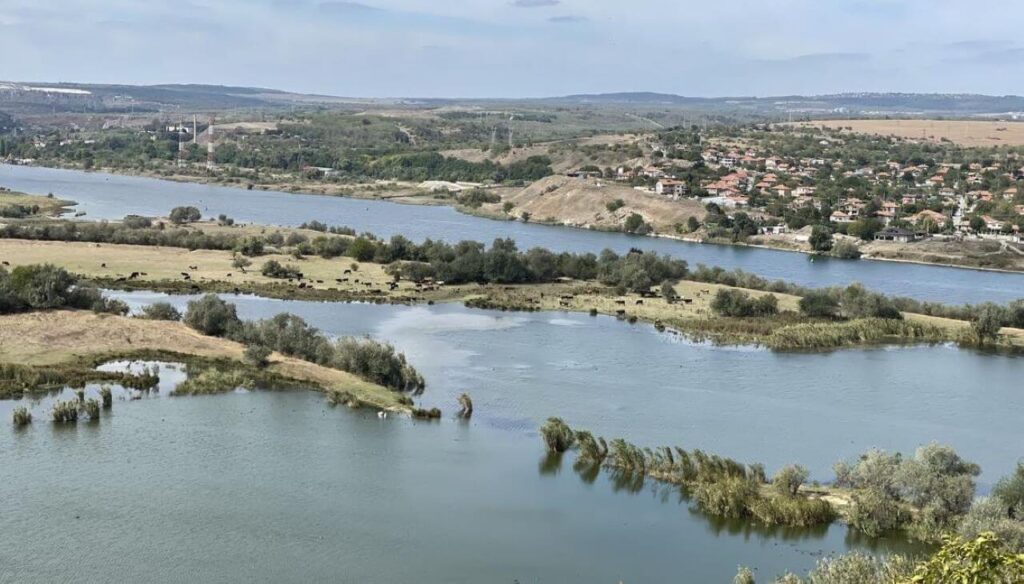
The-Beloslav Lake Complex has not become the tourist destination that was originally envisioned in the distant years of socialism. Instead, the chemical industry has settled here, slowly but surely altering the beautiful landscape and pristine nature, and addressing the consequences of this activity will take years.
The residents of the surrounding villages, as well as those in the town of Beloslav, are concerned about the state of the lakes, which are threatened by chemical production and port activities.
What types and extent of pollution exist in the complex cannot be stated with certainty, as no in-depth comprehensive studies have been conducted thus far. It is also affected by nearby chemical facilities. One thing is certain—there are no fish left; only algae and reeds remain.
According and ecologists, there are two ways to address the problem—through the method of circular economy and mechanical cleaning. The first method involves incorporating waste materials from production into new materials to reduce pollution, while the second focuses on cleaning, preferably using innovative methods.
Entrepreneur Danko Kalchev, who hails from the area and develops his business there, has expressed his civic stance for over 10 years now, seeking solutions for cleaning the lake and preserving its condition.
“Ten years ago, a 300-meter iron pier was planned to be constructed at a newly building port in the lake for unloading. This would not have been beneficial for the Varna-Beloslav Lake Complex, designated as a protected area. I protested at the time and alerted the authorities, and to this day, it has not been built.” This is how Kalchev begins his account, citing Lake Geneva, which was heavily polluted after World War II but was cleaned up by the people, making it an attractive destination for locals and tourists. “It can be achieved slowly and gradually with good intentions,” says the businessman.
He learned a valuable lesson from two Bolivian Indians during the construction of a reed boat: “Take care of your reeds; they are the lungs of your two lakes.”
In 2019, two Bolivian Indians from the Aymara tribe came to Beloslav to initiate the construction of a reed boat for a series of expeditions called “Abora.” They needed to prove that materials for the construction of the pyramids in Egypt came by sea from the territory of present-day Bulgaria.
Reeds maintain water cleanliness and should not be destroyed, which often happens during the construction of ports. Currently, one port is being built in the area of Beloslav. A permit has been granted for a second, and an Environmental Impact Assessment (EIA) is awaited for a third, according to Kalchev.
The deepening of the canal, which many view with suspicion for other reasons, has also yielded benefits—it removed a complex two-meter sludge left over from the old productions of the Devnya complex. This sludge contains mercurial hydrolysis.
Unfortunately, there are reports that part of this sludge was dumped in the Nalbank area, between the old Varna station and the village of Kazashko, in close proximity to the protected area of Kazashko.
The future will reveal the impact on the region.
However, serious problems remain—wastewater from the tailings storage of “Solvay Sodi” in Padina, white mountains of “Agropolihim,” and copper waste from MTG “Dolphin.”
The “main sanitary” of the lake, known as the geibidzhan crab, disappeared 50 years ago. This crab naturally maintained the water’s cleanliness and was the main reason for Beloslav Lake being among the top ten cleanest lakes in the world.
The first defeat of the population came in 1923 with the excavation of a canal connecting the two lakes. Beloslav Lake was about 2.5 meters higher than Varna Lake. When water drained from it during the digging, the crabs were left high and dry in the reeds. Thus began the first massive die-off of geibidzhan crabs. The excavation of navigable canals to the sea allowed salty water to enter the lakes, and this, along with pollution from chemical factories, further devastated the ecosystem.
Now, Danko Kalchev has taken on the idea of their “resurrection”—creating a “crab” using artificial intelligence that can gradually start cleaning up the lakes.
“We are trying to develop this concept with various specialists; we shared it with the Minister of Innovation, Milena Stoycheva. She responded positively, and we hope she will work on the matter. Personally, I continue to seek options and EU funding for the initiative,” claims Kalchev.
This involves a vacuum extraction system based on the principle of a robot that cleans in our homes and pools. It needs to have the ability to determine what is harmful and how to extract it from the lake.
Another possibility for addressing the problem is to utilize waste resources—such as the tailings storage of Solvay Sodi, the massive white mounds of Agropolihim, and the copper waste from Dolphin—for new products. An example of such innovation is the waste product from coal power plants in Germany, where ash is now being used to produce gypsum. Currently, it is home to the largest gypsum board production facilities.
The Varna-Beloslav Lake Complex comprises two lakes—Varna and Beloslav—connected by an artificially excavated canal. Varna Lake is a coastal lagoon lake of natural origin. In 1909, the first canal linking Varna Lake to the sea was dug. Prior to 1923, Beloslav Lake was a closed freshwater lagoon fed by the Provadiya River. With the development of several industrial complexes in the area, the use of both lakes for shipping transport became necessary, leading to the excavation of two new canals—one connecting Varna Lake to the Black Sea and the other linking the two lakes.
This area is an important zone of international significance for wintering waterfowl. Every year, over 20,000 waterfowl from 64 species congregate here. A total of 202 bird species have been identified in the complex, 59 of which are included in the Red Book of Bulgaria.