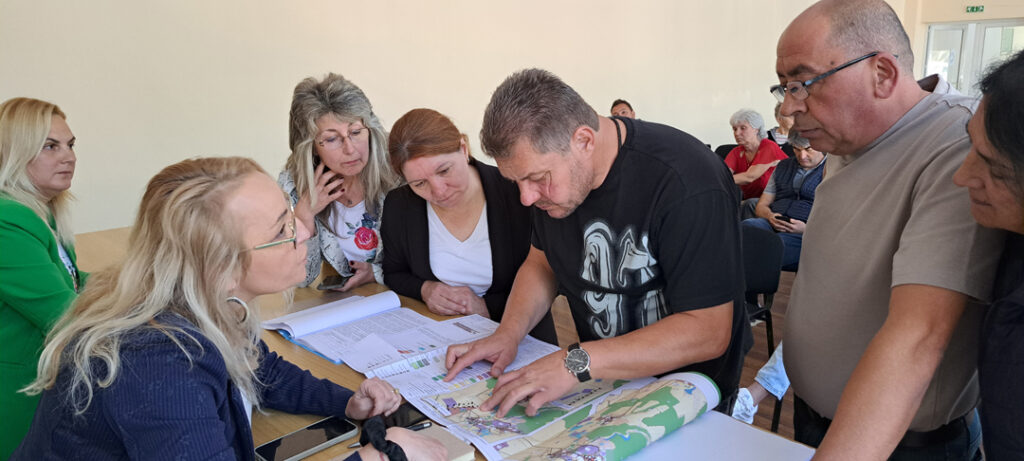
Photo: Diyana Zhelyazkova
A vague project for new energy facilities in the municipality of Kaolinovo, which will be built on fertile agricultural land, angered local people and increased their fears about future wind farms in the area.
At a public discussion on the project held on September 19, citizens did not receive answers to their numerous questions. This increased the tension in the room and led to heated arguments between Kaolinovo residents and the investors and project developers standing opposite them. After nearly two hours of fruitless and heated debate, the two sides parted with even greater mistrust and more fears.
One of the owners of the future wind farms in the area, the company Energaia, is also involved in the investment plan for new energy facilities. The project envisages the construction of energy storage batteries and an electrical substation on three fields with a total area of 30 decares. Currently, all three fields – two in the village of Lyatno and one in the Kaolinovo area – are arable land, and of the highest category – third. In order for the investment to be realised, the land use designation must be changed from “arable” to “purely industrial”.
The change process starts with a draft amendment to the General Development Plan (GDP) of the municipality of Kaolinovo, which has to go through a mandatory public consultation. Usually, these consultations are just a formality, but this time the designers and investors were met by angry and questioning locals. Representatives of two civic associations – “Protection of the Ludogorie Lands – Kaolinovo” and “Protection of the Living Land of Ludogorie” – were also present in the hall. These associations were created after it became clear that three wind farms would be built in the municipality of Kaolinovo.
No answers to the essential questions
For two hours, local people tried to get more information about the project, but never received clear and understandable answers. The designers and investors refused to answer specific questions, arguing that “this is not the subject of today’s discussion; we are only discussing a draft amendment to the OUP.” Or they avoided answering by explaining that no information was available at this stage.
And the people quite reasonably asked about the basic parameters of the project: what will be built on the site of the three fields, what kind of batteries and with what capacity will be installed there, whether the new facilities will be dangerous, whether access for firefighting equipment is provided in case of a fire in the batteries, whether other landowners in the area will be affected, why there is no environmental assessment of the project? And last but not least: how will local residents benefit from the construction of the new energy facilities?
None of these legitimate questions received a clear answer. This will not prevent investors and the municipality from declaring the public consultation a success and continuing with the project procedures.
The investment proposal submitted to the municipality shows that the 30 hectares of arable land will become “pure production land” with a building density of up to 80%. During the discussion, it became clear that the energy storage batteries will be built on land in the village of Lyatno. However, in order to connect to the energy grid, a new power line will be built to Kaolinovo, which will pass through the fields of other owners. This was the first spark that ignited the people’s discontent.
“You will trample our land without asking us.”
The locals were outraged when they saw the route of the future power line passing through arable farmland. The designers never answered the question of how long the new power line would be, why the owners of the affected land had not been asked for their consent, and why such a long route would be built between the villages of Lyatno and Kaolinovo, instead of connecting the batteries to an existing nearby substation.
“This is land owned by private farmers, and the power line will pass through it without asking the owners! How is this possible!” exclaimed the people of Kaolinovo. The head of the design team, Teodora Metodiev, who led the meeting, replied that everything was being done according to procedure and that only at the next stage would the owners be notified that their land would be “run over” by new power facilities.
These explanations about “procedures” were repeated throughout the meeting and provoked the anger of the people. “You are presenting people with a fait accompli and you are not interested in our opinion at all! Investors come, grab the land, build whatever they want without asking the people!” said an angry resident of Kaolinovo.
Nakhide Hasan, chair of the civil association “Protection of the Living Land of Ludogorie,” asked for specifics about the project: what will be built, with what parameters, with what capacity. But she received the answer that “when it is designed, then we will know.” “Now we are only discussing a change in the purpose of the OUP for a project that has not yet been designed,” said the head of the design team.
“So you can’t tell us what’s inside? When will you tell us what this project will involve?” insisted the local people, who were effectively being asked to discuss something that had not yet been designed. The local residents continued to ask why the use of 30 decares of fertile land was being changed. The laconic response from the investor’s representative was that “the owners requested this change in order to store electrical energy” and that everything was being done “according to procedure.” After more persistent questions, it became clear that it was not known what kind of batteries would be used, “that will be in the next stage.”
Engineer Ivanka Kazakova, a representative of civil society organizations, challenged the unwillingness of the designers and investors to answer questions and stated that the investor was obliged to provide parameters for the project from the outset. After nearly an hour of debate, it became clear that the batteries would have a capacity of 90 megawatts. However, the designers did not answer whether space for firefighting equipment and fire lanes was planned around the batteries. “You have planned a maximum building density of 80%, and with such power, there will be no room for firefighting equipment,” commented Eng. Kazakova. The response was that when the design phase begins, “everything will be taken into account.”
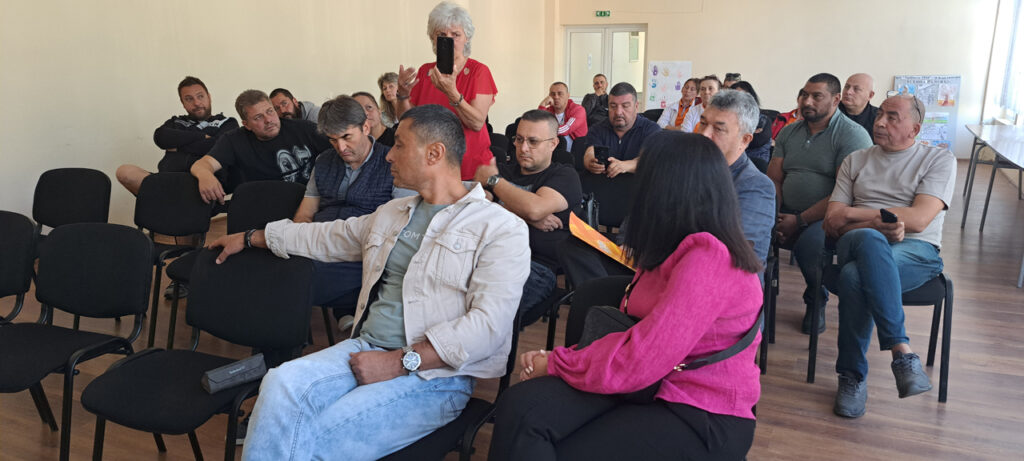
Photo: Diyana Zhelyazkova
Who needs this project?
Why is there no environmental assessment of such serious investment intentions, asked Georgi Moiseev from the association “Protection of the Living Land of Ludogorie.” “Significant capacity will be built, the batteries are close to a wooded area, and we have seen that such facilities pose a fire hazard. How can such a project be carried out without an assessment?” commented Moiseev.
The project designer’s response was that the Regional Inspectorate for Environmental Protection (RIOSV) had determined that an environmental assessment was not necessary at this stage: “Currently, only a change to the General Urban Plan is being considered. When the project is designed, RIOSV will reassess whether an assessment will be required,” said Metodiev. “Do you think this whole project is acceptable without an environmental assessment? You are changing the purpose of 30 decares of agricultural land, the power line passes through many private properties, and this is happening without an assessment!” Moiseev said indignantly.
Residents of the village of Tsarkvitsa in the neighboring municipality of Nikola Kozlevo also expressed their strong disagreement with the project. “You have no right to change the purpose of fertile agricultural land! This can only happen if the local population has an urgent need for this change, and no one has asked the people,” said a resident of the village.
“That’s not true, there is no such legal requirement,” replied Metodiev, but she was refuted by Eng. Kazakova. “There is a rule that the change of agricultural land is only permissible in exceptional cases. Please indicate where the investor has proven that this project is of particular importance,” Kazakova urged. “The investor has no answer to that question, we are discussing something else now,” the head of the design team tried to deflect the question. However, Eng. Kazakova insisted that it is precisely during the public discussion that the investor must demonstrate the need for the project for the municipality and the people who live there.
“There should have been an architect here to confirm that a change in the general urban plan is permissible when the investor has proven the urgent need for the project,” said Eng. Kazakova. She emphasized that in this case, there was no opinion from the chief architect of the municipality of Kaolinovo on whether the project was admissible, which is a mandatory requirement for the project procedures to begin. The designers justified themselves by saying that such an opinion would be given at the next stage, and that the change in the intended use of the agricultural land had been approved by the regional agricultural service, which gave the investors carte blanche to build.
After lengthy debates about who needs the project, the investor’s team finally decided to explain why the batteries are necessary: “The idea is to have electricity for everyone,” said the company representative, making the populist promise that the construction of the batteries would make electricity cheaper for local people, which provoked laughter in the hall.
All these ambiguities provoked an angry reaction from local residents. “So, you have no idea how long the new power line will be, you don’t know how many private properties it will pass through, you don’t know the details of the project, but you come here and present something to us as a public discussion!” said an indignant woman from Kaolinovo. “You can’t treat the population this way without explaining what you’re going to do. There are fire hazards in your project. You don’t say how many batteries you will make, what their power will be, and they are close to a forest. You are misleading us here, saying that now is not the time for discussion. When will be the time?” said a representative of the civil associations indignantly.
Local residents raised the acute question of who needs this project and whether it will be of any benefit to the local population. “How will you guarantee that the energy stored in these batteries will return to the people of Kaolinovo and not be exported abroad? No way,” commented Eng. Kazakova. The residents of Kaolinovo shared the same opinion. “The local people have no benefit from these batteries. Balchik is full of wind turbines, but their villages have no electricity,” said the local people. “I do not agree that we should destroy our land in order to export electricity to other countries!” said Nahide Hasan emphatically, while Georgi Moiseev summed up the fears of those present: “You will destroy the land and people’s fields so that someone can make a few bucks!”
The local authorities in Kaolinovo have approved the construction of three wind farms – Ruzhitsa, Ludogorie, and Kaolinovo. A report by the Regional Inspectorate of Environment and Water Resources states that a total of 39 wind turbines, 180-200 meters high, are under construction in the municipality of Kaolinovo. There will be 13 generators in the territories of Kaolinovo and the village of Lyatno, and after their construction, each turbine will cover an area of 3.6 square kilometers.