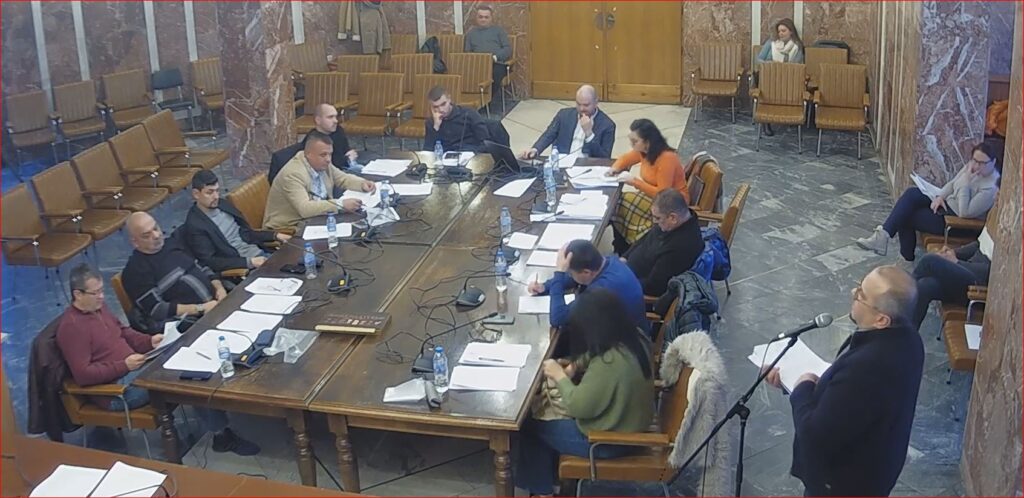
Photo: Screenshot from live broadcast
Local Government Transparency in Dryanovo: Council Renounces Public Video Archive and Delays Meeting Protocols
The Dryanovo Municipal Council does not maintain a publicly accessible video archive of its meetings, and the minutes are published with months of delay, according to findings by “Za Istinata” (“For thr truth”).
The most recent protocol available, providing insight into how local councilors operate, dates back to April 14 of this year, with three additional meetings held since then. Citizens of Dryanovo, who are unable to follow the sessions live, have no access to decisions made, statements, or proposals. An additional concern is that council meetings are scheduled at times when only pensioners and unemployed individuals are likely able to watch.
In the video archive section, there is only a single recording from April 30th of this year. While the municipal administration’s website features an “archive broadcasts” section, it appears unused and outdated, leaving the content inaccessible or irrelevant to current proceedings.
The absence of a video archive of the Municipal Council’s meetings contradicts the Law on Local Self-Government and Local Administration (ZMSMA). Article 28 states that Council meetings and their committees are to be open to the public, with exceptions permitted only for closed sessions.
It further specifies that “every open session of the municipal council shall be broadcast in real-time online via the municipal council’s or municipality’s website, and recordings of the meetings shall be stored on the respective website.”
The law does not address the absence of recordings or minutes from the meetings of the municipal council, nor does it specify sanctions for non-compliance. However, the intention of the legislator, when amending the Law on Local Self-Government and Local Administration (ZMSMA), was to ensure greater transparency of the activities of local lawmakers. The absence of recordings can, therefore, be interpreted as a deliberate restriction on public access.
The municipal council is an organ of local self-government, directly elected by the residents of the municipality, responsible for setting policies for its development and growth, as stated in the “Nature and Functions” section of the Dryanovo Municipal Council’s website. This clearly obligates the leadership of this body to ensure the mandatory transparency and openness, in the name of the citizens who have entrusted their local representatives with decisions of importance for the city.