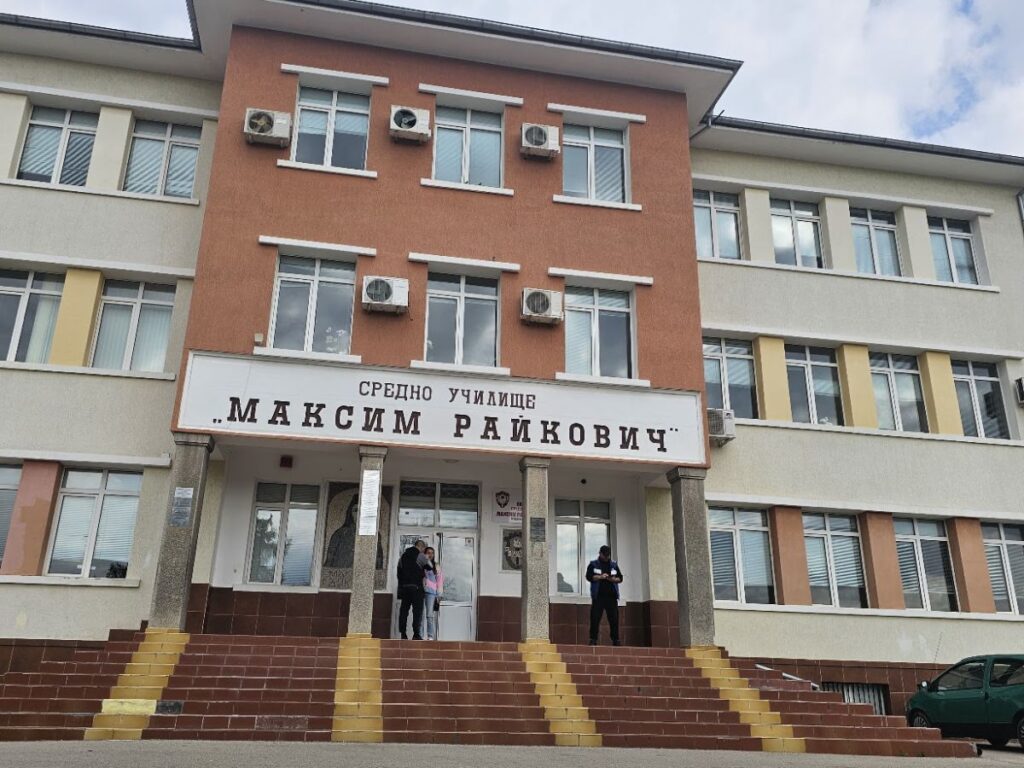
The Dryanovo Municipal Council will have to give the green light to preserve six small classes for the 2026/2027 school year at the town’s two schools. The formal proposal is described as “approval of small classes”, but behind the administrative wording lies one of the serious problems facing small towns: the growing difficulty of filling school classes.
The proposal is due to be considered at the Municipal Council meeting scheduled for August 31. Behind it are 84 students — an average of 14 children per class — and a bigger question: how does low enrolment turn from a problem into an argument for keeping classes open?
One class – two professions
Five of the six classes are at the Racho Stoyanov Vocational High School of Economics and Technology. A total of 71 students will study there in grades 8 to 12. There are 11 eighth-graders, 16 ninth-graders, 15 tenth-graders, 18 eleventh-graders and 11 twelfth-graders.
The eighth-graders are enrolled in two vocational programmes: “Automated Systems and Technologies in Mechanical Engineering” and “Management and Economics”. Six students are in the first programme and five in the second.
Thus, five classes at the vocational school will continue to exist despite their small numbers, while the municipality will provide almost €6,700 in additional funding to keep them running. The money will have to be included in Dryanovo Municipality’s 2027 budget.
Preserving professions needed by business
In the mayor Trifon Panchev’s reasoning for the proposal, the low number of students is not presented as a sign of declining interest in vocational education.
On the contrary, it is placed in the context of the need to preserve professions which, according to the municipality, are needed by local businesses.
The “Automated Systems and Technologies in Mechanical Engineering” programme has been included on the list of professions facing a shortage of workers, adopted by a Council of Ministers decree in July this year, Panchev points out. He stresses that the profession combines mechanics, electronics, robotics and programming for work with high-tech industrial production lines.
Yet in the first round of admissions, the minimum score for this programme was just 96 points, compared with 441 points for the programme with the highest minimum admission score in Gabrovo Region.
That is a gap of 345 points.
This inevitably raises the question of how realistic it is to expect students admitted with such a low score to be prepared for the complex combination of mechanics, electronics, robotics and programming — unless, of course, the expectation is that the school itself will have to compensate for the enormous gap between their entry level and the demands of the profession.
Why preserving the classes matters
Finding workers with the appropriate education and professional qualifications in the region is becoming increasingly difficult and is turning into a challenge, Panchev says.
Thus, in his proposal, the central question is not why the classes are so small, but why it is important to preserve them.
The same approach is applied to the other specialisations. “Economics and Management” is presented as a way of training staff for small and medium-sized businesses and public administration, while “Organisation of Tourism and Leisure” is described as a response to the needs of the municipality’s tourism sector.
A new class because business needs it
At Maksim Raykovich Secondary School, the situation is somewhat different.
There, the proposal concerns a new eighth-grade class with 13 students in the vocational programme “Integration of Digital Technologies”. The specialisation is new to the school and, according to the proposal, is the only one of its kind in Gabrovo Region.
Here too, the small intake is presented as grounds for allowing the class to operate.
The proposal describes it as “one of the newest and most modern specialisations”, created in response to the digital transformation and the needs of business.
The arguments also include the school’s new STEM centre, opened in June this year, with “Mathematics and Informatics” and “3D Design and Prototyping” facilities.
According to the proposal, the new class is directly linked to this infrastructure and will allow students to work with real devices, 3D software and digital platforms.
What happens after graduation?
Both proposals rely on the same argument: the professions are promising and local businesses need qualified workers.
The documents describe in detail the benefits of the training, the modern technologies involved and the opportunities for employment.
What is missing is concrete data on what happens after graduation.
The proposals contain no information on how many graduates of the two schools’ programmes find work in the municipality, how many work in the profession they trained for, how many continue their education and how many actually remain in Dryanovo.
This does not mean that the municipality’s stated need for workers does not exist.
It simply means that the need is cited as an argument without being supported in the proposals themselves by concrete data on the career paths of students who have already graduated.
And one major contradiction
In Dryanovo Municipality’s proposal to approve the small classes, the municipality says that these professions are needed by business, that there is a shortage of workers and that young people who acquire the relevant qualifications will have employment opportunities.
But in the municipality’s Youth Plan, adopted by the Dryanovo Municipal Council in January this year, the municipality itself says that young people are finding it difficult to enter the labour market.
The plan identifies an imbalance between labour demand and the vocational fields young people are trained in, insufficient professional qualifications, problems with career guidance and the fact that a large proportion of young people leave the municipality in search of better opportunities.
As of December 31, 2025, only 14 people aged up to 29 had found jobs on the primary labour market in Dryanovo Municipality, according to Employment Office data cited in the municipal plan.
In other words, while the proposal to preserve the small classes is based on the argument that these professions correspond to the needs of business, the municipality’s own analysis of youth employment acknowledges an imbalance between the vocational fields chosen by young people and the actual demand in the labour market.
There is no good news here.
The bad news is that Dryanovo is not an isolated case.
What is happening there is happening in hundreds of Bulgarian municipalities — victims of the demographic crisis and the increasingly visible depopulation of small towns.
And as the number of students declines, schools increasingly find themselves fighting not so much for the quality of education as for their very survival.