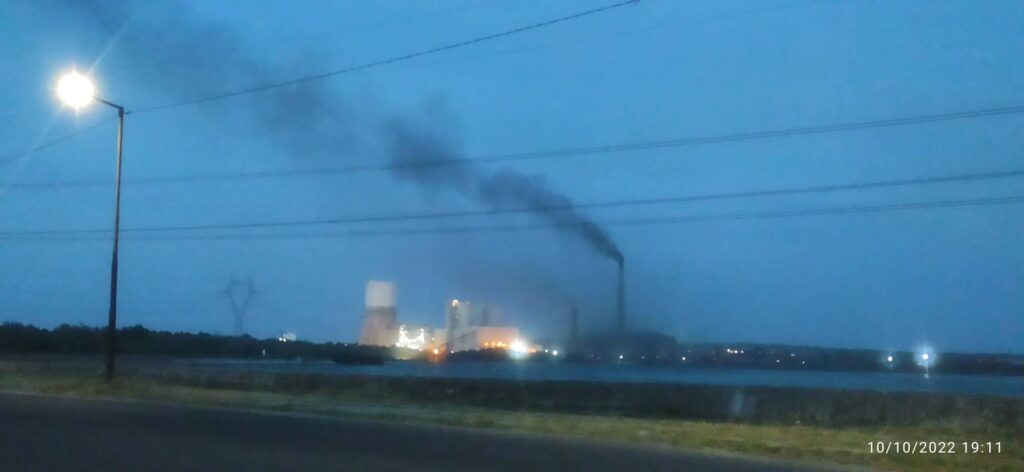
If we had a functioning state and institutions in place, the “Brikel” Thermal Power Plant in Galabovo, associated with energy oligarch Hristo Kovachki, would have long been shut down. Forcibly. With all the legal grounds. But it hasn’t.
The obsolete and oldest power plant in Bulgaria continues to operate, billowing smoke—not metaphorically, but literally.
Black smoke emerges not only from the chimney but from everywhere— the roof, broken windows, and even through the bricks of the building. Citizens protest, file reports, and write complaints to the Ministry of Environment and the RIEW in Stara Zagora, posting photos and videos on social media with angry comments. The youth, better educated, increasingly gaze abroad, yet they have not entirely lost hope of staying in their homeland. Meanwhile, others who see no alternative in the labor market apparently do not realize the risks they are exposing their children’s health—and their own. It is astonishing how they survive in such a working environment, with some even managing to retire.
The “Brikel” Thermal Power Plant was supposed to be decommissioned in 2011, but after its privatization, it continued to operate well beyond its operational life.
During 12 years of GERB and Boyko Borissov’s governance, it received millions from the state for the so-called “cold reserve” of the energy system, alongside the Varna Thermal Power Plant owned by Ahmed Dogan. Additionally, it received permission from RIEW – Stara Zagora to burn waste without an analysis of how this would affect the health of people and the environment. Later, the court annulled the inspection’s decision thanks to the activism of citizens and expert support from organizations such as Greenpeace Bulgaria and “Za Zemyata.”
Instead of investing in modernizing the plant, its owner, according to the Commercial Law—a British citizen of advanced age—attempts to continue its operation by burning cheaper fuels for the company, and then tries to legalize these actions. This is stated in an overview material published on the website of Greenpeace Bulgaria, which tracks all the abuses of the private company “Brikel” EAD, which encompasses the oldest thermal power plant in the country and a briquette factory.
The regulatory authorities are imposing sanctions on the “Brikel” Thermal Power Plant, which is in continuous violation of environmental protection regulations. The European Court recently issued a ruling in yet another case brought by the European Commission against Bulgaria, citing that the Eastern Maritsa power plants and the currently closed “Maritsa 3” in Dimitrovgrad violate the European Clean Air Directive due to frequent exceedances of sulfur dioxide limits. The court has not yet determined the amount of the sanctions, thereby granting a sort of grace period for our country—the only one in the EU that is among the top 20 largest sulfur dioxide polluters in the world—to take measures to reduce these emissions. However, despite the sanctions and citizens’ protests, the plant continues to violate environmental legislation. Why?
The answer is simple—because “Brikel” Thermal Power Plant contests these sanctions, and they are most often overturned in court.
Whether due to the penalty orders being written by incompetent or corrupt lawyers (or both), there appears to be a lack of legal logic in them, according to sources familiar with the matter who spoke to “Za Istinata.”
While other regional inspections manage to uphold their sanctions in administrative courts, the Stara Zagora RIEW does not. These orders are initially reviewed in the court in Galabovo, which has only two judges. It is reasonable to assume that if they are not corrupt, they may simply be afraid of the shadow cast by the energy oligarch. Even if they wished to rule fairly, poorly drafted penalty orders would leave their hands tied.
For the first time, Borisлав Sandov—Minister of Environment and Water in Kiril Petkov’s government—decided to take more vigorous action against “Brikel” EAD.
Following two inspections at the company, the first one scandalously obstructed by the management of the power plant, a directive was issued by the director of RIEW – Stara Zagora, Diаna Iskрева, for the forced shutdown of its operations. The Stara Zagora Administrative Court annulled the preliminary execution of the order, and the Supreme Administrative Court upheld its decision. In the upcoming administrative case on the merits, which starts next week, it must be factually proven whether the power plant systematically violates the Environmental Protection Act and pollutes the atmospheric air in Galabovo and the surrounding region.
This is likely one of the reasons for the one-month inspection conducted at “Brikel” and the other three power plants in the Eastern Maritsa basin—the state-owned “Maritsa East 2″ and the two so-called American plants—”AES Galabovo” and “ContourGlobal Maritsa East 3,” to ensure that the inspection does not appear to be biased. Experts from all regional inspections of the Ministry of Environment and Water were dispatched to Galabovo for this purpose. Early in the week, RIEW – Stara Zagora published a press release on its website regarding the results. It stated that numerous violations had been identified in the operation of the “Brikel” Thermal Power Plant, primarily related to the presence of unorganized emissions from the operator’s boiler building. It was also noted that emissions were released from chimney 2 without the plant being in emergency operational mode, which is a requirement of its integrated permit.
RIEW – Stara Zagora has issued seven acts for violating the conditions of the Integrated Permit, for which penal orders will be imposed.
For non-compliance with the requirements under Articles 123 and 125 of the Environmental Protection Act by the operator of the installation—a legal entity—the law provides for a property fine ranging from 10,000 to 500,000 BGN, depending on the severity of the violation and its impact on the environment. Representatives from other responsible regulatory institutions participated in the inspection, who also registered violations. For example, the “Fire Safety and Civil Protection” service compiled about 14 acts, as learned by “Za Istinata.” During the week, the inspection was halted by order of the caretaker Minister of Environment and Water, Rositsa Karamfilova.
The case in the Administrative Court in Stara Zagora will be challenging.
The judge will need to base their decision not on publications in the press or on reports from Greenpeace regarding the coal empire linked to energy oligarch Hristo Kovachki. Instead, the ruling will rely on the archive of gathered evidence and the sanctions imposed by RIEW – Stara Zagora, which have been confirmed by the court and paid by the operator of the “Brikel” Thermal Power Plant for violations of our environmental legislation and the conditions outlined in the plant’s Integrated Permit—the latest of which has been contested in court by Greenpeace and “Za Zemyata.”
These two non-governmental organizations have submitted a request to the Stara Zagora Administrative Court to be joined as parties to the case alongside RIEW – Stara Zagora. The proceedings are set to begin on October 18, and “Za Istinata” will follow the developments closely, given the high public interest at stake. The outcome of the case will affect not only the power plant and its employees but also tens of thousands of people in the region.