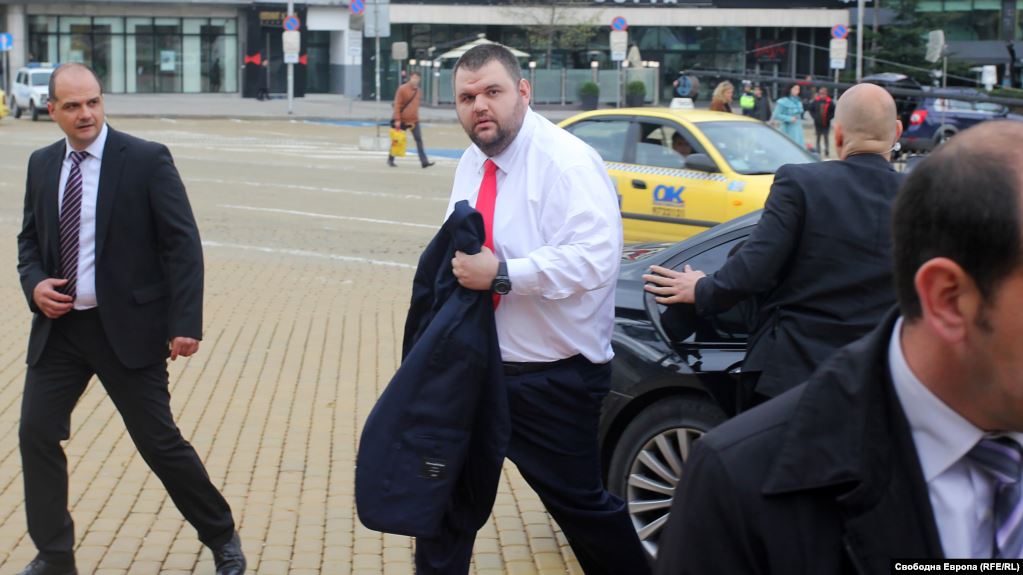
In several consecutive publications, “Pro Veritas” investigated the donations of MP Delyan Peevski, made on behalf of his company “Intrust” EAD to many hospitals in the country after the beginning of Covid-19 epidemic. The reason for this investigation was the noisy media campaign in which these donations were publicly presented as personal gestures of the MRF oligarch.
But
despite many suspicions
and questions about the donations, the prosecution found no reason to investigate the legality of these donations and the origin of the money for them.
This was mandatory, at least because in relation to donors and real owners of donors – legal entities that are well-known political figures, including MPs, actions are applied to establish the origin of their funds and the source of their property. Measures for complex inspection are also applied.
“Pro Veritas” sent applications with asking under the Access to Public Information Act (APIA) to six hospitals in the country. With these applications, we requested the contracts for donations, made by “Inrust” EAD, to be provided to us, as well as the accompanying documentation.
Within the 14-day period established by law, a refusal was received from two Sofia hospitals – “Pirogov” and “Alexandrovska”, as well as from the University Hospital in Stara Zagora. The other three – the Military Medical Academy, the Pazardzhik Regional Hospital and the Kazanlak Municipal Hospital – simply did not respond.
After repeated talks with the press-center of the Military Medical Academy (MMA), its legal department, long after the deadline for response, provided
seven donations contracts,
signed with the company of Delyan Peevski “Inrust” EAD in the period up to May 22, 2020.
DONATIONS-INTRUST EAD-ЕАД-APIADownload
A letter accompanying the submitted contracts states that the total value of the donations is BGN 936,831.80, with which the hospital received gratuitous tests for diagnosing COVID-19, respirators, reusable protective overalls and single-use supporting funds of personnel working on the front lines in the fight against the epidemic.
In addition to the contracts, we received a call from Major General Ventsislav Mutafchiiski – Head of the MMA with a question whether we are satisfied with the information provided to us. Our answer was a further clarifying request under the APIA, dated July 10, with which we again requested the annexes and Acceptance Protocols to the 7 contracts, as well as all other accompanying documents, if any.
And as we expected – we did not receive an answer.
The attempt of one of the largest and most authoritative medical institutions in the country to conceal information that is completely public within the meaning of the law, again casts a shadow of doubt that there are problems with these contracts.
Lawyer Lora Georgieva from the Anti-Corruption Fund, who is a legal advisor to our entire investigation, points out that the Law on Obligations and Contracts introduces a special form for the validity of contracts for donation of movables (including money) and this form is a written contract with notarized signatures, or hand-over.
The contracts presented to us by the Military Medical Academy (MMA), are without notarized signatures.
From them, it is not possible to establish also
whether the donation was actually given to the recipient,
because in the contracts it is written that the transfer and acceptance of the donated property is certified by the parties by signing an Acceptance Protocol, which describes its exact characteristics and quantities.
These protocols are missing, so it remains unclear
whether actual donation contracts have been concluded
and whether the property described as “donated” has been delivered.
There also are no documents certifying the value of the donation. No invoices or other documents have been submitted for the price at which the donor acquired the respirators, tests and protective clothing, before donating them. This circumstance, combined with the lack of information about the characteristics of the donated property, raises
serious questions about how the value of donations is calculated,
that is specified in the contracts.
The only one of the 7 contracts with which money is donated is concluded with d burden:
“The money should be used to provide one-time assistance to MMA employees working on the front lines in the fight against COVID 19 and to be distributed according to the will and in a manner specified by the donor.”
According to lawyer Georgieva, the condition formulated in this way raises several problems:
First, it discloses personal data of employees and represents
interference in the personnel policy of the recipient of the donation
and replacing his will with the will of the donor,
who neither has nor should have information about the workload, personal qualities or other criteria by which the gifted would distribute the sum among his employees.
Second, the donor is provided with information that may have the status of a classified or other secret protected by law in terms of that the hospital is military and most of the doctors have a military rank.
Third – with the donation to the hospital
in practice, the donation to individual employees is concealed,
because the hospital only formally receives the donation, but cannot determine how to use it. And the donation to individuals is treated tax differently than the donation to a hospital,
i.e. if he would donated directly to the doctors, the donor (Delyan Peevski, or whoever he is) should have to tax the amount of the donations with corporate tax. Such a tax is not due on the amounts of donations to state hospitals.
Fourth, but not least – the monetary donations of a private company directly to military doctors – servicemen raise issues related to ethical considerations and to the possible
placing the staff of the MMA in financial dependence,
as well as a possible violation of the Law on Defense and the Armed Forces, which introduces a rather restrictive regime regarding donations in favor of servicemen.
The protests, demanding the resignation of Prime Minister Boyko Borissov and Chief Prosecutor Ivan Geshev, have shifted from the focus of public attention all other public issues that raise awkward questions or reveal misuse of state budget and European funds.
The MRF MP Delyan Peevski is among the most vulgar figures of the Bulgarian transition and political backstage. Therefore, the citizens rightly suspected that the whole media campaign around his donations was organized with a single purpose –
to clean the public image of the oligarch,
whose name protesters across the country chanted along with that of Borisov and Geshev. This makes it even more necessary to check the legality of Peevski’s donations and the origin of the money for them. The silence of the responsible institutions will only confirm the suspicions that have arisen in the course of this investigation, namely that the donations were suspicious, invalid and made by a risky donor.