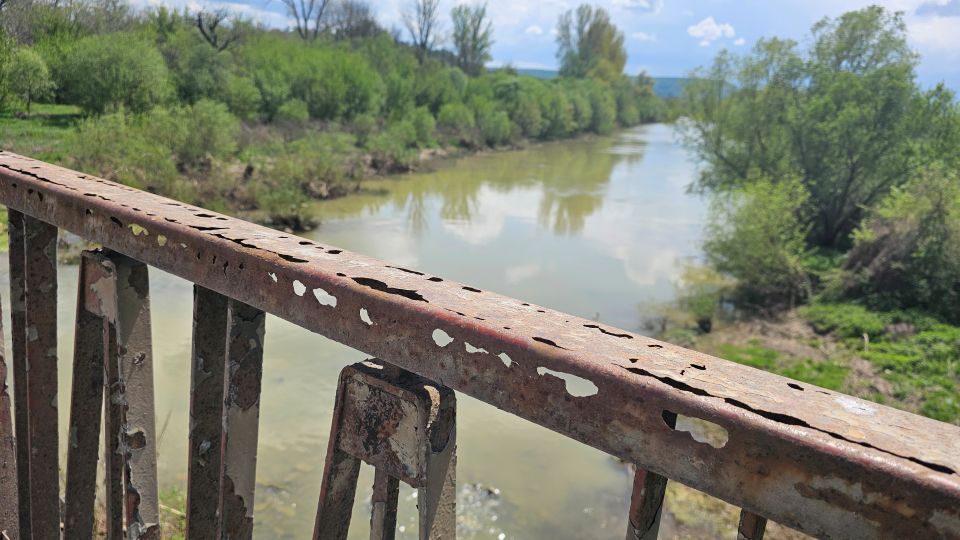
Four years after being classified as “pre-collapse,” the Koly Ficheto Bridge over the Rositsa River in Sevlievo now urgently requires structural replacement.
This was stated by the Road Infrastructure Agency (RIA) in response to questions from “Za Istina,” which aimed to find out why the repairs had not yet begun. The design of the repair and restoration works was commissioned back in 2022 and was supposed to be completed within 156 days.
It turns out that the “ball” is now in the Ministry of Culture, which has requested the full documentation on the survey and design of the repair. However, the responses do not clarify why this process has taken years, during which the structure has gradually deteriorated, especially in its pedestrian section.
The bridge, constructed in just one year (building began in 1856 and was completed in 1857 by Koly Ficheto), initially measured 110 meters in length. In 1939, it was extended to 185 meters. By 1972, it was widened to a width of 18.65 meters, featuring four lanes of traffic—two in each direction—and two sidewalks.
Today, the bridge urgently needs a new extended section. This situation has been reached after bureaucratic delays within various institutions, which ultimately led to the need to replace the upper structure of the part that is not the work of Koly Ficheto. The replacement of this added section is “imperative given the condition of the structure,” according to the Road Infrastructure Agency (RIA).
All of this became clear during an inspection and analysis of the bridge’s condition, conducted by a company commissioned by the Road Infrastructure Agency (RIA) through a contract following a public procurement process.
There is a project for a major repair, but this does not mean that the repairs will begin soon.
To start repair works, a ruling from the Ministry of Culture is awaited, according to RIA’s statement to “Za Istinata” (For the truth) Interestingly, this same response was given to the media a little over a year ago in response to similar questions—when the repair of the deteriorating structure would start and why, despite having a repair project, the work had not yet begun.
Both then and now, the agency explains that because the bridge is an immovable cultural heritage site, any activities involving it require approval of the project by the National Institute for Immovable Cultural Heritage under the Ministry of Culture.
Since 2021, there has been talk of urgent repairs for the bridge.
On August 3, 2022, the Road Infrastructure Agency (RIA) announced a procedure for the “Preparation of a technical project for repair and restoration works on a road structure at km 6+105 of road III-404” (Sevlievo – Veliko Tarnovo – Bogatovo – Sevlievo – Sennik – Graditsa – Beryevo – Lachi border).
Six companies submitted bids, and the contractor selected was “Alve Consult,” with whom RIA signed a contract in December 2022.
At that time, the entire length of the bridge’s roadway had a worn-out asphalt surface riddled with numerous longitudinal and transverse cracks, settlement, an uncertain number of patch repairs, and depressions near the supports.
The sidewalks are displaced, broken, and in some places, concrete tiles are missing. The curbs are damaged, and in some areas, you can see the river below through the gaps.
The protective parapet along the sidewalks is heavily deformed; entire sections have corroded, and the entire length of the parapet is tilted toward the river, appearing unreliable.
In some places, the concrete barriers (regula) are missing, and the sidewalks have been leveled with the roadway. Only luck saves pedestrians from speeding drivers who could crash onto them. Such an incident would be far from negligible, especially since the bridge leads to Sevlievo’s largest park and the riverside zone, popular spots for locals to walk.
Designing in three phases, only the first phase has been completed so far.
The contract stipulates that the project development will proceed in three stages. The only completed stage involves a comprehensive inspection of the entire structure, examining all elements—from the superstructure to the substructure—including the roadway, sidewalk blocks, safety barriers, drainage, and approaches to the structure.
Based on this inspection, a technical report has been prepared, providing detailed information on the identified damages and a project proposal for repair and restoration works, including an assessment of seismic risks.
The second phase of the project involves developing a detailed technical design for urgent repair and restoration works. This stage includes all project components and coordination with operational entities, the Basin Directorate, the National Institute for Immovable Cultural Heritage (NINCH), and the Ministry of Interior regarding traffic organization.
The technical design is subject to review and approval by an expert technical and economic council (ETIS) of the contracting authority, i.e., the Road Infrastructure Agency (RIA), which will assess the outcomes of the work done so far on the technical project. However, RIA does not explain why, after two years, this approval has not yet been granted.
In the correspondence with “Za Istina,” it is understood that the third and final stage of the project involves the final transfer of the project documentation.
In the language of the institutions: there is a need to clarify the territorial scope
What is new in the story of Koly Ficheto’s bridge repair is that an “architectural analysis” has been “prepared and presented,” but “to develop a comprehensive and complete analysis, it is necessary to clarify the territorial scope of the immovable cultural heritage site ‘Stone Bridge on the Rositsa River by Koly Ficheto.'”
What exactly this means is unclear. What is known is that the bridge over the Rositsa River is classified as a “single immovable cultural monument,” declared as an “architectural and construction cultural heritage” from the Renaissance period.
In relation to clarifying the territorial scope of the structure, a new design permit was issued by the chief architect of Sevlievo Municipality. According to the Cultural Heritage Act, in March 2023, this permit and the assignment were sent for coordination to the National Institute for Immovable Cultural Heritage under the Ministry of Culture.
By August of the same year, both the assignment and the design permit were coordinated with the Ministry of Culture.
However, an instruction was given that not only the permit and assignment but all project documentation at every stage must be coordinated with the ministry. Additional guidelines regarding the preservation and conservation of the cultural monument were also provided, explain the Road Infrastructure Agency (RIA).
“The contractor is expected to submit the project documentation” (to the Ministry of Culture), they conclude, which likely means that the start of the bridge repairs is now contingent on the ministry’s decision.
Thus, a structure built in a year in the 19th century is now crumbling in the 21st century while waiting four years for institutional approval procedures to be completed. It’s intriguing to consider how engineers and builders would classify its condition today, given that in 2022, it was already considered “pre-collapse.”