The state-owned Kabiyuk horse-breeding farm near Shumen has accumulated losses of more than €1.6 million. Workers at the enterprise have not received their salaries for four months, debts to suppliers are mounting, and on 5 May electricity to the farm was cut off over unpaid bills of more than €60,000.
What makes the situation particularly striking is that this is an otherwise resource-rich enterprise. The state-owned stud farm owns more than 21,000 decares of fertile arable land and once had livestock herds that generated substantial profits.
“I know people who became millionaires with 2,000–3,000 decares of land, while Kabiyuk, with 21,000 decares, is falling apart and has losses of BGN 3 million,” said Dr Valentin Atanasov, a member of the horse farm’s new management board.
The board of directors at Kabiyuk was replaced in the final days of the caretaker government by then caretaker agriculture minister Ivan Hristanov. The new agriculture minister, Plamen Abrovski, recently cited the horse farm as an example of the “difficult legacy” inherited by the cabinet formed under Rumen Radev.
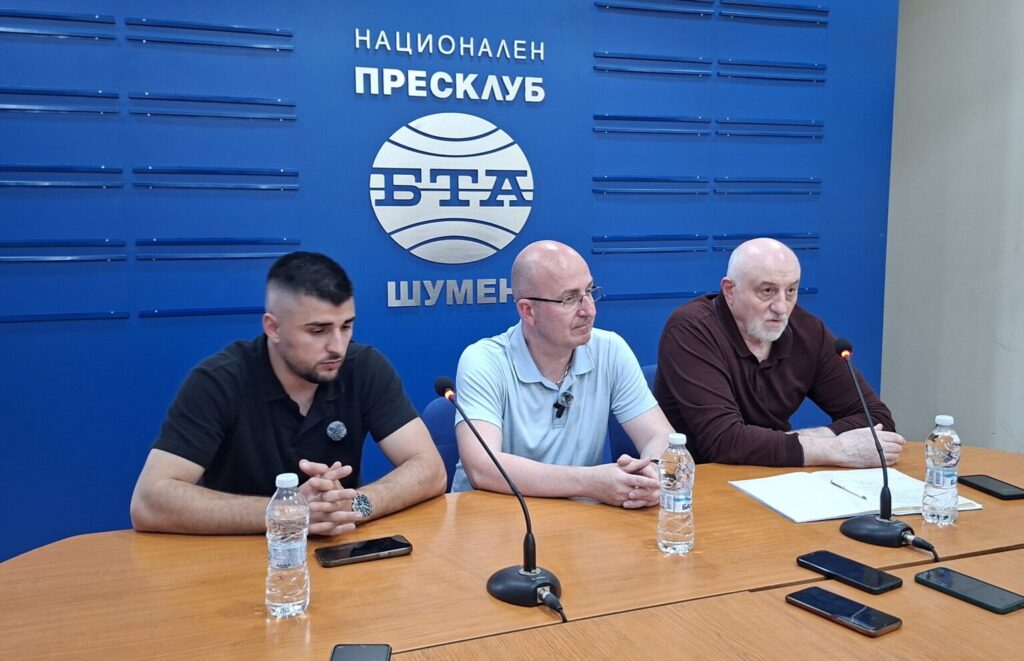
After Abrovski called on the new management to alert the authorities about what was happening at the enterprise, the three members of the new board held a press conference and presented data on the farm’s condition.
Just €95 in the cash register
When the new management took office at the beginning of May, Kabiyuk had just €95 in cash. Its bank balance was slightly above €10,000, while the state enterprise’s accumulated debts exceeded €1.6 million.
“The people had not received salaries since January. There were four unpaid electricity bills and extremely large debts to the National Revenue Agency and to suppliers,” said Zvezdalin Zvezdev, chairman of the horse farm’s management board.
He added that unpaid wages and social security contributions owed to employees exceeded €300,000.
The enterprise also owed around BGN 500,000 to a long-standing supplier of seeds and agricultural chemicals.
Its core source of income – farming – had also been neglected.
Around half of Kabiyuk’s land, approximately 10,000 decares, is used for spring crops such as corn and sunflower.
“Not a single hectare of this land had been planted by the beginning of May, and if these 10,000 decares are not planted, it directly puts us on the road to bankruptcy. There was almost no diesel in the tanks, three unpaid fuel invoices were outstanding, and the procurement procedure for seeds had also been challenged,” Zvezdev said.
The agricultural machinery was also reportedly in a poor condition. Even repairing it had become a problem because the contract for purchasing spare parts had been signed with a car repair shop in Venets that did not even specialise in agricultural machinery.
According to Zvezdev, the dire state of the enterprise raises suspicions of deliberate mismanagement.
“We will leave it to the competent authorities to establish whether this is simply negligence or something else,” the chairman of the board said.
Agriculture Minister Plamen Abrovski, meanwhile, said on the Face to Face programme that the horse farm had deliberately been driven towards bankruptcy and a subsequent sell-off.
Within a month, the new management had managed to prepare the spring planting and secure funds for a minimal advance payment to workers.
These were the most urgent tasks, said the farm’s director, Ivaylo Antonov.
He said a small number of animals had been sold to raise money to pay food vouchers and provide workers with a BGN 150 advance for the Bayram holiday.
“Almost 80% of our workers are Muslims, and they had no money for food for the holiday,” the director said.
He added that the agricultural machinery was now being prepared and that, with limited funding and a great deal of negotiation, the management had managed to purchase seeds and organise the planting.
BGN 230,000 for the previous management board
Against the backdrop of the state enterprise’s dire condition and years of accumulated losses, the previous three-member management board had cost around BGN 25,000 a month.
The former director’s salary was around BGN 15,000, prompting caretaker agriculture minister Ivan Hristanov to publicly condemn the practice of paying huge salaries to executives of loss-making state enterprises.
“It is not normal for a director of a loss-making enterprise to receive BGN 14,000–15,000 when the entire staff of 90 people are on salaries close to the minimum wage. Last year, the board of directors received a total of BGN 230,000, and that is a huge moral problem,” Zvezdalin Zvezdev said.
For 2026, money is still owed not only to workers but also to the previous management board.
The former board is owed around €40,000 for three and a half months, Zvezdev said, calling on his predecessors to waive the payments.
“If they believe that, given the tragic condition of the horse farm, they did not do their job as a management team, let them give up those salaries,” he said.
Zvezdev also accused the previous management of failing to apply to the Agriculture Ministry for the regular subsidy paid by the state to preserve native breeds.
This year, the subsidy amounts to BGN 1.9 million.
“Normally, an advance on this amount is requested by April and is used to cover current expenses, but the previous management did not do this. We do not know whether it was deliberate. We submitted such an application and are waiting for the funds, which are currently our main source of financing,” Zvezdev said.
“A clear intent to destroy the horse farm”
“There is a clear intent to destroy this enterprise,” said Dr Valentin Atanasov, who worked as a veterinarian at the horse farm years ago and remembers it in its best days.
“This is a huge agricultural enterprise covering more than 21,000 decares,” Atanasov said.
He recalled that Kabiyuk once had large livestock herds that generated substantial profits.
“There were profits from cattle breeding, pig farming, sheep farming and crop production. This enterprise was bursting with activity. There was a kindergarten, a school, housing, a health centre, a butcher’s shop and a bakery. Now everything has been destroyed. The enterprise was ruined by short-sighted decisions made by incompetent people,” Atanasov said.
He stressed, however, that the horse farm had been destroyed with the help of the state, which had turned a blind eye for decades.
“There is no way you can steal, mismanage and for the state not to notice. With so much land and livestock, to be losing BGN 3 million, not pay workers for four months and fail to plant the fields – there can hardly be a more unsuccessful operation. The intent to destroy this enterprise is obvious,” Atanasov said.
He cited figures to support his claim.
“The sheep used to number 10,000; now there are just over 1,000. There was a huge poultry farm here, now it is gone. There were more than 400 head of cattle; now there is not a single cow. Every year we used to produce two batches of around 500 fattened pigs. Now we will barely produce a hundred,” he said.
The members of the new management board said they were working in full coordination with the Agriculture Ministry.
“We have the minister’s assurance that the ministry will do everything possible to save Kabiyuk,” Zvezdalin Zvezdev said.
Asked who would alert the authorities about the condition of the horse farm, Zvezdev said the new management would file a report with the financial inspection authorities, while the Agriculture Ministry was likely to refer the matter to the prosecution service.