


Photo: “Pro Veritas”
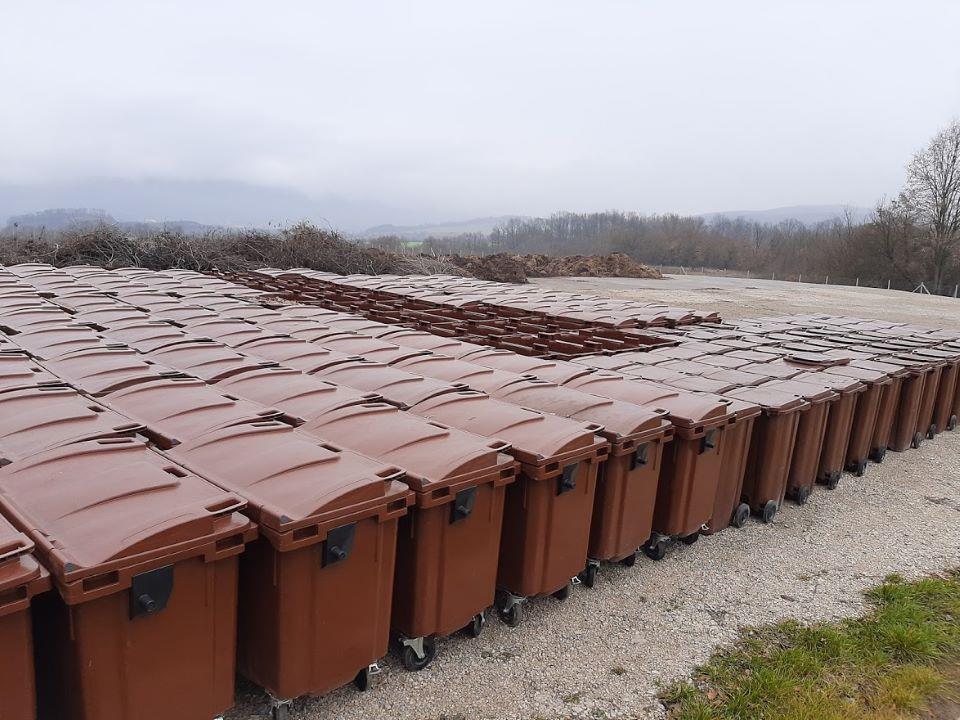
Thousands of plastic containers for biodegradable waste have been placed in an open warehouse in Sevlievo all winter. The view illustrates the waste of millions of BGN collected from the taxes of Bulgarian and European taxpayers.
As in many other similar cases, there is a good intention behind this project – to dispose and to process in compost about 4 thousand tons of biodegradable waste from the municipalities of Sevlievo, Dryanovo and Suhindol. However, eight months after the start of the project, financed under the Operational Program “Environment”, which was allegedly delayed due to the coronavirus, only 241 tons of waste were processed. In short – the money is used, the project is reported as completed, and the fact that it does not work is
an additional detail.
Once a week in winter and twice a week in summer, biodegradable waste from 11,000 containers of various capacities, in which households in Sevlievo and ten Sevlievo villages dispose of garbage, must be transported to the composting site outside the city and be involved in the process that will turn the waste into bio compost. The same should happen with the collection of nearly 6,000 containers in Dryanovo, Suhindol and two villages. For one year, 3000 tons of waste can be deposited on the site in Sevlievo and in Dryanovo – 900 tons. All this is set under the project “Implementation of a decentralized model for bio-waste management in the municipalities of Sevlievo, Dryanovo and Suhindol, including the construction of the necessary technical infrastructure – a system for separate collection and recycling of collected bio-waste.” Its value is BGN 2.2 million, of which 85% are gratuitous European funding, the rest are provided by the budget.
By design one, in fact another
The aim of the project is to reduce the amount of landfilled household waste by providing an option for their separate collection and recycling through composting. Nowhere in the project documentation is it said that in winter waste will not be collected. On the contrary, in all information materials distributed generously to the population in October 2019 (in the midst of the local election campaign), it is written that household garbage that can be processed will be transported once a week in winter and twice a week in summer to the built composting site. However, this is not done.
The household waste bins located in different places in Sevlievo in the early autumn of 2020 disappeared a little later. “Pro Veritas” found them empty and lined up in solid rows on the composting site.
It turned out that this has an explanation. “Due to the lack of biodegradable (green waste) such is not collected in the winter.” The explanation is by Svilen Radkov – Manager of the Regional Landfill in Sevlievo, selected under unclear procedures as the operator of the composting plant. However, this answer of Radkov contradicts another one, again given by him. When asked what is the frequency of waste collection in the months of 2020 in which the composting plant operates, he specified what is written in the project – twice a week in summer and once a week in winter. He also clarifies that in the villages of Sevlievo municipality during the winter months no bio waste is collected.
If what Radkov explains is true, it turns out that in winter the installation does not work, and such a gap is not included in the project at all. There is a clearly defined goal – reducing the amount of landfilled household waste and no division by seasons. This fact calls into question in general the implementation of the project, reported as completed and paid.
In Dryanovo composting is not done
Another proof that the money to reduce household and green waste should be sought in the trash is the fact that in Dryanovo composting is not done. This is the short answer of Svilen Radkov to the question how the project is implemented in the municipality of Dryanovo, which is one of the three municipalities – beneficiary of European funds. It turned out that the composting site there did not work at all. There is not even electricity on it and it is not planned to be switched on. This was explained to “Pro Veritas” by the mayor of Dryanovo Trifon Panchev. In addition, the Municipality of Dryanovo believes that the price of BGN 25 per ton of landfilled waste, which they have to pay to the Regional landfill in Sevlievo, will unnecessarily burden their budget, the mayor commented.
For Panchev, this project is a stalemate. At the signing of the contract with the Ministry of Environment and Water (MoEW) in August 2018, which assigns the implementation of the project activities to the three municipalities, the mayor of Dryanovo is Miroslav Semov. According to Panchev, in order for the composting site in Dryanovo to function, “a lot of money is needed; besides, it is not clear what the produced compost will be used for”.
To close the cycle
The future of compost is not the only thing that is not clear. In order to inform the population of the three municipalities how to utilize the biodegradable waste, BGN 163 thousand were paid under the project, but the large-scale information campaign took place half a year before the pale start of composting activities and when the brown containers labeled “vegetable waste” appeared on the streets in Sevlievo, people did not know what to throw in them. And they threw everything away.
The start of public awareness campaign was in October 2019, and the operation of the composting plant in Sevlievo began at the end of May 2020. Then, in October 2019, the residents of Sevlievo, Dryanovo and Suhindol received a bucket with twenty biodegradable bags and leaflet with detailed instructions on what to do with them. This was the so-called “free start package”, with which the population in the three municipalities was included in the new system for separate collection of bio-waste, so that citizens become part of the process of converting their household waste into compost. 15,000 buckets for nearly BGN 45,000 were distributed. However, no one collects waste in them for one simple reason – these buckets have nowhere to be dumped. Containers for this type of garbage were placed on the streets for a while only at the end of 2020 and then taken back. For this short time, no one reminded the population that the inscription “only for vegetable waste” on the containers was not accidental and people used the containers for everything else, but not for green or kitchen waste.
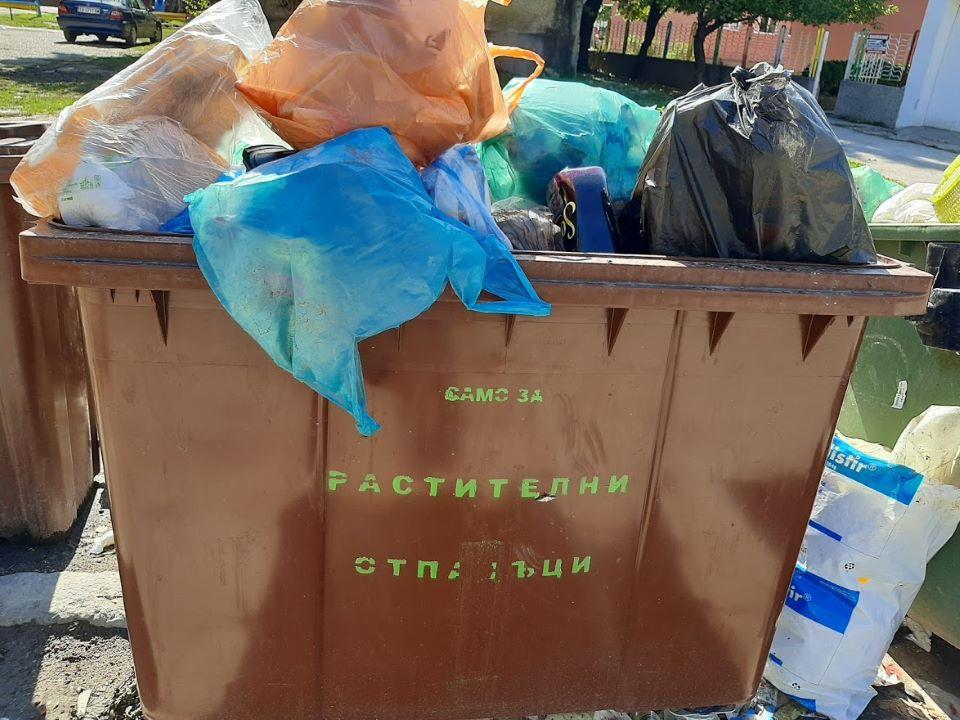
Photo: “Pro Veritas”
False start from the very beginning
The project for processing bio-waste into compost in the three municipalities started with a false start from the very beginning. It was in April 2014, when the then Minister of Environment and Water Iskra Mihaylova signed a contract with the international consortium “Ecorp Biocomp” for the award of a public contract with the subject “Implementation of a decentralized model for bio-waste management in one of the management regions of bio-waste, including the construction of the necessary technical infrastructure – a system for separate collection and recycling of collected bio-waste”. The value of this contract is BGN 3.9 million, the work should be completed in October 2015. The consortium included companies from Austria, Switzerland, Italy and Bulgaria.
The project started loudly – with statements and press conferences convened in Sevlievo by the Ministry of Ecology, where the project was presented as “innovative and unique not only for the region but for the country”, and Sevlievo, Dryanovo and Suhindol are pilot municipalities, i.e. they will pave the way for the processing of household waste, which will subsequently be followed by the other Bulgarian municipalities.
For this purpose, a 140-page report on the state of garbage collection in the region has been prepared, which will serve as a basis for the future methodology for garbage disposal. It was presented within a conference, for which the foreign representatives of the participants in the consortium-performer arrived in Sevlievo. One year later, the creation of a “unique method” to dispose of garbage was announced, nearly BGN 2 million were spent and nothing more.
If you are looking for responsibility for the failed project, one detail should be noted – in early 2015, the municipalities of Sevlievo and Dryanovo signed a contract with the construction supervision company “Kimtex LS” Ltd from Pleven. This is the year in which the project had to be completed, because with the end of that year, the deadline for eligibility of payments under the Operational Program “Environment 2007-2013” expired as well. As the deadline approached, the supervisor requested BGN 35,000 “by hand” in order to put his signature under the handover documents. From “Ecorp Bicomp” they informed the police and in mid-December 2015 the supervisor was caught with a bribe of BGN 10,000.
After this case, it was clear to everyone that the work cannot be completed, which is why the ministry offered the three municipalities an agreement to accept what has been done so far – one report, one methodology, and three – four vegetation cutting machines, whose market prices are not more than BGN 200 thousand.
Two years follow in which the project matured. However, in order to avoid the imposition of financial sanctions and corrections by Brussels, the work had to be completed. Therefore, in August 2018, Minister Neno Dimov transferred its completion to the mayors of Sevlievo, Dryanovo and Suhindol. The new project budget is now only BGN 2.2 million.
The MoEw transferred a project to the mayors after spending half of its budget
At half price
On August 1, 2018, the then Minister of Ecology Neno Dimov signed a contract with the mayors of Sevlievo, Dryanovo and Suhindol for the construction of waste processing plants with the municipalities of Sevlievo, Dryanovo and Suhindol. The project, according to a press release from the Ministry of Environment and Water, includes two composting plants on the territory of Sevlievo and Dryanovo and construction of a composting site on site for the municipality of Suhindol. The facilities will serve over 42,000 residents. The investment is for a little over BGN 2.2 million, of which BGN 1.8 million free of charge under the Operational Program “Environment 2014-2020”. The project implementation period is 12 months.
Nobody mentions that this is a started and unfinished project, which must be completed so that our country is not sanctioned. Not a word can be found in the public space about the BGN 2 million wasted at that time only for a methodology on how to dispose of garbage.
For the project started by the Bulgarian state in 2014, the work was performed actually in 2019. The fact that the year is pre-election turns out to be an additional incentive for the administrations in Sevlievo and Dryanovo.
A contractor has been selected for a composting plant in Sevlievo – DZZD “Compost-92”, which includes “Infrastroezhi” – Sevlievo and Sofia “Patstroy-92”. The value of the performance contract is almost BGN 526 thousand, VAT included.
The local company MONOLIT-T, Dryanovo, has been selected as the contractor for the installation in Dryanovo. The value of the public procurement there is BGN 243 thousand.
The equipment of the still non-functioning composting plant in Dryanovo includes a gasoline generator, a submersible wastewater pump, a digital temperature meter and a probe for measuring carbon dioxide. The performance contract is for BGN 12,450, VAT included, assigned to “Infrastroyezhi” Sevlievo.
The delivery of containers to Sevlievo and Dryanovo is assigned to the Gabrovo Company “Smart Business Company”, the value of this contract is almost BGN 419 thousand, VAT included.
The delivery of equipment for the composting sites in Sevlievo, Dryanovo and Suhindol is for the generally symbolic amount of BGN 10.7 thousand, VAT included. The equipment includes for each site 4 containers of 120 litres each, a lockable wooden box with a capacity of two cubic meters (for storing tools), four garden forks, four shovels, two watering cans, two handcarts, one cover with dimensions 2.50 by 10 m and one thermometer with a range of up to 150 degrees. The supply contract is between the Municipality of Sevlievo and the Sevlievo company “Infrastroezhi”. This is the only contract that mentions Suhindol, where there is no project for a composting facility, but only a storage site.
The delivery of garbage transporting flatbed trucks for the installations in Sevlievo and Dryanovo costs BGN 204 thousand, the delivery of a tractor and a tank for the installation in Sevlievo – BGN 233 thousand.
The delivery of an office container with included furniture, electrical installation, water mains, sewerage and cesspool, and a machine for mineral water for a composting plant in Sevlievo adds to the project costs another BGN 14,340, VAT included and the contractor is “Infrastroezhi” – Sevlievo.
For the information campaigns and trainings of the population what to do with the garbage cost BGN 193 thousand, the contractor is the company under the Law on Obligations and Contracts “Medieval Town Hotalich”, which includes “Elmazova” Ltd Gabrovo and “Adasa7” Sevlievo. The value of this contract is BGN 163 thousand. One of the firms in this company “ADASA 7” is the executor of the contract for information and publicity for almost BGN 20 thousand.
And officials are rewarded
For the participation of municipal employees from the Municipality of Sevlievo in the work on project management and implementation, seven officials have been allocated with a budget of BGN 30,000. The money is for salaries, which is a common practice in the implementation of projects with European funding, although the work in most cases is done during working hours and officials receive a salary for that.
The Covid-19 excuse
One year, after the project for implementation of a decentralized model for bio-waste management in the municipalities of Sevlievo, Dryanovo and Suhindol had to work, it is partially implemented and only in Sevlievo, but in it the population, which must be an active party in the process of bio-waste recovery is not involved.
A project to waste BGN 4 mln or how the coronavirus becomes a justification
According to the project manager and deputy mayor of Sevlievo Municipality Nevena Todorova, the implementation of the project has been delayed due to the declared state of emergency and the complicated situation in connection with the spread of COVID 19 throughout the country. In the answers that in June last year Todorova told for “Pro Veritas”, from July 2020 the phased deployment of containers for biodegradable waste will start. She then urged citizens who received buckets of bags to start using them after a container was delivered near their address.
It is already February 2021. The containers in which the citizens have to throw away are in stock, and the buckets and bags they received in the fall of 2019 are collecting cobwebs in basements and closets. After a final calculation, it turns out that BGN 4 million have been spent in five years, just to tell Europe that we care about how to reduce our waste.





