Bulgaria has spent millions on the construction of wastewater treatment plants that are either unfinished or not put into operation. This has been reported by RNews.bg, which published data from its investigation into the status of three wastewater treatment plants built in the Srednogorie region.
Under the terms of the accession agreement to the European Union, Bulgaria committed to constructing wastewater treatment plants in all settlements with more than 2,000 residents. The financing for this activity is provided through the “Enterprise for Management of Environmental Protection Activities” (PUDOS) and the Operational Program “Environment 2007-2013.” The EU allocated funding of 1.8 billion euros for this program, and by 2014, it was expected that 430 new treatment plants would be operational in Bulgaria.
The implementation of the program began with Bulgaria’s accession to the EU, but significant gaps and irregularities were later identified during audits. As a result, the European Commission suspended payments under this program for one year at the end of 2013. According to official data published by the National Statistical Institute, by 2022, 179 treatment plants had been constructed in the country. The problem is that not only has the target not been achieved, but some of the constructed facilities are non-operational for various reasons. Our country has spent millions on the construction of wastewater treatment plants that, in practice, do not work.
RNews.bg’s investigation into the status of the three wastewater treatment plants in the Srednogorie region was initiated following reports from environmental organizations, which indicated that the critically polluted Tofolnica River is a result of non-operational household wastewater treatment facilities.
Wastewater Treatment Plant or Forest
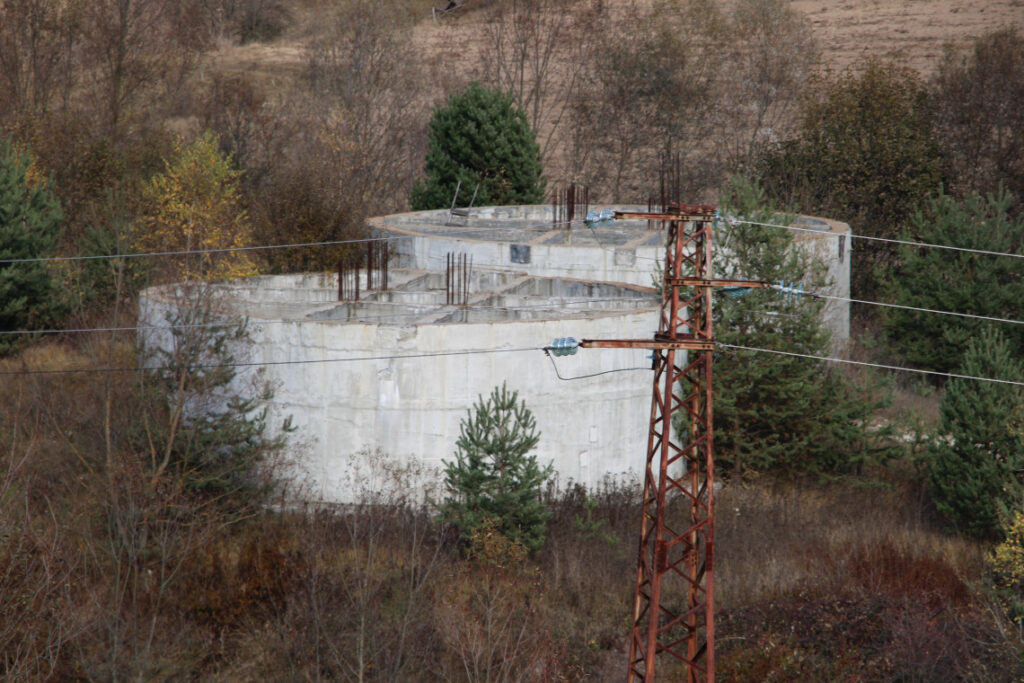
In Koprivshtitsa, the abandoned construction site of the wastewater treatment plant has been completely overtaken by forest vegetation after 20 years.
The town has just over 2,000 permanent residents, but the museum-town is constantly visited by tourists, and during the summer, the amount of wastewater requiring treatment significantly increases. However, the sewage is discharged directly into the Tofolnica River. Construction of the wastewater treatment plant (WWTP) in the town began back in 2003, with the state allocating 2 million BGN through PUDOS.
The construction of the plant has dragged on for years and has faced various difficulties. The project had to be redrafted due to flooding at the site, which caused damage to the already constructed facilities. Ultimately, an additional dike was built on the Tofolnica River, and the structural portion was completed, including the service building, bio-basins, and settlers.
On February 19, 2012, the Municipality of Koprivshtitsa unilaterally terminated the contract with the contractor due to discrepancies between billed and actually completed construction activities, which had amounted to 1.5 million BGN by that point. However, the Municipality contested and refused to pay nearly 140,000 BGN to the contractor. As a result, a legal dispute began, and construction was halted.
According to Osmani Rodriguez, director of the “Territorial and Settlement Development” Directorate in the Municipality of Koprivshtitsa, 800,000 BGN remain in the project’s budget for the completion of the technological portion, but the facility remains unfinished to this day, as the Ministry of Environment and Water has not yet disbursed these funds.
Over, the Municipality of Koprivshtitsa has made attempts to resume construction, but without success. The result is complete degradation of what had been constructed up to that point. For this reason, the current municipal administration has initiated a process to redesign the project, after which funding from the state will again be sought, as reported from there. However, it is certain that Koprivshtitsa will welcome the next National Assembly of Bulgarian Folk Arts in 2025 without a wastewater treatment plant, and once again, several tens of thousands of visitors are expected to gather there.
The Locked Wastewater Treatment Plant in the Village of Dushantsi
In 2009, the Municipality of Pirdop signed a contract with the Agricultural Fund for the “Water Project for the Village of Dushantsi” under the European Rural Development Program 2007–2013. By the end of the year, the first groundbreaking was conducted for the project, which was valued at 12 million BGN and included the replacement of water supply and sewage systems, as well as the construction of a wastewater treatment plant. The executor was the consortium “Vitkovice Interprom Power Engineering,” which includes the companies “Interprom,” “Vitkovice Power Engineering” AD, and “Europroject Consultstsroy.”
By 2012, the facility was completed and accepted by the State Acceptance Commission after 72-hour trials and without any remarks. On December 21, 2012, a certificate for commissioning and an operating permit for the facility were issued.
According to the Water Act, the wastewater treatment plant is the property of the municipality but must be handed over for operation to the local water supply and sewage company (ViK) – Sofia Region. This should have been done by a decision of the regional ViK association, but no such decision was made. It was only in 2016 that the association instructed ViK-Sofia Region to accept the newly constructed water supply and sewage infrastructure in the village of Dushantsi.
During these eight years, ViK-Sofia Region found various reasons to refuse to accept the wastewater treatment plant, despite the fact that the facility had been approved by the State Acceptance Commission, where the company participated with its representative. According to Pirdop Mayor Angel Gerov, the reason for the eight-year delay is that the plant operates at a loss due to the small volume of treated water and the low fees collected from residents of the village.
In January of this year, following signals from citizens and ecologists, the regional governor of Sofia Region, Yuliyan Lekov, ordered a comprehensive inspection of the wastewater treatment plant in the village of Dushantsi. The inspection found that the plant is in good technical condition but is not operational due to a systemic issue—periodic blockages with stones and gravel at the shaft through which it receives wastewater.
According to Rositsa Itova, the manager of ViK – Sofia Region, the company cannot operate the plant in Dushantsi until the problem is resolved due to the serious risk of accidents and subsequent repairs.
Mayor Angel Gerov of Pirdop told RNews.bg that the problem could be resolved by constructing an additional facility—a clarifier—but the municipality lacks the financial resources for this. He believes that the wastewater treatment plant in Dushantsi could be put into operation now within a week for the facilities’ maintenance.
Over the years, the Municipality of Koprivshtitsa has attempted to resume construction, but without success. The result has been complete degradation of what had been built up to that point. For this reason, the current municipal administration has initiated a process to redesign the project, after which they will seek funding from the state again, as reported. However, it is certain that Koprivshtitsa will host the next National Assembly of Bulgarian Folk Arts in 2025 without a wastewater treatment plant, and once again, several tens of thousands of visitors are expected to gather there.
The Locked Wastewater Treatment Plant in the Village of Dushantsi
In 2009, the Municipality of Pirdop signed a contract with the Agricultural Fund for the “Water Project for the Village of Dushantsi” under the European Rural Development Program 2007–2013. By the end of the year, the first groundbreaking occurred for the project, which was valued at 12 million BGN and included the replacement of water supply and sewage systems, as well as the construction of a wastewater treatment plant. The executor was the consortium “Vitkovice Interprom Power Engineering,” which included the companies “Interprom,” “Vitkovice Power Engineering” AD, and “AYB Solutions” and “Eco Aqua Systems.”
By 2012, the facility was completed and approved by the State Acceptance Commission after 72-hour trials and without remarks. On December 21, 2012, a certificate for commissioning and an operating permit were issued for the facility.
According to the Water Act, the wastewater treatment plant is owned by the municipality but must be handed over for operation to the local water supply and sewage company (ViK) – Sofia Region. This was to be accomplished by a decision of the regional ViK association, but such a decision did not occur. It was not until 2016 that the association instructed ViK-Sofia Region to accept the newly constructed water supply and sewage infrastructure in the village of Dushantsi.
During these eight years, ViK-Sofia Region found several reasons not to accept the wastewater treatment plant, despite the fact that the facility was approved by the State Acceptance Commission, where the company had a representative. According to Pirdop Mayor Angel Gerov, the reason for the eight-year delay is that the plant operates at a loss due to the small volume of treated water and the low fees charged to residents.
In January of this year, following complaints from citizens and ecologists, the regional governor of Sofia Region, Yuliyan Lekov, ordered a comprehensive inspection of the wastewater treatment plant in the village of Dushantsi. The inspection found that the plant is in good technical condition but is not operational due to a systemic issue—periodic blockages with stones and gravel at the shaft through which it receives wastewater.
According to Rositsa Itova, the manager of ViK – Sofia Region, the company cannot operate the plant in Dushantsi until the problem is resolved due to the serious risk of accidents and subsequent repairs.
Mayor Angel Gerov of Pirdop stated to RNews.bg that the problem could be resolved by constructing an additional facility—a clarifier—but the municipality lacks the financial resources for this. He believes the wastewater treatment plant in Dushantsi could be operational within a week with maintenance of the facilities.
Wastewater Treatment Plant Pirdop – A Good Example but with Gaps
The wastewater treatment plant in Pirdop was constructed in 2013 as part of the Integrated Water Project for the city, which was funded by the Operational Program “Environment 2007-2013.” The project, with a total value of 44.2 million BGN, was undertaken by the consortia “Vitkovice Interprom Aqua Engineering,” which includes “Interprom,” “Vitkovice Power Engineering” AD, “AYB Solutions,” and “Eco Aqua Systems,” and “Interprom Raikomers Construction 99,” which includes “GP Group,” “Intercom,” “Raikomers Construction,” “RC Design,” and “Eco Aqua System.”
In 2017, the plant was handed over for operation to ViK – Sofia Region, and two years later, part of the wastewater from the city of Zlatitsa was included in the station’s operations.
According to Pirdop Mayor Angel Gerov, the plant operates with good performance indicators, but its location is poorly chosen. It was built in close proximity to houses in one of the town’s outskirts. As a result, during summer, the odor from the plant constantly bothers residents. Additionally, the wastewater from Zlatitsa is pumped, resulting in extra costs. Gerov believes a better location for the plant would have allowed for gravitational inflow of wastewater from both cities. However, such comments are unlikely to be practical, as the plant cannot be relocated at this stage.
Millions for “Phantom” Wastewater Treatment Plants
The examples from the Srednogorie region are not the only ones in the country. Lachezar Bakardzhiev, former deputy regional governor of Plovdiv, claims that the water supply and sewage sector in Bulgaria is in critical condition.
“Ensuring drinking water and managing wastewater is a strategic activity, and the spending of European and budgetary funds should be a priority,” he states. Unfortunately, this year, several settlements were under water restrictions because financial flows are directed in the wrong direction.
According to Bakardzhiev, there is a complete lack of control over the effects of investments made in the water supply and sewage sector due to the multitude of institutions involved, such as the Ministry of Regional Development and Public Works (MRDPW), the Ministry of Finance, the Bulgarian Water Holding, associations related to water supply, and water supply companies. He cited the municipality of Stambolovo, where a number of small wastewater treatment plants were accepted, along with the associated collectors, through the so-called Act 16 (for commissioning construction sites), but in practice, they either do not exist or do not operate.
At one of the sessions of the Municipal Council in Stambolovo held in September 2006, a Development Strategy for the municipality was adopted, as shown by RNews.bg’s investigation. According to this strategy, the local administration accepted an ambitious program to build 11 wastewater treatment plants. However, only 6 were constructed, and none of them function. The remaining 5 were “constructed” only on paper.
Millions of levs have been spent on these “phantom” wastewater treatment plants, and similar examples certainly exist in other parts of the country. At the same time, the number of people living under water restrictions is increasing due to poor management of water resources.