



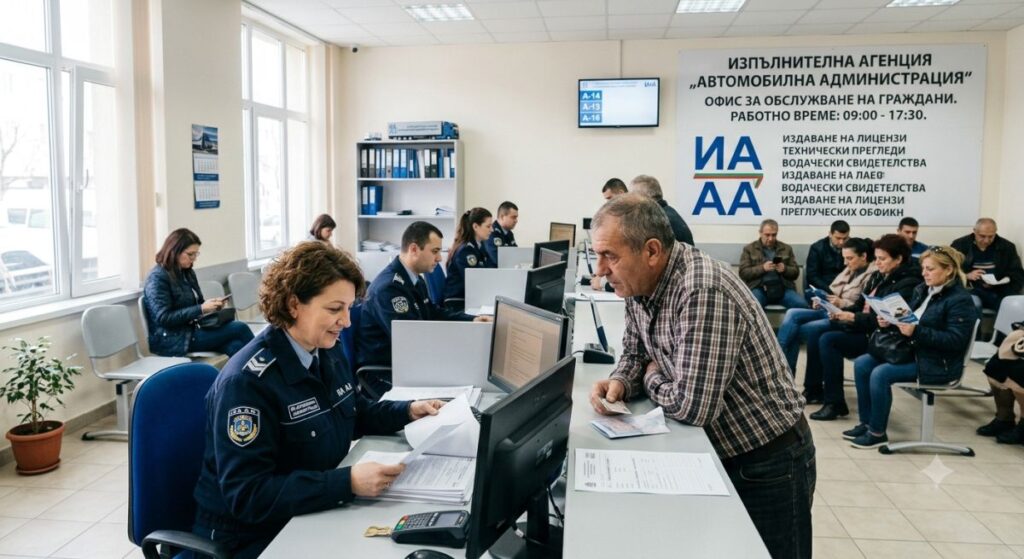
The executive director of the Executive Agency “Automobile Administration”, Boyko Ranovski, has described a state service recruitment competition in the agency’s Gabrovo regional office as a “private matter”.
Ranovski gave that response to questions from “Za Istinata” concerning the appointment of an inspector at the agency. The questions were intended to establish whether the competition had been conducted transparently and on an equal footing, and whether there were grounds for a report received by the media alleging that the outcome may have been predetermined.
Information refused on every point
The agency’s management refused to provide information on how the candidates’ final scores had been calculated, what weight had been assigned to the separate stages of the competition – the test and the interview – and what results the candidates had achieved.
Access was also denied to copies of the assessment sheets and other documents used by the commission members when evaluating the interviews, despite the request for information explicitly stating that any personal data could be redacted.
The agency also refused to say whether the candidate ranked first had previously taken part in competitions for the same position and what results he had achieved – a relevant detail given information available to “Za Istinata” about previous attempts by the same candidate to obtain the position.
Information about a possible conflict of interest was also refused, on the grounds that the position of “inspector” is not a public office under the Anti-Corruption Act covering persons holding public positions.
At the same time, the agency acknowledged that the Executive Agency “Automobile Administration” is subject to the Civil Servant Act and that, in this case, the appointing authority has a legal obligation to check for circumstances indicating a possible conflict of interest.
What if the answers had been provided?
There would have been little reason for doubt about the appointment of the new inspector in Gabrovo if the requested information had been disclosed.
The questions were not asked as an end in themselves. They were prompted by information received by “Za Istinata”, whose claims the media outlet sought simply to verify.
The Access to Public Information request was submitted to establish how the candidates had been assessed, how their scores had been calculated and whether the competition had genuinely been competitive.
Instead of helping clarify the circumstances, the refusal leaves unanswered questions about the transparency and objectivity of the recruitment process in a state institution.
The Automobile Administration considers this particular competition a “private matter”, even though it concerns the appointment of a civil servant in a state body and the way in which a public authority exercised powers granted to it by law.
The fact that both the newly appointed employee’s salary and the agency itself are financed with public funds is also relevant. The public therefore has a legitimate interest in knowing how such appointments are made.
A lack of access to documents that could confirm or disprove suspicions does not in itself prove that a violation took place. But it does increase public interest in the case and does nothing to resolve the question of whether the competition was genuinely competitive and based on transparent criteria, or merely a formal fulfilment of the requirements for holding a recruitment procedure.
No professional experience required
The competition for the vacant “inspector” position at the Automobile Administration in Gabrovo was announced on 30 April this year.
The requirements include at least a bachelor’s degree, while no professional experience is required.
The competition consists of a 20-question multiple-choice test. Candidates pass this stage if they make no more than four incorrect answers.
Those who pass the test proceed to an interview.
The interview lasts at least 10 minutes, and candidates’ answers are assessed on a five-point scale.
Until recently, the names of the candidates admitted to the competition in Gabrovo were publicly available. During the preparation of this report, however, the names had been removed from the agency’s website.
This does not in itself constitute a violation. The appointing authority is required to keep the names public only until the recruitment procedure has been completed.
An Automobile Administration inspector is not a “private matter”
The position of inspector at the Automobile Administration is not an administrative job without a direct impact on the public.
Inspectors carry out roadside checks and inspections at transport companies, draw up reports and administrative violation notices under the Road Transport Act and other regulations.
They also take part in procedures involving professional competence examinations for drivers and transport managers, as well as inspections of driving schools, bus stations and vehicle technical inspection centres.
In practice, inspectors exercise control over carriers, drivers and organisations operating in the transport sector.
Precisely because of the breadth of these powers, the way an inspector is selected is a matter of significance not only to the administration but also to the public interest.
The heart of the dispute
The state agency maintains that disclosing how it selects its inspectors “could not lead to the formation of an opinion regarding the work of any legal entity”.
But how is the public supposed to determine whether a state-service recruitment process has been transparent and objective if the documents showing how the selection commission worked remain inaccessible?
Ultimately, the refusal to shed light on the procedure does not dispel the doubts surrounding it.
Instead, it leaves the impression of a formal competition – while the agency itself is preventing the public from checking whether the process was genuinely competitive.






