



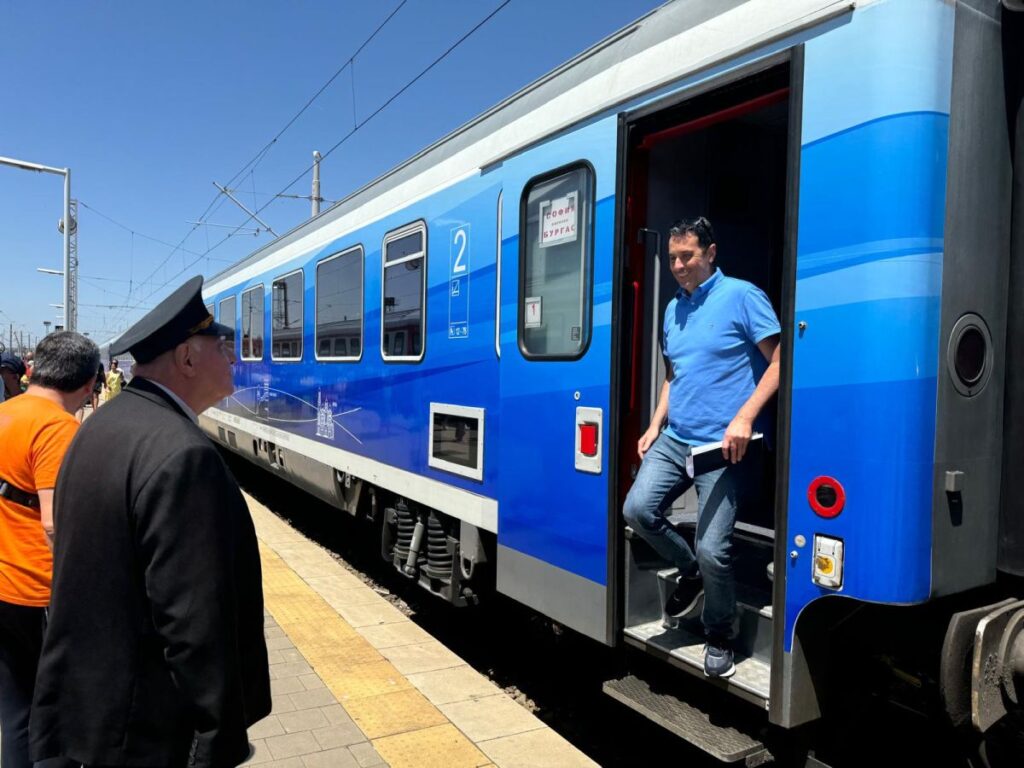
In the middle of the year, Bulgarian Railways “modernized” with 76 second-hand wagons from Germany. They were purchased for 30 million levs without any documentation and absolutely no guarantees from the seller, including safety assurances. Additionally, the introduction of these wagons into service costs nearly half a million levs including VAT.
The deal was finalized just days after the state rejected a newly produced wagon from the factory in Dryanovo, along with six others at various stages of production, some of which had been partially paid for in advance. Today, these wagons are secured with three locks, and it is only a matter of time before they are sold for parts or rust away in the factory hall.
This is a glaring case of reckless spending by the state company
“BDZ-Passenger Transport,” which evidently turned a blind eye to what they were buying from Germany. The second-hand wagons not only are out of service, but the seller also bears no responsibility for defects and does not provide quality guarantees. This is stated in the sales contract, the clauses of which are in direct contradiction with the technical specifications—the document that outlines the precise parameters for the transaction.
The contract was signed on April 3 of this year between “BDZ-Passenger Transport” and “DB Fernverkehr,” Germany. This is just four months after BDZ unilaterally terminated its contract with “Vagonen zavod-Interkom” in Dryanovo for the production of 15 wagons. The project, known as “Sokol,” has one finished wagon that has passed mandatory testing, while another six are at different stages of production, according to the factory owner. The quality of the finished wagon, according to the manufacturer, is above the average European level.
Is there a connection between the purchase of decommissioned wagons and the termination of the contract with Bulgaria’s only wagon manufacturing enterprise?
It cannot be stated with certainty, but the timing of the events cannot be denied.
BDZ-Passenger Transport is adamant that “there is no connection with the subsequent purchase of 76 wagons from Germany.” In an email to “Za Istinata,” the company states that “the need for the delivery of these wagons is clearly justified in a report,” and that the report is the first step toward initiating the procedure for acquiring the wagons.
The primary goal of the wagon delivery is to ensure the train schedule, the company says, specifying that as of February 14, 2024, the company had 187 wagons available, while according to the existing schedule, 205 technically operational second-class wagons were needed. This number was necessary to serve all routes. Additional wagons were also needed to replace those undergoing mandatory maintenance, cleaning, and servicing. With the approaching summer season of 2024, according to the train formation plan, an additional 39 wagons were needed, resulting in a total shortage of 57 wagons for Bulgarian passenger railways.
In light of this situation, the delivery of 76 wagons from Germany is crucial for the timely and complete fulfillment of the train schedule,
especially during periods of increased passenger flow, BDZ adds, without commenting on why they are purchasing 76 when they need 57.
They do not deny that not all of the paid second-hand wagons are currently operational on the railway network. Only 54 have been put into service. Twelve second-class wagons are expected to be gradually deployed after being repaired, as their operation depends on the repair program of the “Nadezhda” wagon depot.
Another ten bistro wagons will also be brought into operation. For them, “the concept for organizing and implementing the services to be offered is currently being finalized.”
With this explanation, BDZ dismisses suspicions that the purchase of the German wagons is a questionable deal in which “the subject of the purchase is used and not in working condition,” as begins the first sentence of the first section of the wagon purchase contract.
According to BDZ, this means that although “the rolling stock has been decommissioned, this is not an indication of lack of operational readiness.”
The contract under which “BDZ-Passenger Transport” purchases the German wagons contains many curious, yet rather scandalous details that raise the question of what the state company, whose financial state is far from rosy, is spending 30 million levs on. In fact, the money is at least 2 million levs more since the thirty million does not include expenses related to commissioning and transport from Germany.
The seller “is not responsible for the accuracy of the provided documents,” is stated in the sales contract. This refers to the documents of the wagons that BDZ is purchasing, which turn out to be “not checked by the seller for correctness and completeness and do not represent characteristics or warranty.” Furthermore, it is possible that the documents no longer correspond to the actual condition of the equipment or legislation, and the buyer is responsible for this, according to the contract.
However, BDZ has a different stance. The company states that “the contract stipulates the provision of design documentation, which is received upon the delivery of the first batch of wagons. This documentation provides the necessary information for the maintenance and operation of the wagons.”
At the same time, every toaster comes with a user manual. But 76 second-hand wagons from Germany do not!
It turns out that, according to the contract, the Bulgarian side will not receive documentation for the operation and maintenance of the wagons because this documentation “is not part of the sale,” according to the agreement. This is strange, as is the fact that the Bulgarian railway company agreed to this condition. In fact, the contract offers some explanation for these oddities. There is most likely no documentation because “the subject of the purchase consists of used and decommissioned rail vehicles.”
The contract explicitly states that these wagons have been decommissioned in Germany. In the section on “Warranty and Responsibility,” it is mentioned that the seller has not subjected the wagons to any separate safety inspection and “therefore it cannot be excluded that the subject of the purchase has defects that are unknown to the seller and that impair the purpose pursued by the buyer.”
Translated into plain language, this means that no one checked whether the wagons in question are operational or in working order, which is why they may not be suitable for Bulgarian Railways. This became evident this summer when the air conditioning in these wagons did not work, and the windows could not be opened. It was also reported that, according to the manager of BDZ, as cited by various media, the blame for this was placed on high temperatures.
In fact, problems with air conditioning are among the most common issues for decommissioned wagons in Germany. Other frequent defects include the functioning of side doors and the anti-slip system. Naturally, all malfunctions were supposedly addressed promptly, claims the company, for which the safety and comfort of passengers are of utmost importance.
They are probably not surprised by the arising issues since they signed under the condition that “the deal is made with the exclusion of warranty.”
In fact, BDZ examined the wagons only through an external inspection, as indicated in the contract, and accepted “the wagons in the condition in which they were seen by the buyer, excluding any guarantees and liabilities of the seller for defects.”
To cap off this entire madness, which reflects the commercial and managerial foresight of BDZ’s management, there is a clause at the end of the contract stating that “the seller draws the buyer’s attention to the fact that due to the age of the object of purchase, the presence of artificial materials from mineral or asbestos fibers cannot be excluded.” The seller’s liability is also excluded for this.
In Bulgaria, since the beginning of 2003, the import, sale, production, and use of all asbestos fibers have been banned. A complete ban on asbestos products came into effect on January 1, 2005, but there was a compromise for welded products that could be used until the end of their operational life. The wagons from Germany are not welded products and were purchased after the ban on the import of asbestos-containing products came into force.
It is clear up to this point that the state-owned BDZ has purchased decommissioned wagons that would, at best, serve as “donors” for spare parts, as no one guarantees their technical condition and, therefore, their safety.
According to BDZ, the old German wagons will not serve as spare parts; only two of the 13 second-class wagons have had elements of the information system dismantled and provided for analysis and development of a technical solution for building a new system. This was necessary because the information system of these wagons is software-integrated with the German railway infrastructure and is incompatible with the conditions of our railway network.
Why and how did the purchase come about?
On January 29 of this year, “BDZ-Passenger Transport” announced a public procurement for the major rehabilitation of 133 passenger wagons for a duration of 26 months. During the repair period, the wagons were to be decommissioned, which would clearly hinder the operations of the railways. This necessitated securing 76 wagons to address the shortage, as stated in the rationale for the procurement procedure for the purchase of the German wagons.
From the documentation related to this procurement, it is understood that BDZ sent inquiries to the railways of Italy, Switzerland, Belgium, France, and Germany to see if they could sell the wagons needed by Bulgaria. There was no interest in this inquiry, according to BDZ.
However, one offer was submitted.
This came from the national carrier of Germany, “Deutsche Bahn.” In its offer, each of the 76 wagons was priced at 200,000 euros excluding VAT, with the price including a maintenance manual. However, this contradicts the contract, which explicitly states that the buyer will not receive documentation for operation and maintenance.
It is evident that there was a need for urgency, as “this offer is exclusive, specifically for ‘BDZ – Passenger Transport’,” is stated in the rationale. The offer has a very short validity period—only 20 days. However, it does not mention what would happen once this period expires, as it is unlikely that there was a rush of buyers for the decommissioned wagons. Therefore, there must be something else behind this urgency, which BDZ cannot be unaware of, but that remains publicly unknown to this day.
Doubts about the accuracy of the motivations for the purchase arise from the apparent contradiction between BDZ’s stated intentions and the subsequent purchase agreement. The rationale states that the wagons are in good operational condition, having undergone major repairs in the last 2 to 4 years, and that according to the maintenance plan, there are between 6 and 4 years left until the next repair. However, as indicated in the contract, the buyer is purchasing decommissioned wagons of unknown condition, which the buyer must address at their own expense. As it turns out, “BDZ-Passenger Transport” is buying German wagons,
but the deal is far from meeting the requirements of the technical specifications.
In fact, almost none of what was laid out in it has been complied with. Regarding the discrepancy between the technical specification and the purchase agreement, they explain that according to the planned maintenance warning system of the German railway operator, the wagons, except for two of them that are subject to the contract, are operational until the end of 2025.
“The fact that the wagons are operational until the end of 2025 supports their compliance with the requirements of the technical specification and the term ‘good operational condition.'”
It states that for each of the wagons there should be design drawings, electrical schematics of the installations, technical documentation for individual electrical blocks and assemblies, including a wiring diagram of the connections of the components, an electrical schematic of the integrated parts and materials with included instructions for operation and repair.
BDZ receives none of this, and the company knows it will not receive it, as the director’s signature is affixed to the contract under which they are buying the decommissioned wagons without any documentation, but he has no grounds for claims regarding this. He has agreed with his signature under the contract, which is publicly accessible through the website of the Public Procurement Agency.
Here, “Vagonen zavod-Interkom” in Dryanovo comes into play.
Somewhere in the rationale defending the purchase of the German wagons, the contract that “BDZ-Passenger Transport” has with the factory in Dryanovo for the modernization of 15 passenger wagons at a price of 1.8 million levs is mentioned. The contract was terminated due to the complete failure of the contractor to fulfill its obligations, as not a single wagon was modernized over a period of three years, as stated there.
“This is not true,” claims the owner of the factory, Valeri Dimitrov.
He contacted “Za Istinata” (“For the truth”) following the publication “Wagon Builders are Seeking Their Wages Through the Courts While the State ‘Invests’ 30 Million Lev in Second-Hand Wagons.”
As his factory is in the process of being declared bankrupt and a trustee has been appointed, it is impossible to enter and see the completed wagon, Dimitrov states. It has been repaired under the “Sokol” project. The appearance of the repaired wagon can be judged by the photos and videos that Valeri Dimitrov sent.
In the video, the wagon is in motion. It has passed a speed test first between Plovdiv and Septemvri, where a speed of 140 km/h was achieved, and then in Romania, where a certified laboratory determined that the wagon reached 186 km/h, thus fulfilling the requirement for a speed of 160 km/h specified in the contract with BDZ.
“This wagon can operate on any railway line,”
claims Valeri Dimitrov, stating that BDZ had no technical remarks about it, even though none of the management attended either the presentation of the wagon or the tests during its evaluation.
“Only the seats might be a bit hard,”
was the reaction of Deputy Minister of Transport and Communications Biser Minchev, who, along with Minister Georgi Gvozdeykov, inspected the wagon. This took place in Sofia, at the “Nadezhda” depot, where the wagon was supposed to be brought for Gvozdeykov to see. To fulfill the minister’s wishes, workers from the factory transported the wagon directly from Romania, where it had been undergoing speed testing, to Sofia.
The inspection by the minister and his deputy lasted about 40 minutes, Dimitrov recounts. “We adhered to BDZ’s technical specifications for the seats, but if you decide, we have material purchased for three more wagons, and we can order different ones for the others,” Valeri Dimitrov replied. After the quick inspection by the minister, the wagon was returned to Dryanovo and stored in the factory, where it remains to this day.
“This wagon is above the average European level in all aspects,”
asserts Valeri Dimitrov. “I know every detail of it because everything has passed through my hands. Some of the best wagon builders in Bulgaria worked on it. A team of 230 people dedicated themselves to its creation, plus another six wagons, which have begun construction and are at various stages. These people should have been retained after BDZ unilaterally terminated the contract with us instead of giving us a deferment.”
The contract between Bulgaria’s only wagon manufacturing plant, located in Dryanovo, and “BDZ-Passenger Transport” was signed in April 2021. It was for the production of 15 wagons. To begin work, the company received an advance totaling 9 million levs, which was paid at various times. In the meantime, it also took a loan from the Bulgarian Development Bank. With the onset of the pandemic, there were delays in deliveries from other countries, causing the wagon manufacturers to miss deadlines. This led to BDZ unilaterally terminating the contract with “Vagonen zavod-Interkom” in December 2023 and demanding the return of the money along with interest. The final decision was not aided by the force majeure certificate received from the Bulgarian Chamber of Commerce and Industry.
Against this backdrop, in the early days of 2024, Valeri Dimitrov filed a request in court for the factory to be declared bankrupt, having previously laid off all the workers.
“Some of these people are already abroad, and if they need to gather again, it will be impossible,” Dimitrov believes. “We have lost a team that could have supported the sector.” He believes that the plant in Dryanovo, together with the wagon repair plant in Septemvri, could have repaired three wagons per month.
Today, the Bulgarian wagon, which the manufacturer claims is above the average European level, stands behind three padlocks that hang on the three entrances of the wagon factory in Dryanovo, Valeri Dimitrov further explains. He states that there is no security there, and the electricity has been cut off due to a fault that has not been repaired. In fact, there was one guard who remained in a car in front of the gate, Dimitrov adds, and claims that Georgi Gvozdeykov is not telling the truth about the German wagons.
In response to a question from MP Dimitar Naydenov (PP-DB), the minister states that the wagons were produced between 1982 and 2003 and have about 15 years of life left. All of them underwent testing, and wherever faults were found, they would be repaired.
“It is not possible,” says Valeri Dimitrov, “because there are no spare parts for them; they have been decommissioned, and as can be seen in the purchase contract, they have also been removed from operation. BDZ knew this when they purchased the wagons and agreed to acquire them without any guarantees from the seller.”
We are talking about 30 million levs, but in reality, it is much more.
The average cost to put them into service is 4,750 levs per wagon (from Minister Gvozdeykov’s response in parliament, ed.). This amounts to 361,000 levs excluding VAT, which comes to just under half a million levs when the tax is added.
In addition to the mandatory checks, this price includes reprofiling and replacement of wheelsets, changing consumables and brake pads, pneumatic brake tests, inspection and replacement of electrical equipment, door and lighting tests, and charging and recharging of air conditioning systems, says Minister Gvozdeykov. All of this does not resemble wagons in good operational condition and after a major overhaul, as outlined in the technical specifications.
BDZ has a different opinion. “According to the planned maintenance warning system of the German railway operator, the wagons, with the exception of two of them that are subject to the contract, are operational until the end of 2025,” the company writes to “Za Istinata.”
Additionally, there are 750,000 levs for delivery to Bulgaria.
On April 29, 2024, a contract is signed between BDZ-PP and “Transa Spedition” – Germany, based in the town of Bozhurishte, for the delivery of the wagons from Germany. With this, the amount for the “modernization” of the Bulgarian railways swells by nearly another 1.2 million levs.
Five directors of BDZ and four transport ministers have changed within two and a half years
—the period during which the factory in Dryanovo was supposed to produce the first truly modern wagons for the Bulgarian railways.
With such frequent changes, it is impossible to have consistency in the decisions and actions that lead to lasting results. Whether the wagon factory is a victim of this uncertainty is a matter of perspective. Valeri Dimitrov states that communication with BDZ has been difficult, at times completely lacking. The same has been true for the Ministry of Transport.
Yes, the factory did not meet the deadline stipulated in the contract, thus violating the agreement, which is grounds for invoking the clauses within it and even terminating it, as has happened in this case. There would be nothing wrong with this if, in the meantime, the state railways had not “modernized” hastily, in just 20 days, with decommissioned German wagons.






