



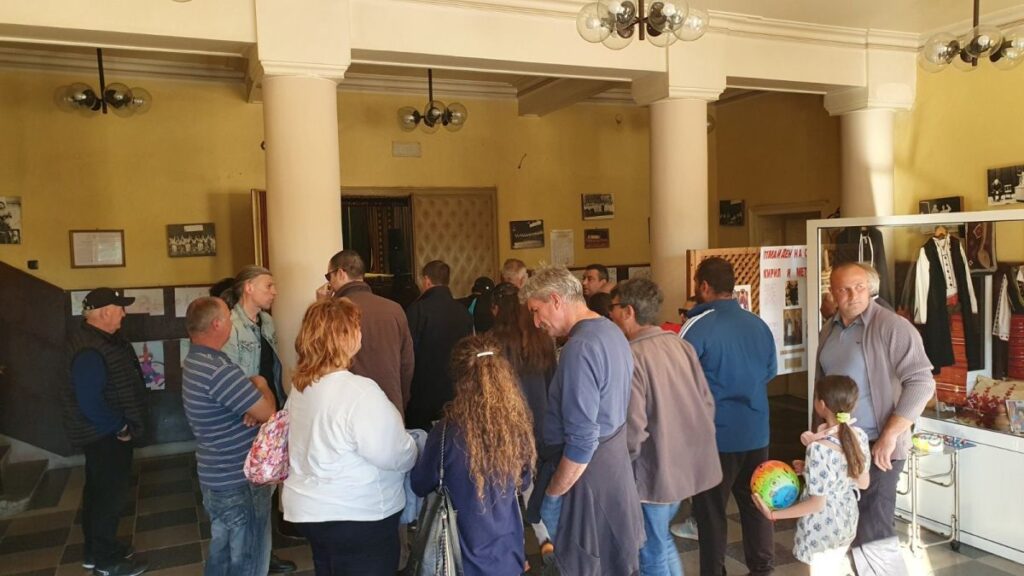
Photo: “You decide”
One of the largest photovoltaic parks in Bulgaria may be built in the municipality of Suhindol on nearly 10,000 decares of agricultural land, pastures, and forests of high natural value. This became clear after a meeting of the Expert Environmental Council of the Regional Inspectorate for Environment and Water (RIEW) in Veliko Tarnovo, at which critical opinions were ignored and there was no debate, according to Pencho Pandakov, who participated in the Council’s work.
The Expert Council was supposed to provide an environmental assessment to prepare an amendment to the zoning plans in the municipality of Suhindol with a view to building a huge photovoltaic park. The park is planned on land in an urbanized area and, according to the investment proposal, will be the largest of its kind not only in the country but also in the Balkans and Europe, according to the civil association “You Decide for Suhindol.”
The project is comparable in size to a small town, according to the non-governmental organization, and the land on which it will be built, in addition to being agricultural, is a site of priority habitats and protected plant and animal species, according to hydrobiologist Pencho Pandakov from the Balkanika association.
Pandakov, who is a member of the expert environmental council, says that the meeting “turned out to be
a staged event to rubber-stamp an outrageous proposal for a decision,”
wrote the conservationist on Facebook, calculating that the park would cover over 10% of the total agricultural land in the municipality of Suhindol – “natural land of exceptional beauty and high biodiversity in an urbanized area.”
The investor “cannot wait.”
With this argument, on January 16 this year, the Austrian limited liability company “Wabi-Sabi Alpha” asked the director of the Regional Inspectorate of Environment and Water in Veliko Tarnovo, Stanislav Stanev, for the project to start before the expert council’s decision. This is, in effect, an attempt at preliminary implementation that completely ignores public discontent and disregards the local population, which, with a petition signed by 641 residents (over 60% of those who participated in the last local elections in the municipality of Suhindol), wants to defend its right to a healthy environment. Furthermore, the request for preliminary implementation clearly shows that the investor is confident of the outcome of the expert council, which suggests that the proceedings have been rigged.
However, the citizens are not giving up and are protesting in front of the RIEW building while the Environmental Council is meeting inside to discuss the environmental assessment procedure, through which an amendment to the Suhindol municipality’s development plan is being prepared in order to give the green light for the construction of the huge photovoltaic park.
“This was not an expert council. It was not even a council. It was a shameful and disgraceful performance.”
This is how Pencho Pandakov described what happened at the Regional Inspectorate of Environment and Water on January 13 in a post titled “Alarm.”
In it, Pandakov says that the meeting of the Expert Environmental Council (EEC) was held “with unprecedented and unacceptable interference in the work of its members by numerous representatives of the contracting authority, whom the Regional Inspectorate of Environment and Water Resources (RIOSV) allowed to participate.” He says that the members were unable to discuss the project, while participants, including lawyers, designers, builders, and representatives of the non-governmental sector “engaged in constant arguments, interrupted, insulted, and made accusations and cynical remarks toward the members of the expert council who were trying to present a reasoned position.”
Pandakov also points out that a representative of the environmental inspectorate showed “extremely biased attitude towards the economic interests of the investor,” speaks of “unprofessional attacks and angry outbursts towards members of the EEC, in sync with the aggressive crowd supporting the client.” He concludes that “the EEC meeting turned into a nervous shouting match” instead of “a council of experts with the necessary competence.”
The result of all this is 19 votes “for,” three “against,” and two “abstentions.” With this decision, whether a photovoltaic city will be built near Suhindol depends entirely on the director of the Regional Inspectorate of Environment and Water, who may not comply with the EEC’s decision.
You scratch my back, I’ll scratch yours
The investor requested a deal with the municipality as early as in its investment proposal, which, if read in detail, sounds like a bribe. Details of it became clear last spring when citizens stopped the illegal felling of trees and shrubs on the land where Wabi-Sabi Alpha wants to build a renewable energy park.
The company was registered on March 29, 2024, at an address in Suhindol. According to the Commercial Register, its partners are three foreign companies: the Austrian Green Source with a share capital of BGN 45,000, Kor Value Capital with the same shareholding, and LSJ Building Solutions with a shareholding of BGN 10,000.
“To strengthen his position” (the quote is from the investment proposal, ed.), he proposes to deposit €220,000 in an escrow account, with the deposit to be refunded upon receipt of the building permit. An escrow account is a special type of account in which an independent third party holds an amount until all agreed conditions are met.
The investor undertakes to cover the electricity costs of the municipality, the community center, two kindergartens, one school, one nursery, and one social home, plus the street lighting bills for the town of Suhindol. There is one condition behind this generosity: electricity costs must not exceed the value of the 2022 invoice plus 5%.
There are more promises: the investor undertakes to replace street lighting with LED, but a specific proposal will come at a later stage. It also offers additional funding for the monthly salary of one employee at the local museum and sponsorship of the local football team. It also plans to compensate tenants of municipal properties who receive subsidies for agricultural land if their properties fall within the areas selected for the solar park.
Finally, the company promises to register in the municipality of Suhindol, which it subsequently does, “thus contributing to the municipality’s budget,” according to its investment proposal.
National Headquarters for Coordinated Civil Resistance in Defense of the Public Interest
formed the non-governmental organization “You Decide.” From there, they commit to all actions permitted by law to protect the right to a healthy environment and future for the people. Because “what is happening in Suhindol is deeply wrong and requires a fair response” and because “Suhindol is yet another bad example of a way of working in which procedures are used to push through investment projects, regardless of public disagreement and serious expert arguments.”






