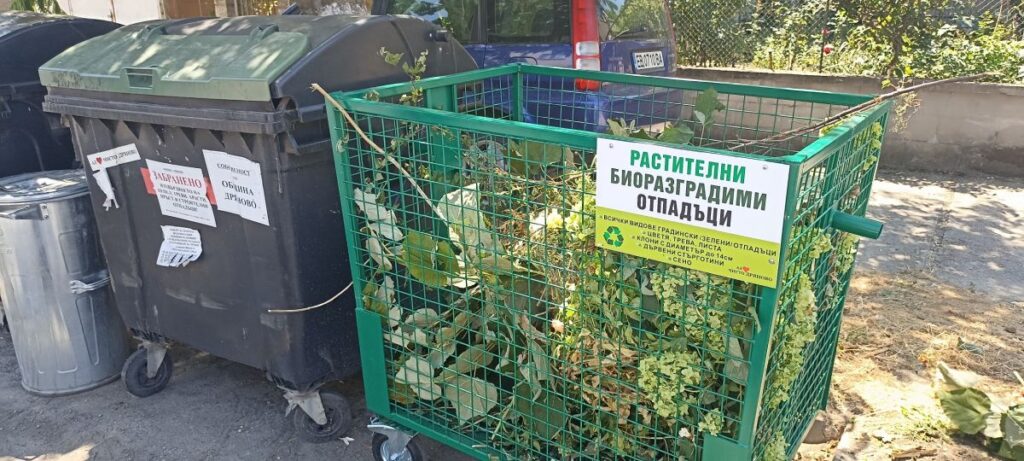
The new containers are next to those for mixed household waste and can be used to dispose of leaves, grass, flowers, branches, bushes, noise, food peelings, etc.
A specialized vehicle will collect the waste twice a week, after which the green waste will be taken to the composting site, where the garbage will be processed into compost. The finished compost will be distributed to citizens who can use it to fertilize their yards, and the municipal enterprise “Chisto Dryanovo” will use it to maintain the municipal parks and gardens.
Separated from Sevlievo
At the end of February this year, the five-year contract expired, under which the Regional Waste Landfill in Sevlievo” was the operator of the composting site in Dryanovo. Upon expiration of the contract, the assets were returned to the Municipality of Dryanovo, which handed them over for use, management and management to the Municipal Enterprise “Chisto Dryanovo”.
At the end of March, the Regional Inspectorate for Environment and Water (RIEW) issued the permits, which gave the municipal enterprise the right to carry out waste treatment activities, and the placement of the green waste containers is the finale of a procedure that began in mid-2024 and was born from the ambition to separate Dryanovo from Sevlievo and for all recyclable green waste to remain in the city.
A non-working project and too little waste
The system for separate collection and recycling of biowaste was built jointly with Sevlievo and Suhindol under the Operational Program “Environment” 2014-2020. However, it did not work as planned in the project – something that is also evident from the reports on the quantities of biodegradable waste deposited.
According to the project, which was reported as completed, but apparently not working at that time, two composting installations were to be built on the territory of the municipalities of Dryanovo and Sevlievo, with the respective capacities – 900 tons and 3,000 tons of treated biodegradable waste per year.
However, the amount of green waste landfilled in Dryanovo was far below the target. Since the site was put into operation in the city, 790 kg of biodegradable waste have been reported landfilled in 2021, 3.69 tons in 2022, and 4.58 tons in 2023. These quantities are based on weighing records reporting the landfilled quantities; the data was provided to “For the Truth” by the Dryanovo Municipality in October 2024.
Apart from the too little garbage for composting, the fact that the Dryanovo Municipality pays the Sevlievo landfill for each ton landfilled should not be overlooked – initially 25 leva per ton, and from the beginning of 2024 30 leva per ton.
New project for half a million leva
In order to become independent in the utilization of green waste, the Municipality had to receive funding, since specialized equipment and containers are needed for the complete processing of biodegradable waste.
Thus, Dryanovo applied for a project for half a million leva, with which the entire amount of biodegradable waste collected from the population in Dryanovo would be deposited and recycled on site, instead of being taken to the Regional Landfill in Sevlievo, as was the case until the beginning of this year.
In fact, the beginning of the process of utilizing biodegradable waste in Sevlievo and Dryanovo was supposed to be back in 2019, when the implementation of a project for 2.2 million leva was completed. The project is “Implementation of a decentralized model for biowaste management in the municipalities of Sevlievo, Dryanovo and Suhindol, including the construction of the necessary technical infrastructure – a system for separate collection and a facility for recycling the collected biowaste”.
With the commissioning of the new containers for biodegradable waste and the purchase of new machines that will transport and process green waste, the Municipality of Dryanovo is truly on its way to turning garbage into raw material.