



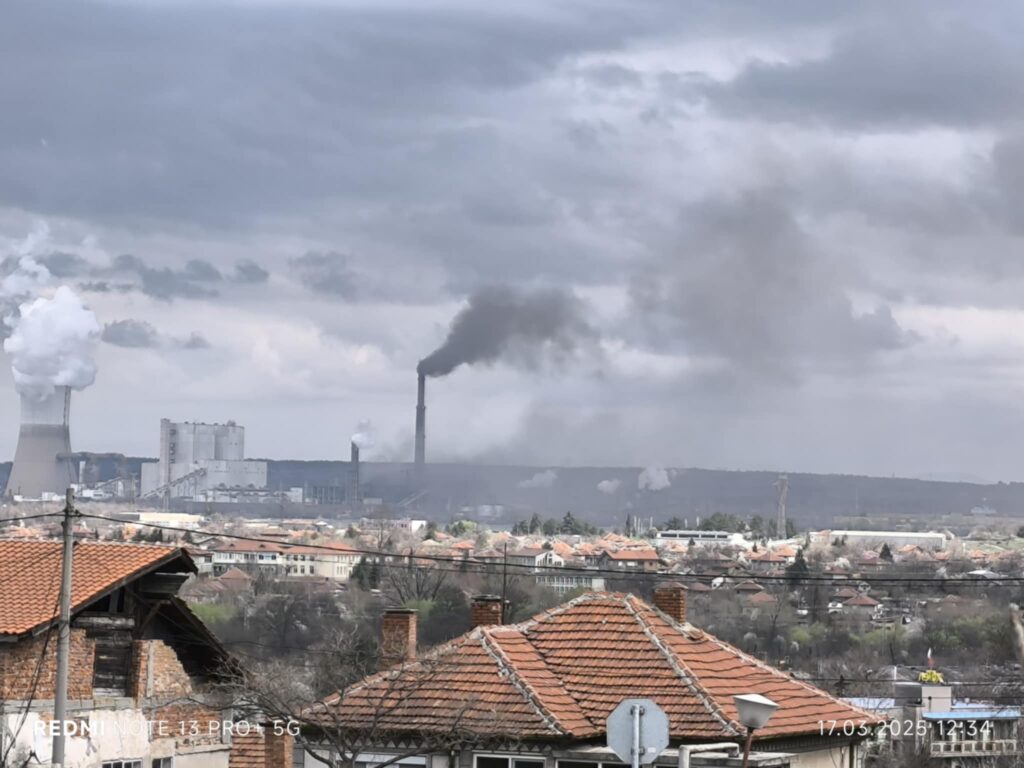
Greenpeace Bulgaria recently published a new report analyzing the activities of the three coal-fired power plants belonging to oligarch Hristo Kovachki — TPP “Brikel,” TPP “Bobov Dol,” and TPP “Repubika.” The data covers a six-year period from 2018 to 2023 and was provided to the NGO under the Law on Access to Public Information by the Ministry of Environment and Water (MOEW) and its regional offices in Stara Zagora and Sofia, which oversee environmental compliance at these major fuel-burning facilities.
During this time, the operators of these power plants were fined a total of 198 times, of which 108 fines were overturned, and 44 fines were reduced through court decisions.
The difference is stark between the fines imposed and the actual payments made by the three coal-fired power plants. Over six years, these penalties amount to over 6.7 million BGN, but less than 2 million BGN have been collected by the state treasury.
as stated in Greenpeace Bulgaria’s report.
TPP “Brikel,” whose operations pose a constant high risk to the health of residents in the Eastern Maritsa basin, especially those in the town of Galabovo, has paid only 6,500 BGN of the fines imposed on it, which amount to over 1 million BGN for the period in question.
Bulgaria’s oldest coal-fired power plant was supposed to be shut down back in the 1990s due to its inability to meet key operational and environmental standards. However, this decision was repeatedly postponed over the years and remained unimplemented under every government after 2000.
Not only does TPP “Brikel” continue to operate, but it has also received funds from the state for the so-called “cold reserve” of Bulgaria’s energy system, along with TPP “Varna,” which was previously owned by the honorary leader of DPS, Ahmed Dogan.
In 2022, during the tenure of the Minister of Environment and Water, Borislav Sandov, the director of the RIOSV in Stara Zagora, Diyana Iskreva, issued an order for the forced shutdown of “Brikel” due to environmental and health risks. However, the Administrative Court canceled the preliminary enforcement of the order, and the Supreme Administrative Court confirmed the decision of the first-instance court in Stara Zagora. As a result, the power plant continued to operate while the case regarding the ban was ongoing.
Two years later, on January 13 of this year, Judge Irena Yankova of the Stara Zagora Administrative Court annulled the order issued by the director of the environmental inspectorate, ruling it was unlawful.
The RIOSV in Stara Zagora has filed an cassation complaint with the Supreme Administrative Court (SAC), but the court has not yet scheduled a hearing date.
The case in Stara Zagora has been delayed for nearly two years due to the preparation of an expert report with absurd tasks that are completely unrelated to the subject matter of the case—namely, the imposition of a forced administrative measure (FAM) to close the power plant on seven grounds related to the company’s operations, as legal experts told “Za Istinata.” Among the thirty questions the expert report was supposed to answer, we will highlight just one:
What is the contribution of TPP “Brikel” to the overall air pollution caused by the operation of large fuel-fired installations in the area?
Of course, a precise answer to this question cannot be provided, since the automatic station of the Executive Agency “Environment” — placed far from Kovachki’s power plant — measures the harmful emissions emitted both from the power plant itself and from the AES plant, which are located in close proximity.
The operator of TPP “Brikel” denies the release of unorganized emissions, but everyone in Galabovo has seen black smoke, soot, and ash coming not only from the chimneys but often also from the windows and even the roof of the plant. The law does not specify what should be done in such cases, because legislation does not allow for unorganized emissions at all.
However, these emissions are present in the environment, and the lack of sanctions flagrantly violates the principle “the polluter pays,” legal experts told “Za Istinata” (For the truth). Thus, it practically turns out that in Bulgaria, anyone protected by the authorities can pollute, avoid fines, and make high profits.
Despite a 2022 ruling by the European Court confirming that due to sulfur dioxide pollution, people in Galabovo and the entire southeastern region of Bulgaria have been living for years in environment hazardous to their health, the Administrative Court in Stara Zagora stated that merely observing violations of the complex permit (CP) by the operator does not constitute immediate danger of pollution or threat to public health or environment components, including atmospheric air.
In 2017, the Executive Agency of Environment issued a new permit for “Brikel,” neglecting new, stricter regulations, despite the fact that the operational conditions of the worn-out plant do not even meet previous standards.
The only existing desulfurization unit does not comply with SO2 removal norms; the second unit, which was supposed to be built and tested by now, has not been implemented yet. The operator has not fulfilled one of the key conditions of its complex permit.
It’s a separate issue how many times a year the plant has operated without a desulfurization unit due to emergency shutdowns or energy saving, and whether it exceeds the permitted 120 hours of operation without SO2 cleaning.
Moreover, instead of the 20% biomass as allowed, “Brikel” declares it burns up to 50%, which in practice invalidates the permit and is a law violation. The emission limit for SO2 at 20% biomass is 270 mg/m³, and at 50%, it should be even lower. But according to the plant’s report, it emitted 327 mg/m³ SO2 — above the permitted 320 mg/m³.
Isn’t that complete absurd?
Yet, it might not be absurd if it can be proved that Kovachki’s plant does not burn biomass at all, but only declares so due to the subsidies the government provides to biomass electricity producers. The amount is calculated as the difference between the market prices of electricity and the preferential prices at which NEK purchases that electricity.
According to “Za Zemyata,” hundreds of millions of euros of public funds will go to energy oligarchs in the name of a “green future,” while the actual effect will be increased carbon emissions and toxic pollutants, contributing to high mortality rates among Bulgarians.
This topic requires special investigation, which sources within the State Security Agency (DANS) allegedly possess, according to “Za Istinata” (For the truth).
Decades in Bulgaria have passed with no political will to shut down harmful coal plants like “Brikel,” where owners exploit rather than invest, operating “to the limit.”
Acts of administrative violations and fines are dismissed in the Gŭlŭbovo District Court; RIOSV does not appeal to higher instances, and citizens continue to report pollution and air quality issues in the increasingly deserted town.
In 2022, the Stara Zagora administrative court temporarily halted the enforcement of the order to shut down “Brikel.”
In 2022, Dyana Iskreva, then-director of RIOSV Stara Zagora, contacted associate professor Stelyan Dimitrov of Sofia University’s Faculty of Geology and Geography, head of the Department of Geospatial Systems and Technologies, asking his team to conduct remote air monitoring over “Brikel” with a drone. The data from the analysis was summarized in a report by the director herself, which she voluntarily sent to the Ministry of Environment and Water (MOEW) and all regional inspectors nationwide. Unfortunately, she was unable to present these findings before the court because she was dismissed from her position prior to the court’s substantive review of the case against her order to forcibly shut down “Brikel.”
Diyana Iskreva’s independent initiative after Borislav Sandov was replaced as Minister of Environment and Water was met with sharp opposition within the ministry, with the argument that unconventional methods for detecting pollution cannot be used across the country.
“Za Istinata” (For the truth) approached Associate Professor Dr. Stelyan Dimitrov to comment on how this monitoring was conducted and whether the reported data can be considered reliable. He explained that his team used a calibrated, certified system to measure levels of fine dust particles, ozone, and nitrogen dioxide in the vicinity of the plant.
The presence of high NO₂ levels confirms that these emissions originate from combustion processes, not from other activities.
Using the same system, and through an agreement between Sofia University and the Sofia Municipality, a one-year monitoring of fine particulate matter in Sofia’s air was carried out—four times a month. According to Associate Professor Dimitrov, serious and repeated exceedances of the permissible limits for harmful substances were recorded over “Brikel” thermal power plant in Galabovo. He emphasized that the fact some refuse to acknowledge these results is irrelevant.
Because this is not just about methodological instrument testing but about a monitoring system. Ignoring the data collected by this system is an attempt to conceal the truth about what is happening there. These findings reveal a serious problem affecting the local population. Some people may not realize it; others probably choose to ignore it. But the state is obliged to intervene because this amounts to a crime, the scientist from Sofia University commented.
When asked whether they would conduct the same measurement again if approached by citizens of Galabovo or another city with unreported air pollution concealed from MOEW or local authorities, Associate Professor Dr. Dimitrov replied that, without sanctions and police presence on site with the team, such monitoring would not be possible.
He added that during their fieldwork in Galabovo, they encountered “some quite beefy people,” likely from the plant’s security, and without cooperation from DANS, the monitoring probably couldn’t be successfully carried out.
“But I don’t believe we will get that kind of protection… when they bury their heads in the sand, it’s a sign that something is wrong.”
“Za Istinata” (For the truth) plans to comment again after the Supreme Administrative Court (SAC) delivers its decision on the case for the forced closure of “Brikel.”






