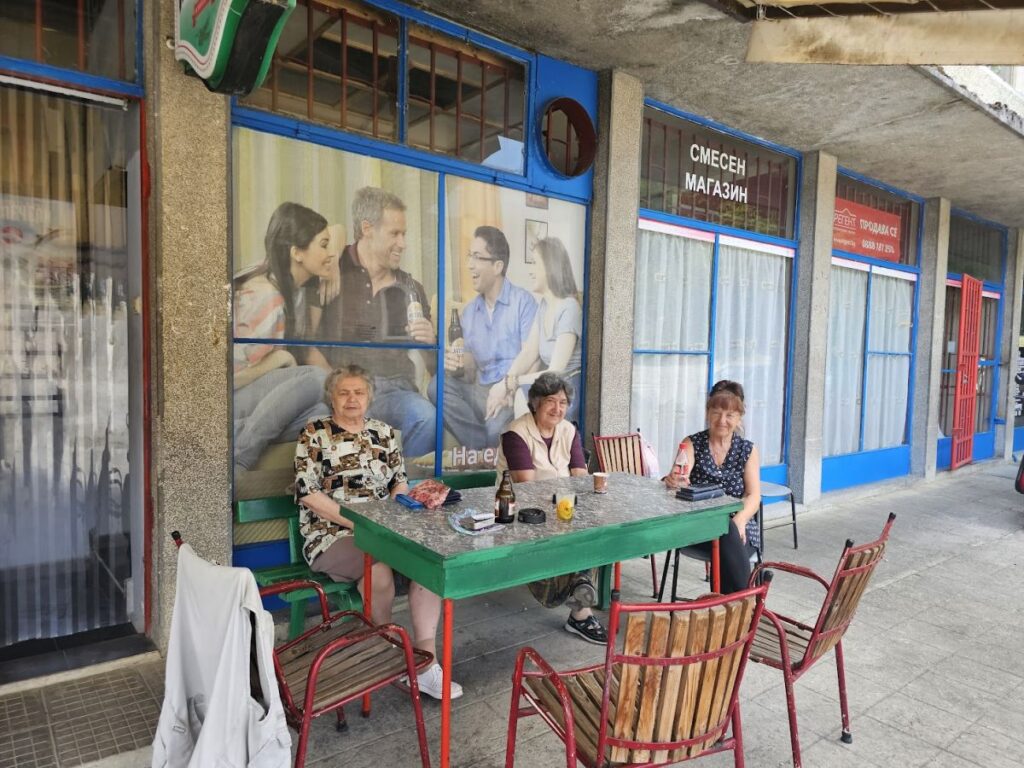
Photo: “For the Truth”
“Now if there’s a fire, how do I call the fire department?” asks a resident of the Dryanovo village of Yantra, who in the late August morning finishes his beer in front of the only place where he can gather for a chat with fellow villagers – the village store, which also plays the role of the local establishment.
“Let’s not talk about a doctor, God forbid he should get involved,” adds the woman next to him. And through her, another adds:
“We connect once in a blue moon“
Despite the dissatisfaction with the poor coverage of mobile operators, the village has not organized a petition or a collective complaint. When a reporter from “For the Truth” mentions that they have done it elsewhere and it has had results, they shake their heads in disbelief. People do not believe that anyone would be interested in their communication problem.
The lack of coverage of mobile operators in remote villages and hard-to-reach areas is not an isolated case. At the end of last year, the deputy mayor of the village of Mlechevo, in the Sevlievo region, reported a similar problem to the republic’s ombudsman, who in turn sought an answer from the three mobile operators.
The terrain is an obstacle, optimization is not planned
The response to one says that the company does not plan to optimize its network, but the complaint will be taken into account in future planning and analysis. The second response says that the rugged terrain prevents quality coverage and that due to the terrain on which the village is located, “optimization of the existing network is not possible.” In plain language, this means that residents of the village either have to change their mobile operator or forget that they have mobile phones.
The response from the third operator is no different, which undertakes to examine the possibilities for improving the network, but does not specify the timeframe.
Criterion “population”, not “territory”
Mobile operators are obliged to provide a certain percentage of network coverage based on the criterion “population”, not on the criterion “territory”, the Office of the Ombudsman of the Republic states in conclusion. The response was signed by the Ombudsman’s Secretary Aysun Avdzhiev, according to whom “the service is mobile, not fixed, and in this regard it is not tied to a specific location and address, but provides the opportunity to use it in different places”. In this case, “the quality of the signal depends on the concentration of people using the services at the same time, as well as on atmospheric conditions, relief and the presence of physical barriers”, and “signal interference can also be due to nearby emissions from security systems, cameras and communication equipment”.
Faster Internet According to the Project, but No Deadline
A project that was signed last month by the three mobile operators and the Minister of Transport and Communications, Grozdan Karadjov, envisages more than a hundred times faster internet in remote areas. The implementation of the project in question “will be in the shortest possible time,” the Ministry of Transport and Communications stated in a press release, but they, like the mobile operators, did not specify the time parameter of the concept of “the shortest possible time.”
About 60 people live in the village of Yantra, Dryanovo Municipality. Almost half of its residents are foreigners. Houses in the village have been bought by Englishmen, Germans, Poles, a Ukrainian woman, an Arab woman from Syria, an Israeli woman and even a Filipina.