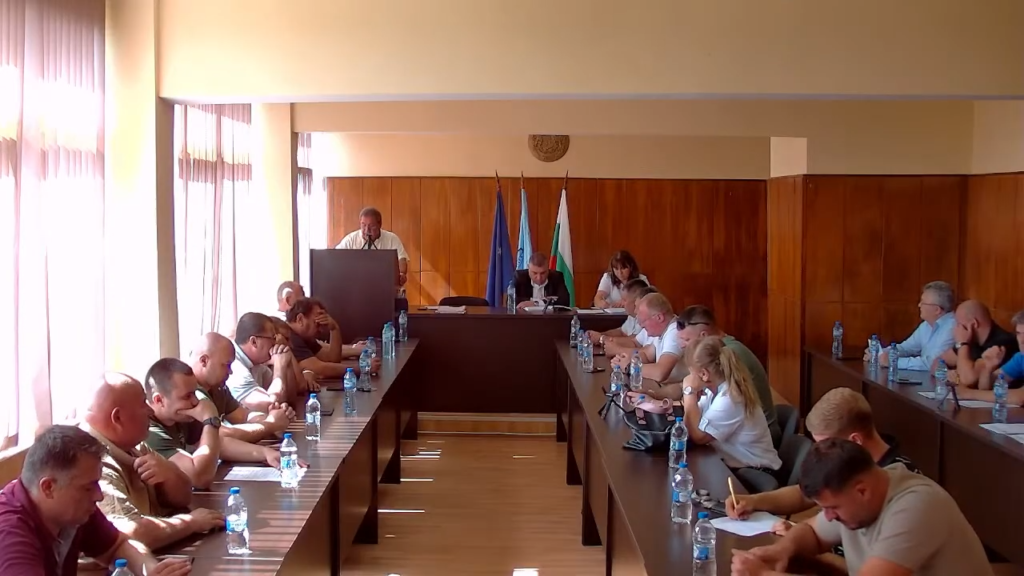
How can a code of ethics, created with good intentions, turn into a “club” against its own creators? An example is the new Code of Ethics for municipal councilors in Kaolinovo, adopted without objection at a session in August this year.
The document, which is supposed to regulate transparency and ethics in the work of the local parliament, was created in connection with the latest amendments to the Local Self-Government and Local Administration Act (ZMSMA). The new version of the LLAMA requires local authorities to adopt a Code of Ethics for municipal councilors and to set up a permanent ethics committee to ensure its implementation.
According to the legislator, the new requirements are being introduced to meet “growing expectations on the part of citizens for greater transparency and accountability in the work of local authorities, as well as in the context of European standards for ethics in the public sector.” A good idea, but it is not for nothing that they say the road to hell is paved with good intentions.
When good intentions become a weapon
According to Article 36, paragraph 2 of the Local Self-Government and Local Administration Act, municipal councilors are now required to carry out their activities in compliance with the rules of the code of ethics – this means that violations can have legal consequences. In other words, sanctions may be imposed for violations of the Code of Ethics in accordance with the procedure and conditions set out in the code itself. According to the will of the local parliament, or more precisely the majority in it, sanctions can be either fines or removal from meetings, i.e. councillors can be deprived of their right to participate in the work of the local authority and to take decisions.
Thus, provisions in the code of ethics can effectively override the voters’ choice and create a convenient majority in municipal councils for making decisions that suit those in power.
A careful reading of the document published on the municipality’s website shows that the code of ethics adopted in Kaolinovo contains at least two provisions that restrict the rights of elected municipal councilors and violate the Local Self-Government and Local Administration Act.
One provision prohibits councillors from commenting on statements made by their colleagues, and the other prohibits them from questioning the professionalism of their colleagues. Both are included in the chapter of the Code of Ethics that defines the behaviour of councillors in the session hall.
Article 27, paragraph 4 of the Code of Ethics for municipal councilors in Kaolinovo states that
“The municipal councilor shall not comment on, evaluate, or discuss the statements made by municipal councilors who spoke before him, and shall adhere to the issues and topics discussed on the agenda.”
Article 28, paragraph 1 stipulates that
“The municipal councilor does not question the professionalism of his colleagues.”
Both provisions contradict the Local Self-Government and Local Administration Act, as the law stipulates that municipal councilors “have the right to participate in the discussion and decision-making on all matters within the competence of the council” (Article 33, paragraph 3).
The document adopted in Kaolinovo quite openly deprives municipal councilors of the right to comment on statements made by other councilors. According to the adopted clause, no one can discuss the opinion of a colleague if, for example, they make a statement in the session hall against Bulgaria’s membership in the EU and NATO – there are very real examples of this from meetings of various municipal councils.
Equally restrictive and illogical is the provision that “the municipal councilor shall not question the professionalism of his or her colleagues.” There are many cases in which councilors make statements on topics in which they are not professionals. But in Kaolinovo, such statements will remain uncommented.
In the same chapter, Article 29 gives the chairperson the right to remove councilors from the meeting until the next vote if the councilor “objects in a rude manner to the penalties imposed on him,” “insults a municipal councilor, the municipal council, or other institutions and citizens,” “calls for violence and discrimination,” or “systematically disrupts order in the chamber.” Nowhere in the document is it specified what is meant by “in a rude manner,” “insult,” or “call for violence,” so the chair is given another tool that he or she can use at their discretion.
For violations of the Code of Ethics, municipal councilors will be punished with a “reprimand” or a 30% reduction in their monthly salary. The decision to impose a penalty is taken by secret ballot by the municipal council, with a majority of more than half of the total number of councilors.
However, none of this has bothered the councillors in Kaolinovo. The local parliament’s code of ethics was adopted unanimously, with 20 votes in favour (out of 21 councillors), no votes against and no abstentions, according to the minutes of the meeting.
A comparison with the Code of Ethics adopted in Burgas shows that in the regional city there are no similar restrictions on the rights of councilors, no prohibitions on comments and doubts about the professionalism of colleagues, and no financial penalties.
No one disputes the restrictions
Since the restrictions in the Code of Ethics in Kaolinovo are in conflict with the Local Self-Government and Local Administration Act, we sought the opinion of the chairman of the local municipal council, Zia Nazif, who submitted the document to the session, and the regional governor of Shumen, Katya Ivanova, who has the power to stop illegal decisions by local authorities.
We asked both institutions whether the regional governor would stop and return the Kaolinovo municipality’s Code of Ethics for review and whether the municipal councilors in Kaolinovo themselves would request a review of the controversial clauses restricting their own rights. This is especially important given that sanctions, including removal from meetings, will be imposed on councilors for violations.
The head of the local parliament, Zia Nazif, did not respond to the questions.
Unlike him, Regional Governor Katya Ivanova responded. Ivanova stated that the Code of Ethics for Councilors in Kaolinovo had not been returned for further discussion, as it had been adopted by a majority vote and in accordance with procedural requirements. “The document may be challenged by entities with a legal interest under the Administrative Procedure Code, in connection with the Local Self-Government and Local Administration Act,” the regional governor said.
Since the “entities with a legal interest” are the municipal councilors themselves who voted for the Code of Ethics, it is more than clear that none of them will challenge the document in court.
“No one can deprive municipal councilors of their powers, and the ban on commenting on statements clearly restricts their rights. On the other hand, the adopted Code of Ethics is an administrative act, and only municipal councilors have the right to appeal acts that directly affect them. So it is solely up to the councillors whether they will challenge the provisions in court,” commented a Shumen lawyer with experience in local government.
The municipality of Kaolinovo is governed by a mayor and municipal council from the party of Delian Peevski, a politician sanctioned for corruption, DPS-New Start. The mayor of Kaolinovo, Nida Ahmedov, has been at the helm of the municipality since 2003, consistently nominated by the DPS (Dogan’s party). After the party split in 2024, he switched to Peevski and was subsequently elected deputy chairman of the political force. Peevski’s party has a full majority in the Kaolinovo municipal council – 17 of the 21 councilors are from the DPS list, subsequently New Start.