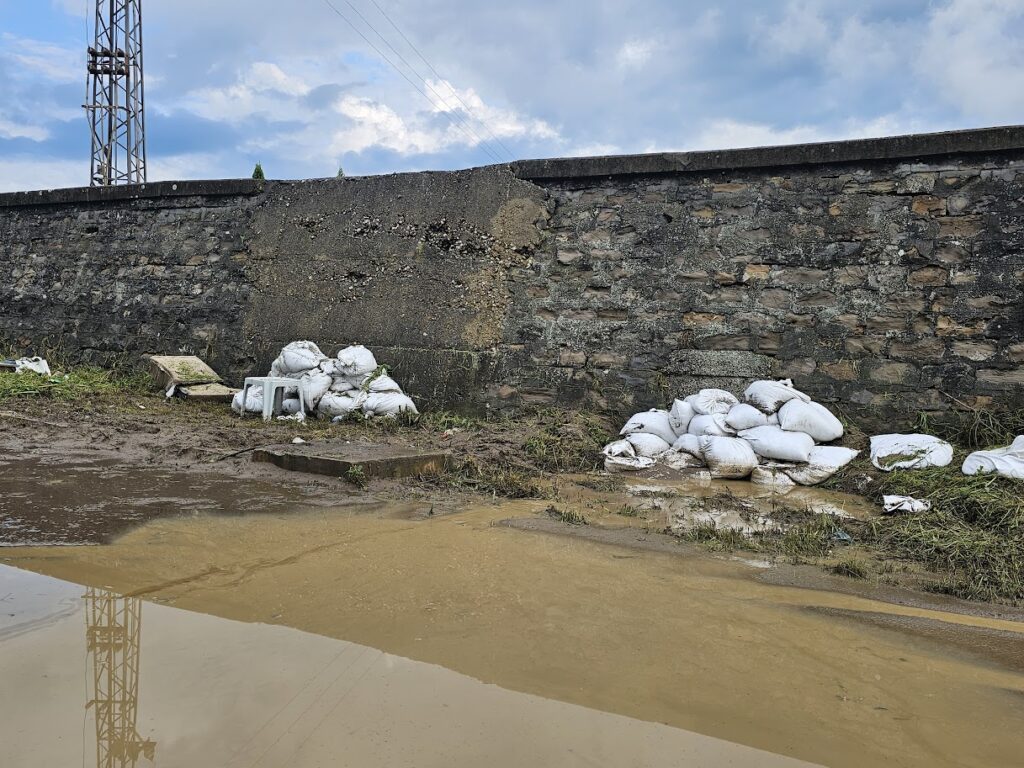
The embankment along the Rositsa River in Sevlievo, which is supposed to stop floodwaters when the river bursts its banks, as it did on 23 May this year, effectively does not exist in legal terms. It is absent from the town’s cadastral map and no one knows who owns it. As a result, the structure is neither reinforced nor maintained. This spring, floodwaters surged through breaches in the embankment, inundating houses and destroying household property worth thousands of leva.
This became clear during a meeting lasting nearly two hours between businesses, residents, local and state authorities and members of parliament. The meeting was convened to establish the causes of and failures surrounding the flooding in Sevlievo and to identify measures to prevent it from happening for a third time. The first major flood occurred in 2005.
That was the stated aim of the organisers – the Sevlievo 21st Century business association and the local Rotary Club.
The biggest problem was that the town was not prepared
As the meeting progressed, it became increasingly clear that the main problem was not the rainfall itself but the fact that the town was not adequately prepared for the emergency.
This was not an emotional conclusion but a series of facts that gradually emerged.
Local protection against floodwaters is inadequate. The Sevlievo embankment, which should be one of the town’s main lines of defence, turned out to be compromised, cracked and unfinished. There has been a project to complete it dating back to 1973, but it was never implemented, Sevlievo Mayor Ivan Ivanov explained.
Breaches in an embankment that turned out to belong to no one
Even more troubling is another fact.
According to Ivanov, the embankment does not exist in legal terms – it is not shown on the town’s cadastral map and has no established owner.
The story sounds absurd, but is genuinely alarming.
The hydraulic structures were state-owned and until 2001 were part of the assets of Hydromelioration, the mayor said. He did not specify whether he was referring to Hydromelioration Sevlievo or to the state economic organisation with the same name, the socialist-era predecessor of today’s state-owned enterprises operating in irrigation.
According to the mayor, after the company was liquidated, its assets were supposed to be transferred to Irrigation Systems, a company wholly owned by the state.
In practice, however, no one currently accepts responsibility for the embankment along the Rositsa River because it has effectively become ownerless.
And when there is no owner, there is no one responsible for maintaining it.
That helps explain the lack of reinforcement, repairs and preventive measures that have rendered the protective infrastructure largely ineffective.
In places, the riverbeds look more like forests
Participants in the meeting also pointed to uncleared riverbeds, extensive accumulations and deformations that are already altering the course of the water and redirected it towards the town on 23 May.
Another worrying detail emerged: obtaining the permits required to clear riverbeds can take months.
MP Tomislav Donchev highlighted this problem, stressing that administrative procedures often move more slowly than the risks themselves.
The result is a paradox: everyone knows what needs to be done, but the system does not allow it to be done in time.
Serious questions about risk management
Business representatives also asked whether, given the yellow weather warning and forecasts of heavy rainfall, the expected inflow into the Alexander Stamboliyski Reservoir had been calculated early enough and why additional reservoir capacity had not been released in advance.
According to the local authorities, the reservoir had not been full, but the incoming water caused it to overflow for around three hours.
That account was challenged.
The owner of a printing company that remained under water for more than 24 hours questioned whether the flood wave that hit the lower parts of Sevlievo could have been influenced by the reservoir overflow. According to him, the dynamics of the water were unusual.
Whether the Alexander Stamboliyski Reservoir contributed to the flooding in Sevlievo remains unanswered. Regional governor Kristina Sidorova said the state is expected to establish the facts after an investigation.
That, however, still does not answer whether the risk-management systems worked as residents would expect.
The delayed warning
The activation of the BG Alert early-warning system and the declaration of a state of emergency were also repeatedly questioned.
According to participants in the debate, the first signal warning of the approaching flood wave was made to the emergency number 112 at 5.45am on 23 May from the village of Batoshevo.
Two more calls followed.
Yet people in the affected area were not warned in time through BG Alert. Some residents received the alert only after the water had already begun to recede, despite the regional administration saying that the warning system had been activated immediately after Sevlievo Municipality requested it.
No specific answer was given as to exactly when and how the population had been notified, so that residents could receive timely information and save at least part of their belongings.
Mokra Byala Reservoir emerges once again
The proposed Mokra Byala Reservoir has been discussed in Sevlievo for decades.
That is perhaps the most accurate description: it has been discussed for decades.
Many believe the reservoir could provide a long-term solution for managing water from the Central Balkan range. Few dispute the need for such hydraulic infrastructure, despite the realistic assessment that it would be expensive.
There was a call for the four MPs from Gabrovo region attending the meeting to lobby for the reservoir to be included in the next state budget.
But there was also the realistic observation that the 2026 budget may in practice remain in force for only a few months.
Regional governor Sidorova reminded those present: “We all know what the financial situation of the state is.”
Between knowing and acting, however, lie unresolved ownership, delayed procedures, inadequate funding and institutions that respond only after disaster strikes.
Water does not wait for procedures.
On 23 May 2026, Sevlievo was not defeated simply by nature, but by decisions postponed for years.