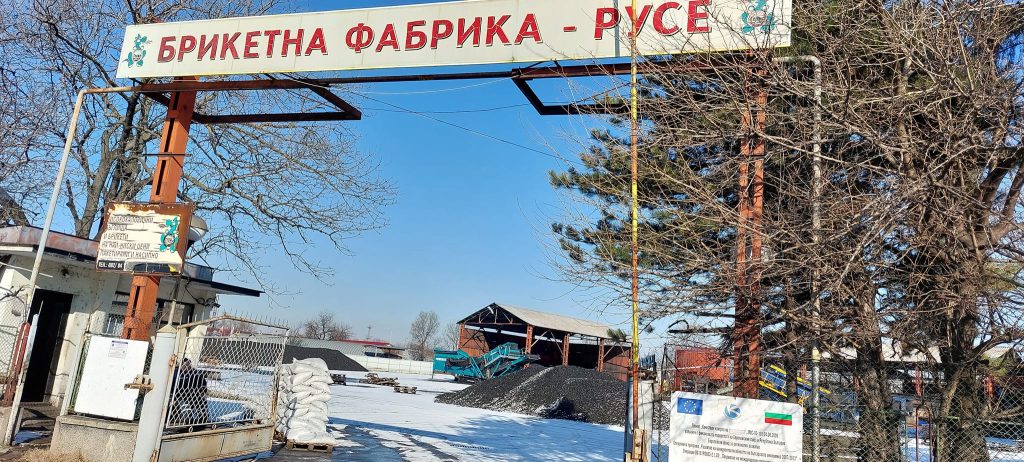
For 20 years, the so-called “Briquette Factory” has been operating in Ruse, known simply as “Briquette” among the residents. It has sparked discontent among those living in the area, who complain about pollution from coal dust. The owners of the factory deny that there is a problem. Their claims are backed by the position of the Regional Inspectorate of Environment and Waters in Ruse (RIOEW) regarding the reports.
Two years ago, Svetlozar Stanchev created the Facebook group “No Coal Dust in Ruse,” which would later become a point of contention between citizens, businessmen, and institutions. For months, he published information about violations and refuted false claims made by local authorities. One of these claims is that the factory is located in an “industrial zone.”
The acknowledgment that there is a problem is not solely Stanchev’s assertion; his business, situated in close proximity to the factory, suffers losses due to the pollution.
“I can’t either hang laundry properly or cook normally because my dishes are always covered in this coal dust.”
“When unloading the gondola, a huge cloud of dust rises, but not just any ordinary dust from outside – a heavy smell of soot.”
“Every time I visited the doctor, she would ask me why my child constantly has soot in their nose and mouth.”
These are quotes from stories of people whose homes are located near the factory. Due to their health condition, some of them are subsequently forced to move elsewhere. At the end of last year, the affected residents attempted to draw the attention of the authorities by organizing a petition. A total of 207 people participated, but no solution to the pollution problem was found, as the responsible authorities claimed there was no issue with the factory.
The factory is not exactly a factory.
Pollution in the area of the “Briquette Factory” occurs during the production of briquettes and their sorting into three fractions based on size. This process leads to the formation of coal dust that spreads to neighboring residential buildings, a bakery, a train station, a bus station, a shopping mall… The factory has been operating since 2003, but it produced briquettes only until 2016, as the owner told “For the Truth.”
After 2016, production was relocated to another leased site in the area of Ruse – East port, while the main site of the enterprise is used solely for packaging and unloading briquettes. This move was prompted by complaints from residents about frequent pollution from coal dust. The owners of the enterprise claim that there should not be an air quality issue following 2016.
“The assertion that briquettes are still being produced and sorted after 2016 is not true,” writes Lyubomir Stoyanov, owner of the “Briquette Factory,” in response to an inquiry from “For the Truth.” However, Svetlozar Stanchev does not believe that production activities on the main site of the factory have ceased. “There is a machine and all the equipment for briquette production on the site. They boast on their website about how good their briquettes are. The portal states ‘Briquette Factory,’ but they want to convince us that they are not producing,” recounts the administrator of the Facebook page “No Coal Dust in Ruse.”
There, he publishes several photos and videos showing operational machines, smoke, and coal dust spreading to neighboring buildings and streets in the area even after 2016. According to the owner of the enterprise, the footage is “manipulated.”
In an effort to limit pollution, “Termi and Co” developed a plan-program, approved by the Regional Inspectorate of Environment and Waters (RIOEW), which stipulated that by August 1, 2021, the storage of the finest fraction of briquettes (0-6 mm) should be completely relocated to the port area.
The position of the briquette factory owner, Lyubomir Stoyanov, is that the information published by Stanchev regarding potential violations is “false, misleading, and defamatory.”
This is confirmed by all the checks conducted so far by the competent authorities, including measurements of particulate matter in the atmospheric air. For unclear reasons, this individual is designated as an eco-activist, without the necessary qualifications and educational background, allowing himself to classify coal as toxic, dangerous, and harmful, which is complete nonsense,” he writes to the editorial office of “For the Truth.”
The authorities have not identified any violations.
The checks by the Regional Inspectorate of Environment and Waters (RIOEW) to date have not found any violations by the company “Termi and Co,” which owns the briquette factory in Ruse. This was also confirmed by the acting Minister of Environment and Waters, Rositsa Karamfilova, in response to a parliamentary question in the 48th National Assembly.
She claims that in the past five years, seven emergency inspections have been conducted at the work site. In all cases, no air pollution or dust dispersion outside the work area was noted.
However, documents from RIOEW Ruse, which “For the Truth” possesses, reveal that there were indeed violations, but the owners of the “Briquette Factory” have not been fined. This refers to an inspection conducted on December 13 of last year, during which “fine fraction briquettes (0-6 mm), intended for direct distribution,” were found on the main site of the factory.
This is in contradiction to the company’s plan-program, which obligates it to store this type of briquettes solely at its second site outside the urban area of Ruse, starting from August 1, 2021. Experts from RIOEW noted the presence of fine fraction (0-6 mm), recorded it in their inspection report, but did not issue a citation, highlights eco-activist Svetlozar Stanchev.
The RIOEW report further reveals that the manager of the company informed the inspectors that “after exhausting the currently available remaining quantities of fine fraction, no such fraction will be stored at the site address.” Upon a follow-up visit two days later, RIOEW found that the problematic fraction had already been sold.
The problem with this so-called “fine fraction” is that even with a light breeze, it generates clouds of coal dust that envelop the area and cause pollution. At the same time, the impact of coal dust on people’s health is alarming, as regular exposure can lead to severe injuries. This was stated in response to a parliamentary question by Acting Minister of Health Dr. Asen Medzhidiev regarding the issues surrounding the Ruse briquette factory.
According to the Ministry of Health, “the coal dust that miners and other workers who are in contact with it inhale for years accumulates in the lungs and gradually leads to irreversible changes.”
They further note that once deposited in the bronchial mucosa and distal areas of the lungs, these particles “cannot be eliminated or destroyed. (…) In cases of established disease, especially complicated pneumoconiosis with diffuse fibrosis and chronic respiratory failure, there is no pathogenetic treatment.”
Defamation Case on Facebook
At the beginning of January this year, the owner of the “Briquette Factory,” Lyubomir Stoyanov, and his wife filed a defamation lawsuit against Svetlozar Stanchev, the administrator of the “No Coal Dust in Ruse” group. The claim is based on five posts by Stanchev, which the plaintiffs argue are “false and defamatory.” As a result of the publications, “their prestige, good name, and professional ethics have been damaged to the maximum extent,” states the complaint.
The first hearing in the case took place on February 27. Witnesses in favor of the owners of the “Briquette Factory” and against the eco-activist included the domestic helper of the Stoyanov family, Tseta Krasteva, RIOEW expert Hristo Mikov, and Ivan Tonchev, who is the manager of production processes at the briquette factory. In court, the domestic helper recounted a phone conversation between Stanchev and Stoyanova, which the plaintiffs’ daughter overheard, resulting in the child being “very shaken and in tears.”
Krasteva also mentioned that in recent years, the family harmony of the Stoyanovs has been disrupted – “that tranquility is no longer there, and it is felt. I just hear that there are some inspections, and that’s why they’ve been tense lately.”
The documents in the case do not clarify why Hristo Mikov, an employee of the Environmental and Water Inspection, is testifying in a defamation case. It is also unclear how this action aligns with Mikov’s primary role at RIOEW, as described on their official website: “Protection and preservation of air, water, and soil from pollution and damage.”
In court, Hristo Mikov stated: “Every time he (Svetlozar Stanchev – ed.) files a report, we go and conduct an inspection – we do not establish any pollution. If I’m not mistaken, on November 8, during Mr. Stanchev’s latest report, I went with a colleague. We entered the site and saw what was happening – there had been unloading of a truck. During the unloading of the truck, there was likely indeed dust being stirred up, but when we arrived, there was nothing.”
Is the pressure against the Ruse eco-activist a strategic “slap-in-the-face” case?
Alongside the lawsuit filed by the Stoyanov family against Stanchev, the director of the Ruse Regional Inspectorate of Environment and Waters (RIOEW) has also filed a complaint. This time, it is with the Commission for the Protection of Personal Data. The reason is that a post by Svetlozar Stanchev on Facebook, again related to the case of the “Briquette Factory,” shows Christova’s signature.
Stanchev questions why “Ms. Tsonka Christova has not filed a complaint against any of these allegations. She only complains that someone published a document showing her signature.” The accusations that Stanchev refers to are related to the activities of the “Briquette Factory” and his suspicions that it operates with the assistance of institutional protection.
Such actions exhibit the characteristics of so-called “slap lawsuits,” also known as SLAPP cases. According to the Association of European Journalists – Bulgaria, SLAPP, or “strategic lawsuits against public participation,” are filed against journalists and activists with the aim of exerting pressure and harassment, under the seemingly legitimate goal of protecting violated civil rights. This type of lawsuit is used to intimidate and silence critical journalistic publications and investigations, as well as civic engagement.
The owner of the Briquette Factory explains that his goal is “in no way connected with intimidating Svetlozar Stanchev. The purpose of the lawsuit is to refute the lies he has written and discredit all defamatory and slanderous statements from his side that tarnish my and my family’s reputation.”
The second hearing in the case of the owners of the “Briquette Factory” against eco-activist Svetlozar Stanchev is scheduled for today (April 5 at 10 AM) at the District Court in Ruse.
Questions on the matter were sent last week to the Regional Health Inspection in Ruse, to Hristo Mikov, and to Tsonka Christova. No responses were received by the editorial deadline for this text.
*Erwin Rudolf Josef Alexander Schrödinger was an Austrian theoretical physicist, one of the creators of quantum mechanics, who significantly contributed to its development.
Schrödinger proposed that a cat, enclosed in a box with a switch activated by a random quantum event – such as radioactive decay – could be both alive and dead at the same time, as long as we do not open the box to check.