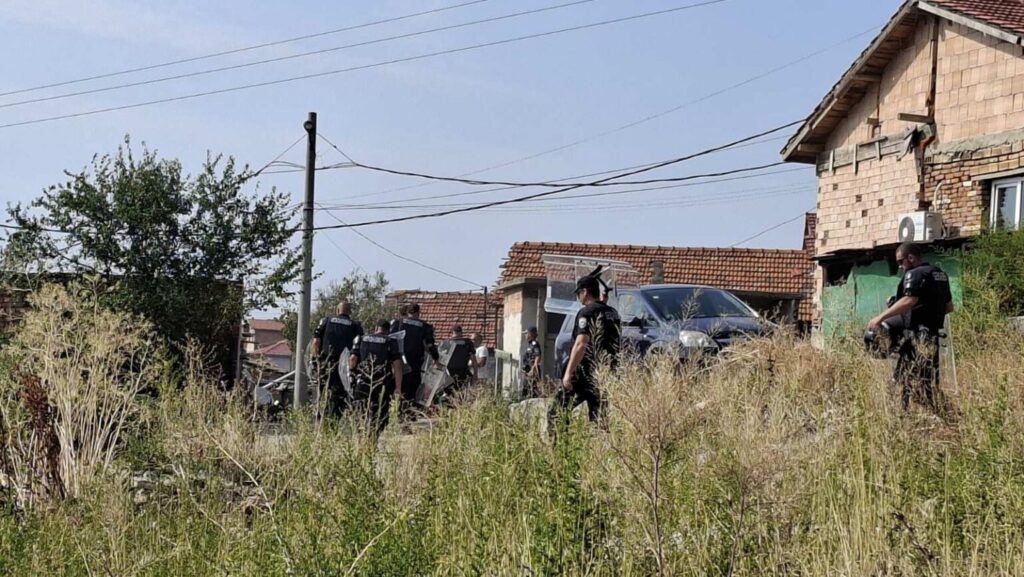
In the third year of his fourth term as mayor of Stara Zagora, Zhivko Todorov, a former member of GERB’s Executive Commission, demolished the last 20 illegal houses in the city’s Roma neighbourhood of Lozenets. None of them, he said, could qualify for “tolerated status” — a legal regime for illegal structures built before March 31, 2001, without construction permits, which are nevertheless protected from demolition — because they stood on land belonging to the State Forest Fund and formed part of the former Borova Gora park.
For years, however, the authorities in Stara Zagora have failed to find the courage to demolish an illegally erected fence around the residence of businesswoman Irina Dineva in the middle of Ayazmoto Park, as well as other buildings there that Mayor Todorov promised to remove several years ago. Because, after all, the law is supposedly the same for everyone.
It turned out that for one of GERB’s most emblematic mayors in Bulgaria, the most important thing was to fulfil his administration’s programme of removing 550 illegal structures before the end of his fourth term. In Todorov’s public presentation of the issue, the phrase he used most often was “illegal structures”, as if these structures mattered more than the people and children who were left homeless.
The operation in the neighbourhood resembled scenes from a surreal film, in which half-naked children and their parents appeared “on screen” like silent shadows. As excavators demolished the Roma homes, leaving their gutted walls standing, officials and the media watched and filmed the unfolding drama with cameras and drones.
This time there were no scenes of drama, male curses, women’s cries and children’s tears, as there had been during previous operations, particularly in the Zaycheva Polyana area.
An administrator from Zhivko Todorov’s team quietly told Za Istinata:
“We managed to discipline them!”
I do not know whether such operations can discipline people who have always lived outside or on the margins of the law — marginalised, stigmatised and rejected, even through the language used by the authorities to describe them in ways that dehumanise them.
But they have certainly succeeded in frightening them.
The script for these operations has been the same for 15 years
The local authorities follow the Spatial Development Act and its mandatory provisions. Formally, they comply with the law by removing illegal houses in stages.
The operations boost the mayor’s popularity among sections of society with strongly negative attitudes towards Roma people, including nationalists, radicals and football fan groups.
This is probably why Todorov appears so self-confident, at least outwardly, when explaining that he postponed the latest operation in the neighbourhood to make sure the municipality was acting correctly and in full compliance with the law.
The focus of his public presentation of the issue is the illegal construction on land allegedly “occupied” by Roma people, as though he were not talking about human beings but about locusts or termites that had occupied a territory and built a colony there. He also points to resentment among other Roma residents in the neighbourhood against the newcomers who were building illegally, supposedly creating other problems such as prostitution, pimping and drug use — as if such problems did not exist elsewhere in the neighbourhood.
The local authorities’ attitude towards Roma people
We did not hear the mayor say: “Before sending in the excavators, we thought about the people.”
He left that task to Deputy Mayor Pavlina Delcheva, who presented the human tragedy as statistics: social services had identified 18 families with 21 children who would be left without homes. Twelve had submitted standard applications for accommodation, filled in by lawyers. Not all of them met the criteria for vulnerability, while four had already been provided with temporary social or municipal housing.
Delcheva rejected rumours that the local authorities were unwilling to accommodate Roma people in the dormitories currently inhabited mainly by Ukrainian refugees.
But there was not a word about the local authority’s policy towards the Roma community: whether the municipality has a support centre for vulnerable people and families in the neighbourhood, how it works with them, why several generations of Roma have emerged with diplomas for completing primary or lower-secondary education while remaining illiterate.
Nor was there an explanation of why the neighbourhood — parts of which have become fully fledged ghettos, such as Zaycheva Polyana — still has no sewage system. Every time heavy rain falls, wastewater from Lozenets, built on a hill above the city, floods the streets of Stara Zagora.
Mayor Todorov acknowledged that the state had taken “overdue action” towards Roma people and that the Spatial Development Act could have been more flexible in addressing the Roma housing problem.
But the main problem he identified, in response to a question from Za Istinata, was that
Roma people had been used and manipulated over the years by different political parties and politicians.
Todorov said he knew the names of those who had once lobbied the state’s electricity and water utilities to connect illegal houses to the electricity and water networks, but said he would refrain from naming them for the time being. He did not explain why.
The non-governmental sector in this maze of problems facing the minority
During the years of the Decade of Roma Inclusion, Bulgaria received more than BGN 600 million from European funds, mainly through PHARE and the Operational Programmes “Human Resources Development” and “Regional Development”, to finance Roma integration projects. Numerous Roma foundations, as well as organisations working on behalf of the community, took part as beneficiaries.
The result was that Roma people came to hate the word “integration”, while the vast majority remained excluded from the process — a process that produced no visible results but was heavily promoted in public discourse. Meanwhile, some foundations and associations successfully benefited from the distribution of European solidarity funds.
In Stara Zagora, Mission Wings Foundation works actively on the ground in the Roma neighbourhood, where it runs its own centre.
Now, as during previous operations to demolish illegal Roma homes, the foundation issued a statement. It did not condemn the local authorities’ lawful actions, but raised the issue of violated human rights and advocated for every individual case, particularly those involving people from the most vulnerable marginalised groups.
It called for Roma problems to be addressed through dialogue involving state and local authorities and the community itself, with the mediation of human rights organisations and NGOs.
The account given by Gancho Iliev, director of the non-profit organisation World Without Borders, whose main work focuses on the Roma community, sounds very different.
“Do not expect a statement from us opposing the removal of the illegal Roma houses, because we know what kind of social time bomb they are — HIV, drugs, prostitution, nobody knows who actually lives in them, many people have no education, and some also own other properties…”
Gancho Iliev insists that it is high time Roma people understood that, alongside rights, they also have obligations.
However, some of his expressions, such as “they steal from the benefits enjoyed by everyone”, directly echo the language of hate. His claims that a large proportion of Roma people cannot live in municipal or social housing because they do not maintain it, lack established habits and have no culture of communicating with other residents, leading to constant conflicts,
reveal the indirect attitude of the Roma organisation towards its own ethnic community — a community stigmatised and marginalised by the lack of adequate policies from state and local authorities and society during both the previous regime and the years of transition.
Don Bosco Bulgaria Foundation, founded in 2009 by the Salesians of Don Bosco, a Catholic religious order operating in Bulgaria, is among the most active NGOs in Stara Zagora focusing on the problems of Roma people in Lozenets, particularly their children.
Over 12 years, a church dedicated to Our Lady Help of Christians was built on the outskirts of the neighbourhood, with dedicated rooms for activities with Roma children.
Martina Staneva, a group therapist at the foundation, told Za Istinata that they did not have the capacity to put pressure on the authorities, even through public statements on issues such as the demolition of Roma houses.
Instead, they are committed to changing the children’s worldview, helping them overcome the fears and prejudices associated with their community, increasing their motivation and positive attitude towards school, and developing their individual potential and talents.
When working with Roma families, Staneva repeatedly encountered the same problem: fear that social services would take their children away.
She also says that Roma people find it very difficult to adapt to rules.
But there is no other way.
Several Protestant communities belonging to the United Evangelical Churches also carry out social work to support Roma people in the Stara Zagora neighbourhood. There is, however, no representative of the Orthodox Church and no Orthodox church there.
And in a telephone conversation, Stara Zagora Metropolitan Kiprian told Za Istinata that he was hearing about the demolition operation for the first time from the publication — both the latest operation and the previous ones.
It is a strange answer, particularly since the official website of the Stara Zagora Diocese carries a statement by the metropolitan concerning plans to build a crematorium in Harmanli, yet not a word about this pressing issue, which has occupied the authorities, the public and the media for an entire month.
The demolition operations targeting Roma houses in Stara Zagora have now ended — at least those planned by Mayor Zhivko Todorov during his terms in office.
It is time for the local and national authorities to turn their attention to the problems facing this ethnic community and begin addressing them.
It will be a long and difficult process. Countries around the world have faced — and continue to face — the challenge of integrating minorities whose culture, traditions and degree of social inclusion differ from those of the majority.
But without such a process, we risk sinking into a swamp of misunderstanding, division and hatred.