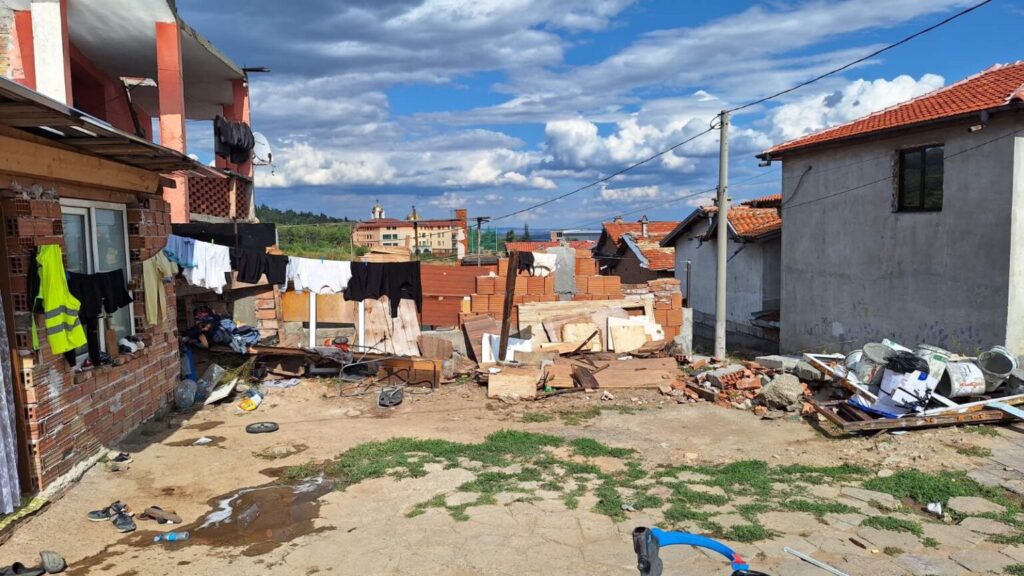
On Monday, 27 July, Stara Zagora was due to carry out the forced demolition of illegal Roma houses in the Lozenets neighbourhood – the last such homes in the area, according to Mayor Zhivko Todorov.
The houses were built outside the regulated urban boundaries, without development plans, and are located in Borova Gora Park and on state forestry land, where construction is prohibited. For that reason, the properties cannot be legalised.
Todorov told “Za Istinata” that there were no longer any obstacles to carrying out the operation, which had originally been postponed from August last year, because the municipality had won all the relevant court cases.
But the planned demolition of around 40 houses does not solve the problem; it creates a new one, because dozens of families with children will be left homeless.
The majority of the houses in the neighbourhood are illegal, although some stand within regulated areas.
According to Roma Policy Lab, one of Bulgaria’s largest Roma neighbourhoods is home to around 30,000 people, based on unofficial estimates. An expert assessment by the EU Agency for Fundamental Rights (FRA) from a decade ago put the population at around 21,000, of whom 14,500 identified themselves as Roma and the rest as Turks.
The first announcement was that the demolition operation would take place on Wednesday, 22 July. It was then postponed to 27 July. Following reactions from organisations including Amnesty International, the Bulgarian Helsinki Committee, Mission Wings Foundation and the Ministry of Regional Development and Public Works, however, the demolition was postponed indefinitely.
The most likely reason is that the mayor, who does not like “noise in the system” amplified by the media and NGOs, will wait for the attention to die down and then carry out the operation.
In the meantime, some of the families facing forced eviction are removing materials from their homes that can be salvaged.
A “Za Istinata” inspection found that some residents had already removed roof tiles and PVC window and door frames.
But they are living under constant stress because they have not been told when the demolition will take place, nor have they been offered alternative accommodation by the municipality.
The bulldozers first entered Lozenets during Todorov’s first term
In August 2013 and July 2014, the demolition of homes built in Borova Gora Park began.
In 2014, the situation escalated into the first clashes between residents and police forces. Elderly women cursed and children screamed as bulldozers and gendarmerie units approached.
The most recent, fourth operation in the neighbourhood took place in August last year.
A total of 101 houses were demolished, another 14 were removed voluntarily by their owners, while more than 30 of the mayor’s demolition orders were challenged before the Administrative Court.
Different sources give different figures for the number of illegal Roma homes demolished in Lozenets during Zhivko Todorov’s 14 years in office – between 300 and 550.
According to municipal secretary Nikolay Dikov, the number is more than 400 so far.
The most disproportionate deployment of uniformed officers took place during the operation in the Zaicheva Polyana area, when a wall of helmets, shields and batons confronted Roma residents watching the roofs and walls of their homes collapse.
The impression of such disproportion may be subjective, but the sight was shocking.
It was not the only such episode.
For a long time, photographs of gutted sofas and mattresses on which Roma families and their children slept under the open sky circulated on social media.
Human rights organisations react
The Bulgarian Helsinki Committee, Amnesty International and Mission Wings Foundation issued statements, while from the floor of parliament, MP Marin Tikhomirov of Continue the Change, who is of Roma origin, read a declaration following his visit to Lozenets and conversations with families at risk of eviction.
Esther Major, Deputy Director of Research at Amnesty International’s regional office for Europe, sent an official letter to Mayor Zhivko Todorov requesting urgent information about the planned eviction of Roma families, possible alternatives for their accommodation and whether the municipality had carried out a detailed census and impact assessment to determine how many people would be affected, including their ethnicity, gender, age, disability and other protected characteristics.
The Bulgarian Helsinki Committee expressed concern that dozens of Roma, particularly the most vulnerable – young children, pregnant women and elderly people – could be left on the street if the municipality violates international law.
“Experience with similar actions in Bulgaria, particularly when they target Roma, shows that they are governed by legislation that has not been reformed despite condemnatory judgments against Bulgaria by the European Court of Human Rights.”
Mission Wings Foundation, which has worked on the ground in Lozenets for more than five years through a mobile prevention centre and has supported dozens of women and children at risk, called on the local authorities to provide urgent assistance and temporary shelter and care for affected children and elderly people.
The foundation also called for a genuine, long-term housing policy for vulnerable families and effective participation by the Roma community in designing and implementing policies that directly affect them.
“Demolishing illegal structures will not eliminate poverty, nor will it solve the social problems of the Roma community. Social policies cannot and should not be implemented with a bulldozer.”
MP Marin Tikhomirov of Continue the Change also called from the parliamentary rostrum for the state to find a solution to the problems in Lozenets by combining the rule of law with the protection of human dignity.
“Responsible governance does not mean leaving children without a home and saying that you have done your job.”
The local authorities’ response
Mayor Todorov told “Za Istinata” that he had no concerns about pressure from NGOs and had responded to all organisations that had urged him not to violate Article 8 of the European Convention on Human Rights, which guarantees the right to respect for home and family life, even where a dwelling has been built or occupied unlawfully.
The European Court of Human Rights has held that the concept of “home” under Article 8 is a factual rather than a legal concept and does not depend on whether occupation is lawful under domestic law.
Todorov’s response was that Bulgarian legislation does not comply with the requirements of the European Convention and that if MPs decide to bring it into line, the law will have to be changed.
“There is no other option. If a house without documents collapses tomorrow, the mayor will be blamed.”
The municipality does not plan to accommodate all Roma residents who are left homeless in municipal housing.
Such accommodation would only be available to those who meet the eligibility criteria: they must be socially disadvantaged, must not own another home and, most importantly, must have a permanent registered address in Stara Zagora and valid identity documents.
According to municipal secretary Nikolay Dikov, most of the Roma residents who challenged the demolition orders told the court that they did not want accommodation in the reserve housing fund or municipal housing because they did not want to change their way of life.
He said that during inspections of the homes scheduled for demolition, none of the affected families had submitted applications for accommodation on social grounds.
Diana Dimova, chairwoman of Mission Wings Foundation, told “Za Istinata” that highly vulnerable families with young children were unable to navigate the application process for accommodation on their own and needed comprehensive support from institutions and NGOs.
The voice of those with no voice
A “Za Istinata” visit to Lozenets revealed a picture quite different from the one presented by local authorities.
Roma residents anxiously waiting day after day for bulldozers to arrive and demolish their homes – or what remains of them – said that none of the social workers who had visited them had offered municipal accommodation or any other form of assistance.
Instead, they described encountering a wall of administrative indifference.
A middle-aged man sat outside his home, which looked gutted because the doors and windows had been stripped of their frames.
He declined to be photographed or recorded, but said he had been born in his mother’s house across the street and had lived there for nearly 40 years.
He bought his current house from neighbours around a decade ago, without a notarial transaction because the property was illegal.
But he has an address and electricity, water and tax accounts, all of which he pays regularly.
He has no idea where he will go with his wife and four children once the bulldozers reduce his house to rubble.
All that would remain would be the bank debts from loans he and his wife took out – around BGN 35,000 in total – to complete and furnish the home.
A Roma woman who appeared to be around 50 said she lived in a small single-storey, one-room house with her husband and eight children and grandchildren. One of her daughters is pregnant.
Years ago, her previous house, which was also illegal, was demolished.
The municipality has offered her no accommodation. When she tried to rent an apartment in the city, she said the first question landlords asked was whether she was Roma. They then hung up.
A young man working at one of Stara Zagora’s factories showed me his substantial house, which is also on the demolition list.
He asked why illegal construction in Baba Alino near Varna would be allowed to remain while Roma homes were being demolished.
He also questioned how it was possible for a street with an address to run past his house, for him to pay electricity and water bills, while the municipality refused to allow him to buy the land on which his home stands.
As we spoke, a group of children played nearby in dust, dried grass and rubbish.
Authorities apply the law selectively – and fail to enforce it for years
The authorities – municipal mayors and the regional construction control directorates – often fail to stop illegal construction when it begins, including construction on land outside regulated areas and without the required permits.
Conversely, Roma residents have sometimes been tacitly encouraged to build and, not infrequently, given electoral assurances that their homes would eventually be legalised.
Illegal houses are demolished without the state having a consistent nationwide policy for addressing the Roma housing crisis.
Illegal homes are taxed
Authorities also fail to exercise effective control over private electricity distribution companies that connect illegally built homes, potentially in violation of the Spatial Development Act and the relevant regulations governing connections to electricity networks and the Energy Act governing the supply and metering of electricity.
A review by our media outlet found no cases in which the Energy and Water Regulatory Commission had sanctioned an electricity distribution company for such a practice.
All identified court cases under the relevant provision of the Criminal Code concerning unlawful connections to the electricity distribution network involve private individuals.
Similar oversight appears to be lacking with regard to water and sewerage companies that supply illegal homes – homes that could not be inhabited without electricity and running water.
Authorities also allow dozens, and in some cases hundreds, of people to register at the same address.
The problem resurfaces during every election campaign, but remains unresolved.
This pattern of official inaction, combined with the lack of dialogue between institutions, human rights groups and Roma organisations to address the serious social and cultural problems facing the community’s most vulnerable members, risks leading to greater segregation and marginalisation rather than to sustainable models of safe, healthy and dignified living.
“Za Istinata” will continue to follow how the local authorities respond to human rights organisations’ demands to reconcile enforcement of the law with the rights of Roma residents, as well as the instructions of the Ministry of Regional Development and Public Works – including any forced demolition of illegal structures, should it go ahead.