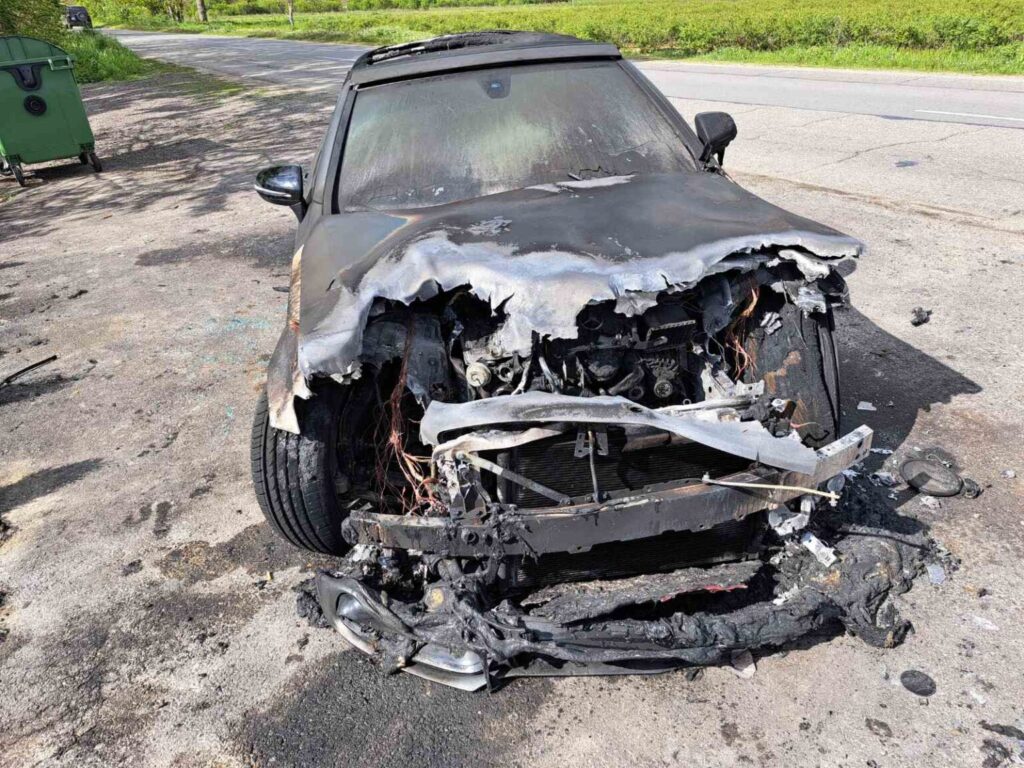
A Mercedes Brabus convertible owned by Stoycho Stoykov, known as “Yogata”, was set on fire at around 10pm on 1 May. The car was parked alongside other vehicles outside Stoykov’s ranch in the land of Cherganovo village, near Kazanlak, where he was celebrating with friends.
Firefighters managed to put out the blaze, but the expensive car, manufactured in 2019 and purchased just weeks earlier, was completely destroyed. Police have launched an investigation, and on 2 May the owner was questioned at the Kazanlak police station.
Stoycho Stoykov is well known in Gurkovo’s criminal circles
The small town in the foothills of the Balkan Mountains, through which the road to the key mountain pass known by its old name, Ha inboaz, runs, often appears in Bulgaria’s crime reports.
Stoycho Stoykov is no exception.
Years ago, he voluntarily left a group involved in vote-buying and became an important witness in a series of investigations into economic fraud and electoral manipulation during the 2019 local elections, won by Marian Tsonev.
Roma residents of Gurkovo previously told “Za Istinata” that Tsonev had personally given them BGN 50 each during the 2019 mayoral campaign.
Later, witnesses who repeated the same allegations before a judge withdrew their statements, saying they had been threatened by the mayor. According to them, Tsonev warned that if they did not retract their testimony, bulldozers would enter the Roma neighbourhood and begin demolishing illegally built houses.
Stoykov’s “betrayal” could not be forgiven, and he became a target of his enemies.
On 1 October 2022, the day before another parliamentary election, Yogata was shot in the back from a distance at his restaurant on the Predela section of the Republic Pass.
After emergency surgery at Pirogov Hospital, Prof Nikolay Gabrovski managed to remove the bullet from his spinal column. Had the operation failed, Stoykov could have been left disabled for life.
Nearly four years have passed since the shooting, but there has been no result in the criminal investigation.
The shooting also led Stoykov to attack and beat up Kolyo Kolev, a businessman from Gurkovo. He later apologised and told “Za Istinata” that he had committed the assault because Marian and Georgi Tsonev had manipulated him into believing that Kolev had ordered the attack against him.
Last year, following an anonymous emergency call reporting a bomb near Stoykov’s restaurant on the Predela, the area was cordoned off and searched by a team of criminal investigators sent from Sofia.
Whether an actual explosive device had been found and neutralised or the report had been false and intended to intimidate him, Stoykov told the media that he did not know.
He also described repeated inspections of his restaurant by the Regional Food Safety Directorate, accompanied by officers from the Directorate General for Combating Organised Crime because local uniformed police officers were allegedly afraid to escort the inspectors.
During one inspection of his refrigerators, the authorities reportedly found … homemade pork fatback.
Days before the 19 April election, Stoykov said he had been threatened by Roma vote-buyers who had gambled away part of the money intended for vote-buying operations. He said they warned him that he would “see what happens after the election, when they will have to carry him in the boots of their cars”.
Stoykov accuses a former mayor and his son
Stoykov has identified the former mayor of Gurkovo and his son as the alleged organisers behind the attacks against him.
In a complaint submitted to the Stara Zagora Regional Directorate of the Interior on 11 November last year, Stoycho Stoykov said he feared that Marian and Georgi Tsonev, or people working for them, could commit further crimes against him.
The complaint was investigated by the Interior Ministry’s Internal Security Directorate and subsequently forwarded to the Stara Zagora Regional Prosecutor’s Office.
Prosecutor Grisha Mavrov later merged the case with another investigation based on a complaint filed by Gurkovo businessman Kolyo Kolev with the Stara Zagora police on 16 December.
The two cases were combined because they concerned the same subject matter and sought to establish the same facts and circumstances – namely allegations that Marian and Georgi Tsonev were operating as an organised criminal group under Bulgaria’s Criminal Code.
Stoykov also claimed in his complaint that the two men had organised vote-buying, for which he was a key witness.
He further alleged that the father and son were protected by the General Directorate for Combating Organised Crime, the prosecution service, the National Revenue Agency and the courts.
On 2 March this year, however, prosecutor Grisha Mavrov of the Stara Zagora Regional Prosecutor’s Office refused to open criminal proceedings against Marian and Georgi Tsonev.
In his ruling, Mavrov stated that:
“During the investigation, no evidence was found pointing even hypothetically to the existence of an organised criminal group. Moreover, despite being given the opportunity, Stoykov failed to specify his allegations, which consisted solely of general conclusions about unlawful acts in past years.”
As for the allegations of vote-buying organised by the Tsonevs, a criminal investigation had already been opened by the Stara Zagora District Prosecutor’s Office in 2021, with Stoycho Stoykov questioned as a witness.
“Za Istinata” made several attempts over the years to obtain information from the Stara Zagora district prosecutor about the progress of the case, but without success.
The Regional Prosecutor’s Office ruling states that the criminal proceedings were suspended because the perpetrator had not been identified.
Regarding Stoykov’s claims that Marian and Georgi Tsonev enjoyed protection from various state institutions, the ruling says that during the investigation he provided no information identifying specific officials, institutions or specific actions.
The prosecutor also noted that when Stoykov did provide names, his allegations were lengthy and general, claiming that his complaints and case files had not been properly handled or making statements such as “the investigation was crushed”.
All of this, as well as Stoykov’s negative assessment of the work of state institutions that had previously dealt with the Tsonevs’ activities, “categorically does not constitute evidence of a crime and cannot justify the opening of criminal proceedings”, the prosecutor concluded.
When Stoykov was again asked whether he knew of prosecutors, judges or other state officials who had acted unlawfully on behalf of the Tsonevs, he replied:
“I cannot name prosecutors or judges, or institutions that assist Marian and Georgi Tsonev in their criminal activities. I have no such information.”
The case involving alleged organised crime, vote-buying and corrupt police officers, magistrates and other state officials therefore remains, at least for now, in the archives of the police and prosecution service.
The arrest of Marian Tsonev and his son by the Directorate General for Combating Organised Crime, and their 2007 convictions for extortion, robbery and arson, are long forgotten by the authorities.
But not by the people of the small town in the foothills of the Balkan Mountains, who continue to live in fear and speak quietly about the alleged abuses and crimes of the former mayor and his son.
After the latest incident, in January this year, involving violence against Dimitar Stoilov, known as Chakmaka, whom Marian and Georgi allegedly attacked after he turned from a member of their group into a witness against them over vote-buying, residents of Gurkovo finally found the courage to protest against lawlessness.
In a complaint to Bulgaria’s Prosecutor General and the prosecutor’s college of the Supreme Judicial Council, they wrote about “the inaction of the prosecution service towards a criminal gang operating in the municipalities of Gurkovo, Tvаrditsa and Nikolaevo, with the characteristics of an organised criminal group”.
They are still waiting for justice.