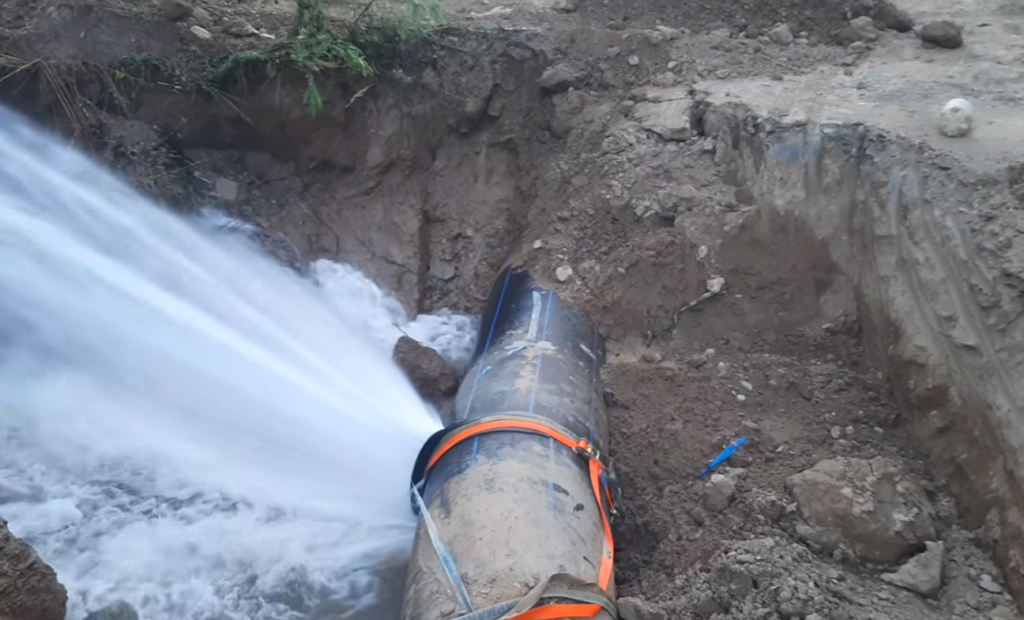
The photos are on Krasimir Minev’s Facebook page.
With over BGN 220 million invested in the water supply and sewerage network in Shumen, water losses jumped to an incredible 83.7%, and Shumen became the record holder in Bulgaria for water loss. This was reported in a publication by “Za Istinata” in September 2024, which analyzed the tragic state of the water sector in the Shumen region, despite the hundreds of millions of levs of European and national funding poured into it.
At that time, both citizens and experts hoped that things could not get any worse, but it turned out that the monopoly water and sewerage company could always do more.
A year later, the publication could be repeated verbatim, with only the date changed. In October 2025, the shocking water losses in the Shumen region are still 83.67%, and the water operator still holds the title of national water waster from the network. And all this is happening after the latest millions in European and national funding have been absorbed, rosy promises that water losses in Shumen will be reduced, and new price increases for ordinary consumers, who since January 1, 2025, have been paying one of the highest prices in the country—6 leva per cubic meter, nearly 10% more than the previous year.
No institution has been able to provide a meaningful explanation as to why water problems in the Shumen region continue to worsen, despite the hundreds of millions poured into the sector and the high price of water. Over the past 15 years, more than BGN 220 million has been invested in the region’s water supply network, and that is only from European funds. National funding, loans from the water supply holding company, and payments from citizens and businesses were separate.
Between 2007 and 2014, nearly BGN 100 million was invested in the Shumen water supply network under a European Commission program. Water losses, which were over 60% at the start of the program, were supposed to decrease. But the result was disastrous – losses increased to 80%.
From 2020, a further BGN 126 million began to be poured into the water sector in Shumen under a project under the Environment Operational Program. According to the business plan of VIK-Shumen, after the absorption of the next few million euros, water losses in the region were supposed to decrease to 79.93% (not that this percentage is not alarming – editor’s note).
Nothing of the sort happened. This time, losses in the region jumped to a staggering 83.7%. Even more shocking are the losses in the water supply network in the regional city of Shumen – a whopping 87.05%!
The data on the current tragedy in the water sector in Shumen comes from the Energy and Water Regulatory Commission (EWRC). On October 16, the EWRC published an analysis of the reasons for disruptions in access to drinking water in 2025. The document is 130 pages long and was prepared after inspections of water supply and sewerage companies in the country to see how they are fulfilling their task of reducing water losses.
The EWRC report indicates that water losses are increasing among 12 regional water supply and sewerage operators, including Shumen. The largest losses in 2024 will be in the regions of Shumen (83.67%) and Pernik (83.25%). The top five also include Sliven (81.39%), Montana (77.63%), and Dobrich (74.91%). There are only two water companies in the country with losses below 40%: Sofiyska Voda (37.40%) and VIK-Blagoevgrad (38.77%).
VIK-Shumen is not even fulfilling its minimum business objectives
In its five-year plan for the period 2022-2026, VIK-Shumen has set a target to reduce total water losses from 81.38% in 2020 to 79.93% in 2024. As can be seen, the water operator plans to reduce its losses by only 1.45%. However, the company is not even fulfilling this minimal task, according to the EWRC. From 2022 to 2024, instead of a reduction, VIK-Shumen reports a 3% increase in losses, with water wastage in the Shumen region reaching a shameful 83.67%.
At the same time, “non-revenue water” has increased, according to the EWRC. Unaccounted-for quantities jump by 15% – from 26,789,000 cubic meters in 2020 to 30,898,000 cubic meters in 2024. The amount of water billed to consumers will decrease from 6,130,000 cubic meters in the base year 2020 to 6,030,000 cubic meters in 2024.
Water losses are increasing across the region – in cities and towns alike, according to data from the last five years. In Shumen, water losses jumped from 84.81% in 2020 to 87.05% in 2024. In Novi Pazar, losses are growing from 76.68% to 79.16%. However, Veliki Preslav holds the top spot in the region, where 91.84% of the water in the network is officially lost. Overall, for the other settlements in the Shumen region, losses jump from 68.98% to 71.22%.
Due to the increasingly poor state of the sector in Shumen, the EWRC has requested explanations from VIK-Shumen for the measures taken against water losses. The company sent a two-page response, but it lacks many answers, according to the EWRC’s analysis.
ViK-Shumen justifies itself by saying that the construction of the new water supply pipeline from the Ticha dam has been delayed and for this reason the huge losses from the old pipeline continue. However, VIK-Shumen is responsible for the delay, as the company is the beneficiary of the €126 million EU project under which the new water pipeline is being built. It was not until November 2024 that the old water pipeline in the section from the distribution point for Targovishte to the pumping station in Shumen was shut down.
It was not until November 2024 that the old water pipeline in the section from the distribution point for Targovishte to the pumping station in Shumen was shut down. In the section from the Ticha dam to Targovishte, however, the old water pipeline has not been shut down. Therefore, water losses along the route of the old water pipeline continue, according to VIK-Shumen. And no one can answer the reasonable question asked by the people of Shumen: Why was it necessary to spend BGN 70 million on the construction of a new water pipeline when the old one continues to function and waste water? Otherwise, the water supply company informs that in 2024, the replacement of 9.9 km of main water pipelines in Shumen, repaired in stages, was completed.
Otherwise, VIK reports that in 2024, the replacement of 9.9 km of main water pipes in Shumen, repaired under another EU project, was completed, and a reduction in water losses from 162,000 cubic meters per month is expected.
However, the water operator remains silent on questions about specific actions against water losses. VIK-Shumen does not specify how many (and whether) checks have been carried out for unauthorized use of water by citizens and companies. No information has been provided on water losses in the individual water meter zones of the settlements, and there is no answer to the question about surveys of the water supply pipes in the settlements and assessment of water losses. The company also did not answer the specific question about the number of leaks detected in the network and the water lost through them. In conclusion, the EWRC states that VIK-Shumen does not answer most of the 9 questions asked. “The company has only provided a textual description of the zoning of the water supply network in the cities of Shumen and Novi Pazar, without providing evidence that the requirements for measuring flow and pressure at the inlet/outlet zone and at critical points have been met. No data has been provided on the assessment of water losses by water meter zones, including measured minimum nighttime quantities.
The situation is most severe in the town of Varbitsa, the village of Chernoglavtsi in the municipality of Venets, and the village of Tsarkvitsa in the municipality of Nikola Kozlevo. From the beginning of 2023 to August 2025, each of the three settlements was without water for more than 200 days.
In Vurbitsa, where 3,851 people live, people have been without water for a total of 294 days over the past two and a half years.
In the village of Tsarkvitsa in the municipality of Kozlevo, with 839 inhabitants, water restrictions have been in place for 256 days.
In the village of Chernoglavtsi, with 688 inhabitants, the water shortage lasted a total of 235 days.
The village of Zlatar in the municipality of Veliki Preslav, with 1,204 inhabitants, is also under water restrictions. Over the past two and a half years, people have been without water for a total of 168 days.
In the village of Mengishevo in the municipality of Varbitsa, with 575 inhabitants, water restrictions lasted a total of 49 days.
Of all five large settlements under water restrictions, only the village of Tsarkvitsa in the municipality of Kozlevo was provided with drinking water by two water tankers. No information has been provided by VIK-Shumen for the others. Water losses in the five settlements range from 41.8% to 52.5%.
Since 2023, no water supply pipes have been replaced in the five affected settlements. No water reservoirs have been rehabilitated, and no pressure control reducers have been installed. This is evident from the report of the Shumen Water Supply and Sewerage Company on the measures taken to improve water supply in the affected areas. Only one pump unit has been replaced – in the village of Chernoglavtsi, Venets.
VIK-Shumen states that it has financed a project to strengthen the water supply in the village of Tsarkvitsa, for which the municipality of Nikola Kozlevo has applied to PUDOOS (Enterprise for Management of Environmental Protection Activities). The project is currently being implemented.
The company has replaced 0.48 km of distribution network in two settlements, and for the village of Chernoglavtsi, it is noted that the municipality of Venets has prepared a project for the complete reconstruction of the water supply network, which it has submitted to the State Fund “Agriculture”.
VIK-Shumen reports that it has replaced a total of 292 building connections in the five settlements and installed three stop valves in two settlements. The company lists a total of 12 water sources with improved capacity in the settlements under water restrictions.
Information about other settlements under water restrictions is also published on the VIK-Shumen website. These are villages with fewer than 500 inhabitants and are not included in the report to the Energy and Water Regulatory Commission.
In the village of Izbul, near Novi Pazar, water is supplied from 5:30 a.m. to 8 a.m. in the low zone and from 5 p.m. to 8 p.m. in the upper zone. In the village of Sechishte, water is supplied for 48 hours in the low zone and for the next 72 hours in the high zone. In the village of Konevo, near Vurbitsa, there was a strict regime throughout the summer – water was supplied for only 6 hours every two days. Since October 10, there has been a continuous water supply in the lower part of the village, while in the upper part the regime is 24 hours of reserve and 72 hours of water supply.