



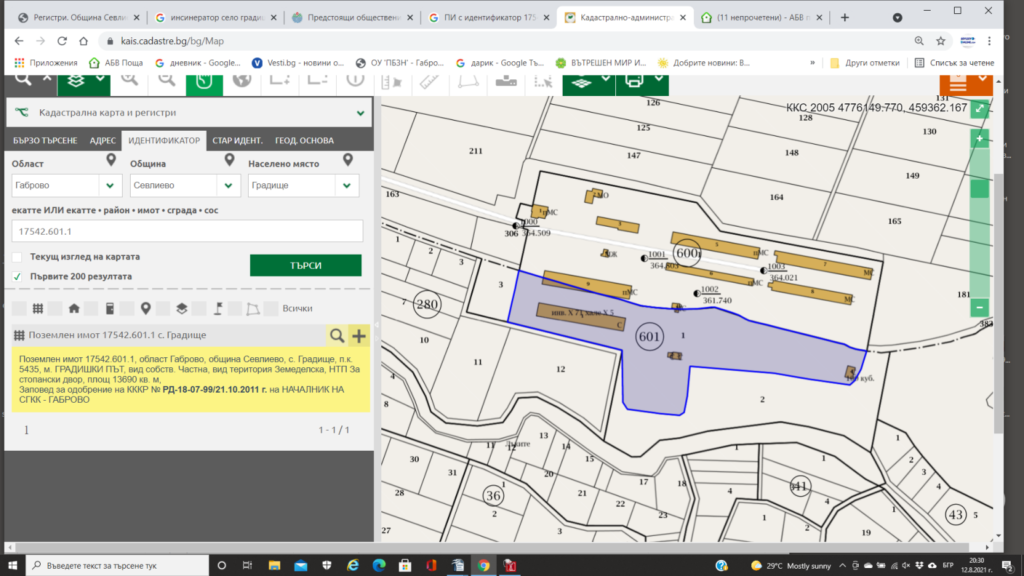
According to the information, the newly constructed mobile incinerator near the village of Gradishte has a maximum capacity of one ton of animal waste per hour. The facility is owned by the company “Eko BG-SJP,” which gained notoriety due to the investigation by Genka Shikerova and the Anti-Corruption Fund’s “War for Corpses.”
An announcement regarding the commissioning of the incinerator has been published on the website of the Regional Inspectorate of the Environment and Water (RIOSV) in Veliko Tarnovo, as well as on the website of the municipality of Sevlievo, where the village is located. According to this announcement, those interested in the investment have one month to review the documentation and present their opinions.
The installation itself consists of a feeding mechanism, a grate, a bottom ash separation device, an air duct system, a combustion chamber, and auxiliary burners. The gases produced from the incineration will pass through an oxidation chamber equipped with two auxiliary burners. The temperature will reach 1,200 degrees Celsius, which, according to the documentation, will ensure the incineration of all organic substances present in the flue gases.
Beneath the combustion grate, there will be a chamber designed to capture and collect the ash from the incineration, which will be channeled into a tightly sealed container.
The annual air pollution is claimed not to have a negative effect on people and the ecology, as stated in the RIOSV permit. However, it is expected that there will be some pollution affecting the nearest villages—Agatovo is a little over a kilometer away, Gradishte is two and a half kilometers away, and Malak Vurshits is three kilometers away. This pollution, however, “cannot cause discomfort to the population, due to compliance with the established norms for permissible emission levels,” according to RIOSV.
But what happens when the wind starts to blow?
In that case, it is possible for there to be one-time pollution, but only if the wind blows from the north or south. However, there are no “populated areas or zones subject to special health protection” in those directions.
“In both the annual and short-term perspectives, the quality of the ambient air will not be significantly negatively affected following the implementation of the investment proposal, as the impact is acceptable on local, regional, and transboundary levels,” further states the decision of the ecological inspection in Veliko Tarnovo, granting approval for the incineration of animal carcasses near Gradishte.
This decision bears the signature of Elin Andreev, who was appointed as the director of RIOSV in Veliko Tarnovo shortly before the end of 2013 and is a former MP from the DPS party from Smolyan.
According to information from “Yantra News,” Elin Andreev graduated in “Accounting and Control” from Veliko Tarnovo University. He was elected as a Member of Parliament from the DPS party in 2009, but after his term ended in 2013, he registered on the stock exchange. When a competition was announced for the director of the ecological inspection in Veliko Tarnovo, he applied and won the position.
Elin Andreev granted permission to “Eko BG-SJP” to install a mobile incinerator at the site of the former agricultural yard near the village of Gradishte.
The investor is featured in the investigation “War for Corpses” by journalist Genka Shikerova and the Anti-Corruption Fund.
According to the Anti-Corruption Fund, from March 2018 to March 2019, the company received over 10 million BGN under a contract with the Bulgarian Food Safety Agency (BFSA). For the period from 2019 to 2020, it secured nearly another 8 million BGN, and according to an annex to a contract dated April 1, 2019, signed on March 6, 2020, it will receive almost 13 million BGN more for the incineration of animal waste.
At the same time, the company lacked the capacity to meet the planned quantities for incineration, raising questions about how the millions from the state were spent.
Subsequently, the Anti-Corruption Fund alerted the State Financial Inspection Agency, which began investigations. These investigations revealed violations in both public procurement contracts and subsequent annexes extending their terms in the absence of competition, as the rendering plants in Shumen and Vrana were closed. As a result, the disposal activities for animal products shifted to two companies—”IDDD Logistics” and “Eko BG-SJB.”
The two companies are connected in terms of the property where the incinerator near Gradishte will operate. Initially, the documents for the ecological inspection were submitted by “IDDD Logistics”—the company is the tenant of the property on which the mobile incinerator will be installed. During the procedure for the RIOSV’s decision, the investor changed, and “Eko BG-SJB” was then behind the proposal.
And a public discussion without public knowledge is part of the story of the future incinerator. On June 25, 2021, a public discussion was scheduled in Gradishte regarding the investment intention to construct the mobile incinerator. However, the locals did not learn about it, as then-mayor Milen Nedelchev told “Za Istinata.”
According to Nedelchev, notices were posted at the entrance of the municipality, but he wondered why no one showed up. It was only later, when it became known that animal carcasses would be burned nearby, that people began to ask what was happening, but by that time the discussion had already taken place.
Starting from January 29, 2025, a one-month period begins during which those interested can review the documents for the commissioning of the incinerator on-site at the municipal administration in Sevlievo.
The review of the documentation takes place in person at the Ecology Department of the Sevlievo Municipality.
To gain access to the documents, one of the two employees in the department gets up from their spot and provides their computer for the purpose of “Za Istinata” (For the Truth). It is curious to consider how many citizens would take the effort to sit in the municipal employee’s place to read the documents regarding the incineration of tons of animal waste and carcasses near Gradishte.
It is unclear how many citizens would express their opinions, especially since the Regional Inspectorate of the Environment and Water (RIOSV) approved the installation of an incinerator for the disposal of animal products in the territory of Gradishte back in August 2021. Based on this approval, the facility is now ready to be put into operation.
The incinerator is intended to burn waste from animal tissues originating from hunting and fishing activities, livestock farming, meat processing, animal by-products, and carcasses of deceased animals, as stated in the permit from RIOSV in Veliko Tarnovo.
Animal waste and carcasses will be delivered using specialized transport, and their unloading will take place in a production building. The documentation explicitly states that the unloading and storage of the animal waste will be conducted in a closed room and in containers. It is also noted that in case of any unpleasant odors, immediate measures must be taken. Additionally, there should only be a few hours between storage and incineration, as further specified in the documents.






