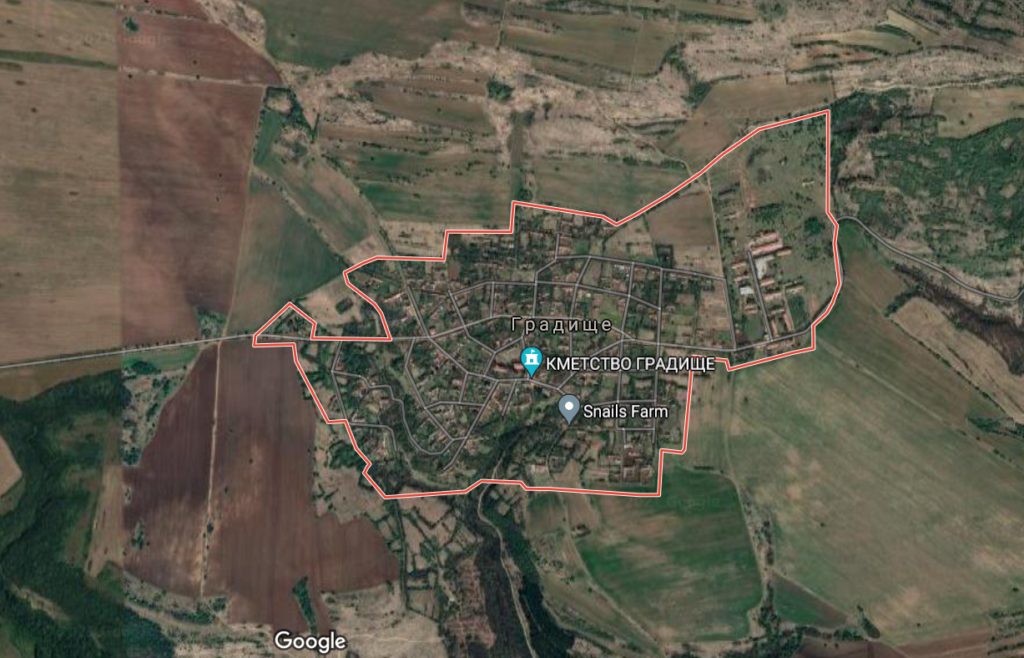
On August 2 of this year, the Regional Inspectorate for Environment and Water (RIEW) in Veliko Tarnovo approved the installation of an incinerator for the disposal of animal byproducts in the land of the Sevlievo village of Gradishte.
The incineration facility is planned to be located 1.3 kilometers from the nearest populated area, according to the decision, which states that this proximity does not pose a risk of discomfort to the population. However, the local residents are completely unaware of what is planned just beyond the village’s borders, an investigation by “Za istinata” (“For the Truth”) has revealed.
No residents attended the public consultation organized by the Regional Inspectorate for Environment and Water (RIEW) on the investment proposal to install an incinerator for animal byproducts near the village of Gradishte, said Milen Nedelchev, the local mayor’s representative. When asked how villagers reacted during the consultation, he replied, “No one raised the issue.”
Lack of Awareness Among Residents
The public consultation was scheduled for June 25 of this year at 11 a.m. Information about the event was available only on the website of RIEW Veliko Tarnovo. According to Nedelchev, announcements were posted at the entrance of the municipal office in Gradishte, but he expressed surprise that no one attended. When asked whether people later learned about the planned incinerator and how they responded, he added, “I’m often at the village center, but no one here has brought up the issue. I haven’t heard any comments.”
This raises questions about whether the residents of Gradishte were adequately informed about the consultation. In a small village where news usually spreads quickly, it seems unusual that no one knew an incinerator for animal waste would be installed nearby or that locals were supposed to provide feedback on the project.
Limited Transparency
The municipality of Sevlievo’s website also lacked any mention of the investment proposal. This omission is notable given that, in the past, a proposal for a composting facility in another Sevlievo village was prominently announced on the site, sparking significant public opposition. Following the backlash, the investor withdrew the proposal. Even now, the website features announcements about other investment projects, but there is no mention of the incinerator near Gradishte. Without such information, it is unclear how residents could provide feedback as stated in the RIEW announcement.
Despite the lack of public awareness, the municipality of Sevlievo sent two representatives to the public consultation, which was organized by the investor. According to RIEW, the meeting was attended by one official from RIEW, the mayors of Gradishte and the neighboring village of Agatovo, and three representatives of the investor.
Known Players Behind the Project
Another critical aspect of this investment is the parties involved. Initially, the application to RIEW was submitted by “IDD Logistic,” the company leasing the land for the mobile incinerator. During the review process, the investor changed to “Eco BG – SZHB.” These two companies were previously featured in the investigative report War for Carcasses by Genka Shikerova and the Anti-Corruption Fund. The report revealed that these companies received contracts worth BGN 89.5 million from the Bulgarian Food Safety Agency, many of which violated public procurement laws. Subsequent audits uncovered financial irregularities in the contracts and extensions, which excluded competition and isolated rendering plants, transferring animal waste disposal activities to these two companies.
Pending Registration
The incinerator near Gradishte has not yet been registered with the Regional Directorate for Food Safety, as required by veterinary law. However, registration could occur later, as the RIEW decision is still subject to a 14-day appeal period. The director of the regional food safety office, Dr. Spasov, confirmed he was unaware of the incinerator plans until informed by “Za istinata” (For the Truth).
The national registry of facilities for animal waste disposal, which should have been publicly accessible since 2018, also lacks information about the incinerator. The registry only lists approved enterprises for animal byproducts.
Land Ownership
The land designated for the mobile incinerator was acquired in late 2020 through a public auction held by a court bailiff. The new owner is “MKB Development,” a company reportedly preferred in animal studies and projects of this type.
Miroslav Borislavov Petkov, the sole owner of the company “MKB Development,” is also the owner of the “Central Veterinary Laboratory.” Petkov and his laboratory gained public attention due to a contract awarded by the Bulgarian Food Safety Agency (BFSA) without prior notice, worth just under BGN 400,000, for testing the brains of cattle, cows, and calves. This is not Petkov’s only contract with the BFSA. A company he represents won a BGN 14.6 million contract for diagnostic testing under the National Program for Animal Disease Prevention, Surveillance, Control, and Eradication between 2019 and 2021.
Land Lease and Project Details
The land near Gradishte was initially leased to “IDD Logistic,” the company behind the investment procedure with RIEW. Later, the lease was amended to transfer tenancy to “Eco BG – SZHB.” The property spans approximately 13 decares, with the incinerator site covering about 700 square meters. The project also includes designated areas for the temporary storage of animal byproducts in metal containers and zones for fuel, wood ash, and other materials. According to the environmental impact assessment (EIA) report, the storage duration will be limited to a few hours, and the incinerator will have a capacity of 1,000 kilograms per hour. The byproducts will be transported in tightly sealed metal containers using specialized vehicles.
Public Awareness and Concerns
Despite these detailed plans, residents of Gradishte and neighboring villages remain unaware of the project. Even if they had objections or questions, there is no clear avenue for them to voice concerns since they missed the public consultation. The process appears to have lacked genuine public involvement, as the consultation was neither widely publicized nor designed to facilitate meaningful discussion.