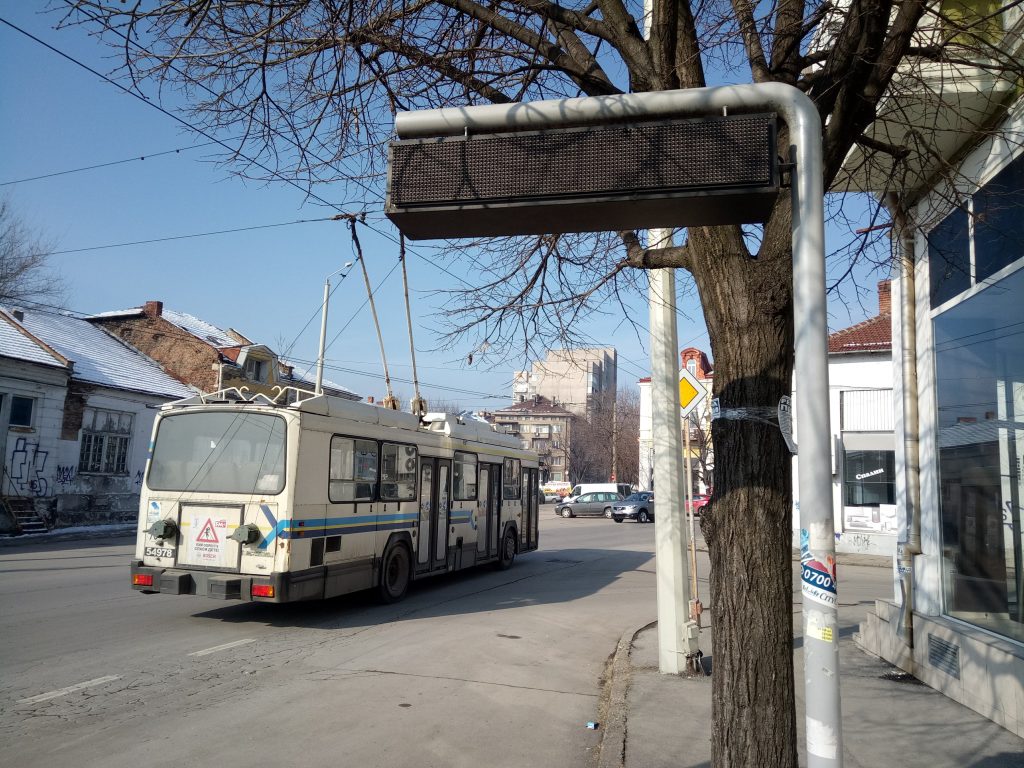
Nearly eight years after the ceremonial opening of the automated transport system in Ruse, constructed with European funds, none of its components are functioning properly.
The validators installed in the vehicles do not work, and most of them have even been dismantled. It is a regular occurrence for the electronic boards at the stops to display Chinese hieroglyphs instead of informing citizens about the next buses or trolleys, or they do not work at all. These are just some of the troubles faced by Ruse residents and their failed “integrated urban transport.”
The municipality paid a modest 3.5 million leva for it through the Operational Program “Regional Development 2007-2013.” The project was implemented between 2014 and 2015, during the mayoralty of Plamen Stoilov (GERB). With the funds from the European Union, 100 information boards were installed at stops, onboard computers with GPS were put in the vehicles, validators for cards and tickets were set up, 25 machines for recharging cards were installed, and an interactive online portal for real-time tracking of each line was created. For his “success” in implementing the project, Stoilov received an award in 2016 for his contribution to infrastructure development in Bulgaria, presented to him by then-Minister of Regional Development and Public Works and his party mate Liliyana Pavlova.
The assessment eight years later is that none of the constructed systems are functioning. This is also confirmed by the responses to questions posed by the editorial team to the current municipal administration.
Repairing the Repair
Now, the Municipality of Ruse is attempting to restore the integrated urban transport system “with its own funds and efforts” – that is, at the expense of Ruse taxpayers.
A public procurement was conducted for the supply of 80 new validators at a total cost of 55,916 leva. The winning company, “EN ER GI SOFT” Ltd., has committed to deliver, install, and put the devices into operation, which, as stated in the procurement assignment, should provide the long-awaited “flexible fare system in public transport for the citizens of Ruse.”
The municipality justifies the need for new validators for the vehicles by stating that those purchased with European funds eight years ago are now “morally outdated” and have “exhausted technical resources and operational viability.”
“The validators you are referring to were installed in 2015, meaning 8-9 years ago. Almost everyone now has a smartphone, which typically lasts about 3 years. The same goes for the validators, although with a longer lifespan,” reads the response from the municipal press center, which states that the first problems with the system emerged in 2020.
At that time, new requirements were introduced concerning the mandatory presence of a QR code on issued tickets. The Municipality of Ruse explains that updating and upgrading the existing system to comply with the new regulations was not feasible due to a lack of “communication and informational connectivity between the various components and the central server system.”
A check of the transcripts from the local municipal council reveals that the first issues with the validators in the public transport system occurred not in 2020, as claimed by the municipality, but as early as 2018 – three years after the official launch of the system. At that time, municipal councilor Marieta Wolf from the “Voice of the People” party raised questions to Mayor Plamen Stoilov regarding citizen reports about non-functioning validators in the vehicles. The city administration responded that “in fact, in some of the vehicles operated by the two companies (serving public transport in Ruse – ed.), the equipment is not functioning,” and explained that the identified malfunction is not covered by warranty services.
An internet portal with questionable effectiveness
These are two additional components of the larger project for integrated urban transport that the Municipality of Ruse implemented between 2014 and 2015 through the Operational Program “Regional Development 2007-2013.” The only trace of the so-called “Interactive Internet Portal” that “For the Truth” discovered is this static website.
According to official statements, it is supposed to “provide information on traffic, the location of vehicles, the time until their arrival, as well as data on possible routes and lines.” However, it is evident to the naked eye that the page contains nothing of the sort. It only features the schedules of urban transport lines and the prices for prepaid travel cards.
Another interesting component is the 25 stationary machines for recharging prepaid travel cards, delivered with European funds. Since 2021, these machines have also not been operational due to a lack of “communication and informational connectivity,” and as of today, some of the machines are in a dilapidated condition.
“For the Truth” requested information from the municipality regarding how frequently these devices were used by the citizens of Ruse before they, like the validators, ceased to function properly.
From 2015 to 2021, the revenue from recharging cards through the machines amounted to 192,453 leva. During this period, approximately 4,900 recharges were made, which equates to around 70 cards per month or about 3 cards per machine.
This is the sad story of the non-existent integrated urban transport in Ruse. However, the city is not an exception. Within the framework of the Operational Program “Regional Development 2007-2013,” funds were utilized for similar projects in several other provincial cities – Varna, Burgas, Stara Zagora, and Plovdiv. Problems were also encountered there, and in fact, they were quite significant.