



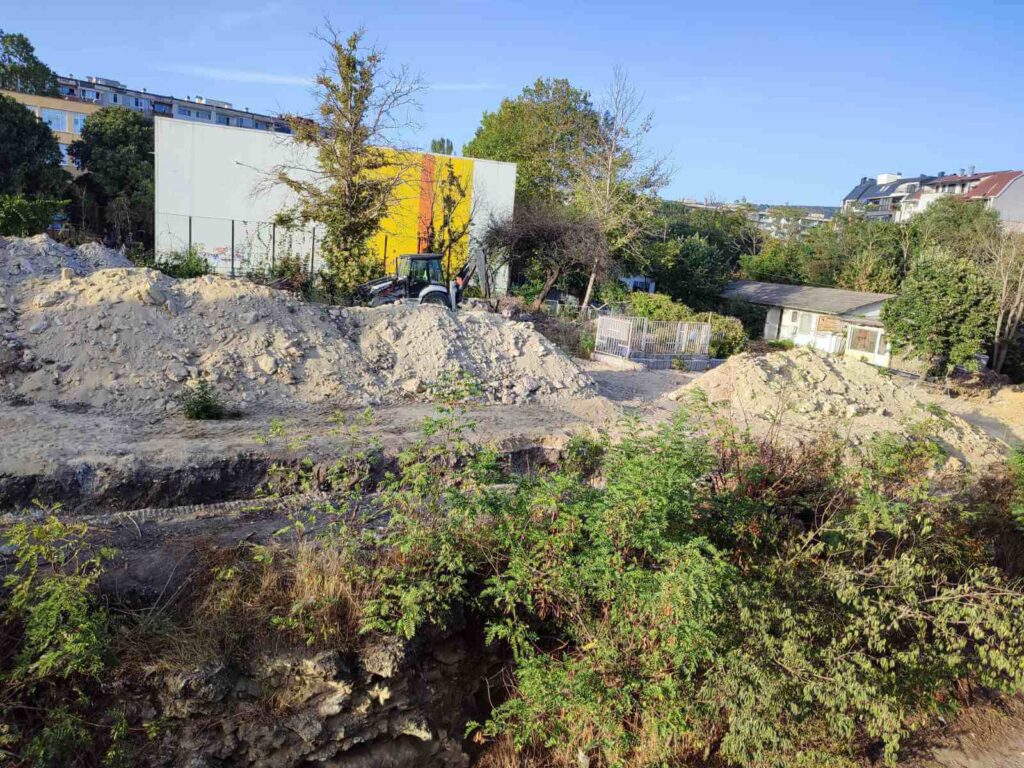
This is a story of tree destruction in Varna, devoid of fiction or journalistic commentary—just the facts. It unfolds on Zelenika Street in the so-called “Flower District.” (The irony of the name is purely coincidental – Zelenika means holly plant).
a story of a (non-)accidental fire
“Come, come and see the view from up here!” urges a resident of Block 25, pointing to the mounds of soil, the trench, and the excavator. The scene is visible from the third-floor staircase of the panel building. Less than a year and a half ago, this spot hosted 22 trees. Now, it is a site being prepared for construction.
On April 30, 2022, the media reported a major fire near the First Language High School in Varna, mentioning only burned shacks. The pretrial investigation was launched against an unknown perpetrator.
In reality, the fire completely consumed two 9-meter Atlas cedars, five 8-meter eastern thujas, and ten white acacias. Two 12-meter plane trees—classified as “near-threatened” in Bulgaria’s Red List of Higher Plants—were heavily charred and later removed, along with two 8-meter sycamores that met the same fate.
“I stepped onto the balcony minutes after it started and saw the trees in the middle of the lot burning,” recalls Diyan Dinkov from Block 25. He filmed the fire on his phone. “They said some kids had started it. After the fire, everything was removed shockingly fast. The investigation, filed against an unknown perpetrator, led nowhere,” he shrugs.
conifers or deciduous trees? for varna municipality, it doesn’t matter
The inspection report on the burned vegetation, prepared by experts from the “Primorski” district, is dated May 12, 2022. A day later, a request was submitted to the municipality for the approval of a comprehensive project for an investment initiative titled “Mixed-use building,” along with a construction permit and approval for the removal of vegetation from the building site.
On December 12, 2022, the municipality issued a report, signed by a landscape architect from the “Architecture, Urban Planning, and Development” department, recommending the removal of 11 more trees from the site to accommodate the construction of the building and its adjacent parking lot.
On January 31, 2023, the mayor of Varna, through his deputy Hristo Ivanov, signed an order for the removal of five long-standing decorative trees, including three 100-year-old cypresses and a 50-year-old sycamore, as well as six acacias, hackberry, mahaleb cherry, and fruit trees. Eight of these trees were protected under Ordinance 1 for the preservation of green spaces and decorative vegetation.
In the order for vegetation removal, the deputy mayor disregarded the landscape architect’s report regarding the species and quantity of trees to be planted as compensation. Instead, the order stipulated a compensatory program to include 33 coniferous Arizona cypress trees, each 150–175 cm in height.
According to the expert’s recommendation, each removed broadleaf tree should be replaced with five medium-sized broadleaf trees, 1.8–2.4 meters tall, while the four pyramidal cypresses should be compensated with five coniferous trees each. For the removal of the hackberry, three broadleaf trees of similar size were required as compensation.
The mayor’s order designated the investor to reforest a different area, specifically between “Osmi Primorski Polk” and “Hristo Smirnenski” boulevards. However, for the residents of Zelenika Street, the inconsistencies between the landscape architect’s report and the order for vegetation compensation are not the main concern.
Residents of blocks 22, 23, 24, and 25 fear that the entire green vegetation of over 50 mature trees south of the fence of the First Language High School will be cut down to create a new street. This street, planned in the Detailed Development Plan (DDP) of the area, is intended to serve the investment project.
The Mystery of Over 50 Trees Missing from the Map
As early as 2021, local residents filed two complaints with Varna Municipality, pointing out that the street greenery map for the 25th microdistrict, published on the Urban Planning and Development Directorate’s website, omitted over 52 trees along the southern fence of the First Language High School. This section runs between Podvis Street and Block 21 on Zelenika Street.
The missing trees include valuable endemic species like 6 lime trees, 15 Japanese maples, 3 sycamores, 5 ash trees, and others. Residents demanded corrections to the map.
Two years later, in response to an EcoVarna inquiry under the Access to Public Information Act, the municipality stated that they lacked data on the types of trees within the municipal property located between the high school, the construction site, and Zelenika Street. Existing vegetation was only marked with symbols and locations on the green register map.
A Sense of Loss and Concerns for the Future
“These trees are from our childhood, over 50 years old. Where the parking spaces for the construction project are planned, there used to be a playground,” recalls Diana Velichkova from Block 22 on Zelenika Street.
“Our goal is to preserve the trees. But we’re also concerned about our parking spaces and the structural stability of our blocks during the construction of the new building,” says Diyan Dinkov from Block 25.
Legal Action Postponed Until After Local Elections
When the municipality approved the new Detailed Development Plan and Regulation Plan for the area (DDP-RP), residents of the neighborhood only found out by chance and didn’t get the chance to review the plan.
“All notifications for the residents of the five blocks were piled together near the mailboxes of Block 25. People had no way of knowing what it was about. Some notices were addressed to long-deceased individuals who once owned garages in the area. Their heirs couldn’t collect the registered letters either,” says Dinkov.
Attempts to review the plans at the “Primorski” district office were futile, with staff frequently unavailable due to medical leave, absenteeism, or workload.
The residents of Zelenika Street have filed a lawsuit against the municipality, claiming they were not properly informed about the DDP-RP.
The first court hearing took place on October 3 this year but was postponed—until after the local elections.
This article was created by the “Public Center for Environment and Sustainable Development” (PCESD) as part of the project supporting independent regional media by the non-profit organization “Pro Veritas.” The views expressed herein are those of PCESD and are not necessarily shared by “Pro Veritas.”






