“Put up a notice saying that on the 16th, they will come to collect payments. Those who haven’t paid will have their water shut off. People are laughing. Which water are they going to shut off? There is no water… When you turn on the tap, the water meter spins, but nothing comes out. There are people who don’t even get water at all, yet they’ve received bills for 120 BGN.”
Velichka Gacheva is a shopkeeper in the village shop of Solnik, in the municipality of Dolni Chiflik. “They turn the water on once every two days. And those who live up in the neighborhood sometimes go one or two weeks without water. The water comes from the Dvoinitsa River. The village of Dyulino is also supplied from there, but they don’t have any problems,” she wonders.
This was supposed to be a story about the water shortage affecting three villages and the plight of 1,000 people in the Varna region in the 21st century. However, it turned into an investigation into the illegal extraction of inert materials.
For the prosecution, “the perpetrator of the crime under Article 240a, paragraph 1 of the Penal Code has not been identified, which is why the criminal proceedings were suspended with a decision on November 28, 2023, and the case has been sent to the Varna Regional Directorate of the Ministry of the Interior for further investigation.”
What the law says
According to Article 240a (1), anyone who extracts underground resources without a concession or when the concession for extraction has been suspended under Article 68 of the Subsurface Resources Act or based on the signed contract, is punished with imprisonment of up to six years and a fine of 1,000 to 20,000 BGN.
Additionally, according to Article 1, paragraph 3 of the Subsurface Resources Act, the extraction of underground resources is prohibited in riverbeds, river lands, and reservoirs, as well as in the floodplains of rivers.
The voice of the people
Despite the legal prohibition and the formal absence of an offender, people from the affected villages with water shortages believe otherwise. “We assert that inert materials were extracted from the bed of the Dvoinitsa River, resulting in the expansion and deepening of the riverbed. This has led to the displacement of the natural flow of water, causing the water sources we rely on to fail to maintain the necessary quantities to meet our drinking water needs,” the people from Solnik wrote in a letter to the chief prosecutor, the Minister of Regional Development, the governor of Varna, and several other institutions.
Formally, everything is legal
In response to a request under the Access to Public Information Act (APIA), the Black Sea Basin Directorate (BSBD) provided a written report, which revealed that in September 2007, the director of the institution issued a permit for the use of a water object—the Dvoinitsa River in the Solnik area. This permit was extended five times with various decisions and was valid until December 2015. The permit holder was “ZSK DEVNYA” JSC, and the purpose of use was to “extract sedimentary deposits from the surface water body to ensure the flow capacity of the riverbed.”
Although they are not obliged to provide a response under APIA, “ZSK DEVNYA” confirmed that they held the permit for the use of the water object for the extraction of sedimentary materials from the Dvoinitsa River near Solnik until the end of 2015. During this period, the company did not transfer the right to extract sedimentary materials.
But de facto…
The law only differentiates between “extraction of sediments” and “extraction of inert materials.” For the people of Solnik, including those who worked at the site, there is no difference.
According to Wikipedia, sediments are unconsolidated deposits on the earth’s surface—sand, gravel, pebbles, clay, etc.
According to the Bulgarian Association of Producers of Inert Materials, inert materials include sand, gravel, crushed stone, and are used as a primary ingredient in concrete production and other composite mixtures.
We spoke with former workers of “ZSK DEVNYA” who were witnesses to the so-called clearing of sediments from the river.
“Work was being done across the entire riverbed. The excavator would first dig and check if there was ballast, i.e. sand and stones, and to what depth. Below that, there would be earth material. Then there was more ballast, but it was already at a depth of 4-5 meters. The company was digging up to about 2 meters,” claims Atanas Nenov, who worked as an electrical mechanic at the company from 2007 to 2014. During this period, the site had three crushers and about 10 conveyors transporting the stones from one crusher to another, along with pumps and… a concrete plant. (Inert materials are used for concrete production.) “The water used was from the river,” Nenov continues. “It would clean the ballast under pressure with pumps, pass through three settling tanks, and then return to the river again.”
The Control
Control was limited to the amount of water used and its pollution. This seems illogical given the permit aimed at cleaning river sediments. “They came from Burgas every month to take samples to check for pollution in the water leaving the site and entering the river,” says Atanas Nenov. There is no data showing control over how much sediment or inert material was extracted from the river, how it was done, or at what depth. Such control is not mentioned in the official response from the BSBD to EkoVarna. Hence, information on the ballast material being removed from the river ranges from 150 to 1400 tons per day, according to worker reports. Around 80% of this amount remained as finished product for construction. Without concession fees, too. The current price of ballast is about 32 BGN per ton. If we calculate with prices half as low due to inflation, and an average daily amount of 800 tons, the gross income would be 12,800 BGN per day. (The figures are approximate, given the lack of official data on quantities and prices.)
“This was pure theft—extraction of inert materials,” believes Atanas Nenov.
And the connection to the water shortage
“There might be a connection between the water shortage and the extraction. Because there was another company that dug 6 meters deep into the river, as deep as the excavator’s arm could reach,” says Yordan Yordanov, a driver at “ZSK DEVNYA” from 2006 to 2014. According to him, the said company was digging above the water collection wells of Solnik. “And above the pumping station, another Varna company was digging during 2012-2013. They had very large trucks. They were even banned from passing through the village,” recalls Yordanov.
According to the BSBD, no other companies had permits for using the water object—the Dvoinitsa River—nor for extracting or mining inert materials in the area. No one from Solnik worked for them, and it’s difficult to find witnesses.
The perpetrator is unknown
With a decision from October 2023, a supervising prosecutor from the Varna District Prosecutor’s Office initiated pre-trial proceedings for a crime under Article 240a, paragraph 1 of the Penal Code. The investigation concerns the extraction of underground resources without a concession or when the concession for extraction has been suspended in the Dvoinitsa River area, near Solnik, between 2020 and 2022.
According to information on the permits for the use of water objects issued by the BSBD, found by EkoVarna on the Basin Directorate’s website, from 2007 to 2013, “Atlant-Kristev” sole trader had a permit to extract sediments from the Dvoinitsa River, but it was for the area of the village of Koznitsa, near Nessebar.
“The water shortage in the villages of Solnik, Bardarevo, and Golitsa began about 3-4 years ago,” says Ivan Petrov, who has been submitting complaints to authorities for over a year. According to him, besides “ZSK Devnya” and “Atlant-Kristev,” inert materials were also being extracted from the river by “Kul Beton” until 2019. In an attempt to confirm this, EkoVarna sent a written inquiry to the company in December of the previous year, but has not received a response yet.
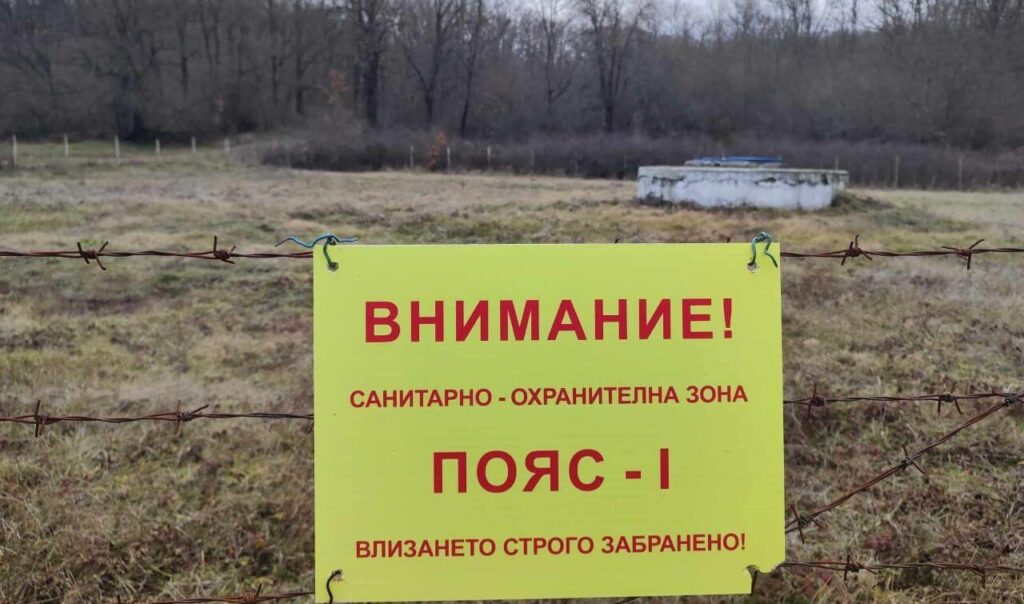
According to Petrov, when the shaft wells for water supply in the village were built over 30 years ago, a clay dam was constructed along the river, similar to a dam, to support the water and prevent it from flowing into the ballast layer. It is claimed that during the extraction of inert materials, the dam was destroyed, causing the ballast layer to lower below the groundwater zone. This has resulted in water flowing out more quickly and not being retained in the sanitary zone, explains Ivan Petrov. Such findings based on witness testimonies were also confirmed by the prosecution’s investigation.
Water Regime and Drought
Since the autumn of 2017, a water regime has been implemented by the mayor of Dolni Chiflik for the villages of Solnik and Golitsa, initially due to drought and a decrease in the flow of water sources. However, in January and April of 2023, the BSBD conducted checks on the water intake facilities, finding no violations in the integrity of the dikes, traces of heavy machinery, or activities in the river terrace. In previous years, the BSBD responded to “signals of established extraction of inert materials,” but these were located further downstream from the shaft wells, as noted by the Varna District Prosecutor’s Office. According to the prosecutor’s response to EkoVarna, it was not possible to determine the age of the vegetation around the water flow of the Dvoinitsa River, making it impossible to confirm whether the extraction of inert materials in the vicinity of shaft wells 1 and 2 was responsible for the water shortages in the villages of Solnik, Bardarevo, and Golitsa.
Circumventing the Law
“The law prohibits granting concessions in riverbeds, but due to riverbed cleaning, the Basin Directorate allows the extraction of sediments to facilitate river flow and prevent clogging. Formally, this way the law could be circumvented,” says environmental lawyer Alexander Asenov. He argues that the problem lies in the fact that no one monitors the quantity of extracted materials, whether they are only sediments, and what happens to them. According to Asenov, this is a loophole that institutions cleverly exploit under the guise of clearing the riverbeds.
Illegal extraction of inert materials from rivers is an ongoing issue, as this activity is poorly regulated, according to the Bulgarian Association for the Production of Inert Materials. Their analysis indicates that the amount of cement and bitumen used in construction is 50% higher than what was declared as extracted in 2010, when permits for the extraction of river sediments were issued in large numbers.
Why Rivers Are Disappearing
Rivers are slowly “disappearing” due to the extraction of inert materials, according to an analysis by the WWF. The organization believes that the extraction of underground resources is one of the biggest problems for rivers in Bulgaria. The reason we do not recognize it as a major factor is because it happens gradually, over years, unnoticed.
Rivers and groundwater are interconnected; they are part of a single ecosystem. What people fail to realize is that beneath the river flows another—an underground river. The more material that is extracted, the deeper the rivers start to cut into the earth, which also lowers the level of groundwater. This is often mistakenly attributed to climate droughts, say experts.
This conclusion is echoed by the BSBD, the Dolni Chiflik Municipality, and the prosecutor’s office regarding the water regime imposed on over 1,000 people in the three Varna villages: “The problem with water shortages in the area arises from prolonged drought and a lack of sufficient rainfall, causing the groundwater sources to significantly reduce their flow rates.”
As the people of Solnik put it, “The river has always dried up in the summer, but we never had a problem with water shortages. It is not just nature to blame, but human greed.”