



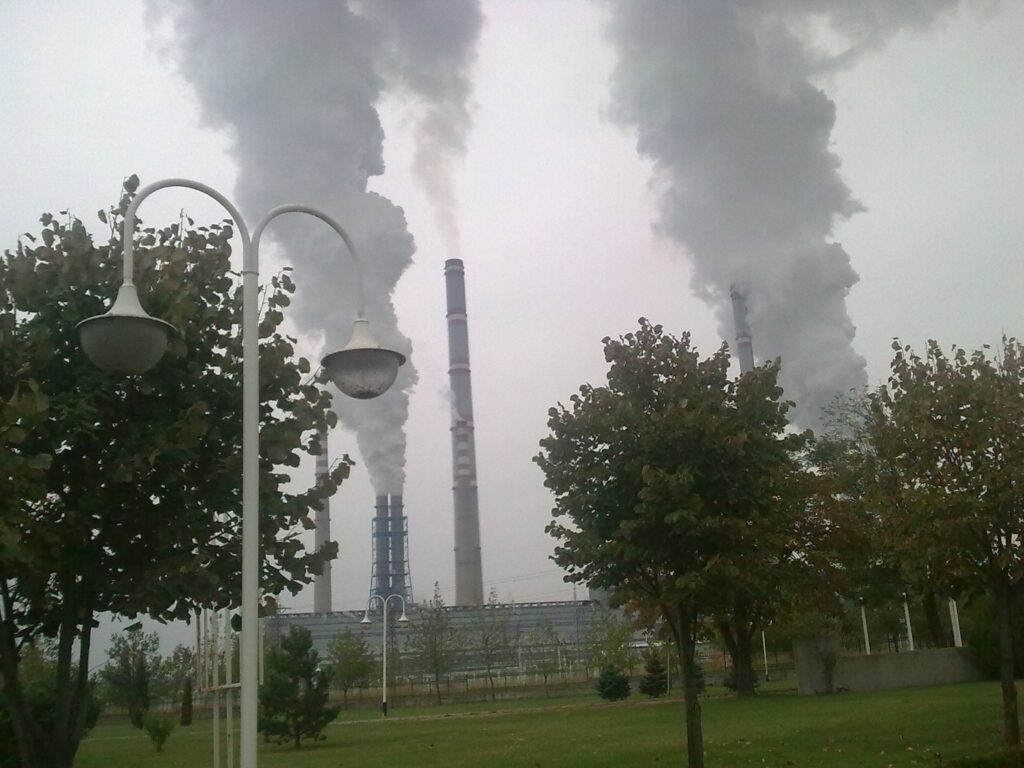
The Court of Justice of the European Union ruled today that Bulgaria is violating European environmental legislation by allowing the state-owned power plant “Maritsa East 2” to breach sulfur dioxide environmental standards indefinitely and without a plan to address harmful emissions.
This information was shared in a press release by “Greenpeace Bulgaria.”
The court’s decision came after the Bulgarian Supreme Administrative Court posed three questions to the Court of Justice of the European Union concerning the interpretation of provisions from two EC directives that regulate air pollution and the environment.
The inquiry was prompted by a lawsuit filed by the environmental organizations “Greenpeace” – Bulgaria and “For the Earth” at the Administrative Court in Stara Zagora against a decision by the Executive Environment Agency (IEA) dated December 21, 2018, which updated the integrated permit (IP) for the plant and set a minimal sulfur cleaning degree of 97 percent.
In a statement to “Za Istinata,” Meglena Antonova, director of “Greenpeace Bulgaria,” noted that the Air Quality Program of the municipality of Galabovo plans for a 98.3% desulfurization rate. However, the Stara Zagora court refused to discuss and assess the significance of this program, arguing that for “Maritsa East 2” to meet its goals, it would need to invest an additional 150 million euros. The court confirmed that
“Maritsa East 2” pollutes the air in both Bulgaria and Greece,
yet deemed that no action was necessary from the administration because the pollution on neighboring territory is not considered “significant.” Consequently, the court did not revoke the plant’s indefinite operating permit, which allows it to operate without complying with legal emission standards.
Following the EU Court’s ruling, the Bulgarian Supreme Administrative Court should issue its decision, returning the case to the Stara Zagora Administrative Court. That court is expected to rule on the appeal from “For the Earth – access to justice” and return the integrated permit of “Maritsa East 2” for review by the Executive Environment Agency (IEA), commented Meglena Antonova. She emphasized, however, that this is not about shutting down the plant, as such speculations may arise in public discourse, but about reviewing the court’s decision that has allowed “Maritsa East 2” to pollute uncontrollably for years and ensuring compliance with the best available technologies in our energy sector.
According to the environmental organization, the energy crisis in Europe, exacerbated by the war in Ukraine, has contributed to the enormous profit of 762 million leva generated from energy sales last year by the state-owned plant.
“The short-term success was politically used as an argument to compel the caretaker government to initiate renegotiation of the Recovery and Resilience Plan concerning the reduction of carbon emissions from coal-fired power plants. This allows the power plants to operate until 2038, which automatically blocks the transition to renewable energy,” stated the press release from “Greenpeace Bulgaria.”
After stabilizing energy prices in Europe and the region, the largest state-owned power plant in Bulgaria began reducing its production since it cannot sell its expensive electricity. This means it will again start incurring losses and will need state assistance to avoid bankruptcy. In discussions about the country’s energy transition, the issue of air pollution from coal-fired power plant operations is rarely addressed.
According to a study by “Greenpeace Bulgaria,” the economic costs associated with health impacts from coal-fired electricity production in Bulgaria amounted to 11.8 billion euros for the period 2016 – 2020.
“The problem is enormous because ‘Maritsa East 2’ is located in a region that is already heavily polluted,” the organization reminded, noting that Galabovo is the only place in the European Union where systematic violations of health protection standards for sulfur dioxide are observed, which was also confirmed by the EU Court in 2022.
Whether all these factors will weigh heavily in the Bulgarian court remains to be seen. There is also another case pending in the Stara Zagora Administrative Court regarding the order to close “Brikel,” the oldest and most depreciated plant in Bulgaria, which systematically emits unregulated harmful emissions into the atmosphere. This plant is also under investigation by the European Prosecutor’s Office for possible fraud with greenhouse gas emission quotas, along with other power plants and heating facilities linked to energy oligarch Hristo Kovachki.






