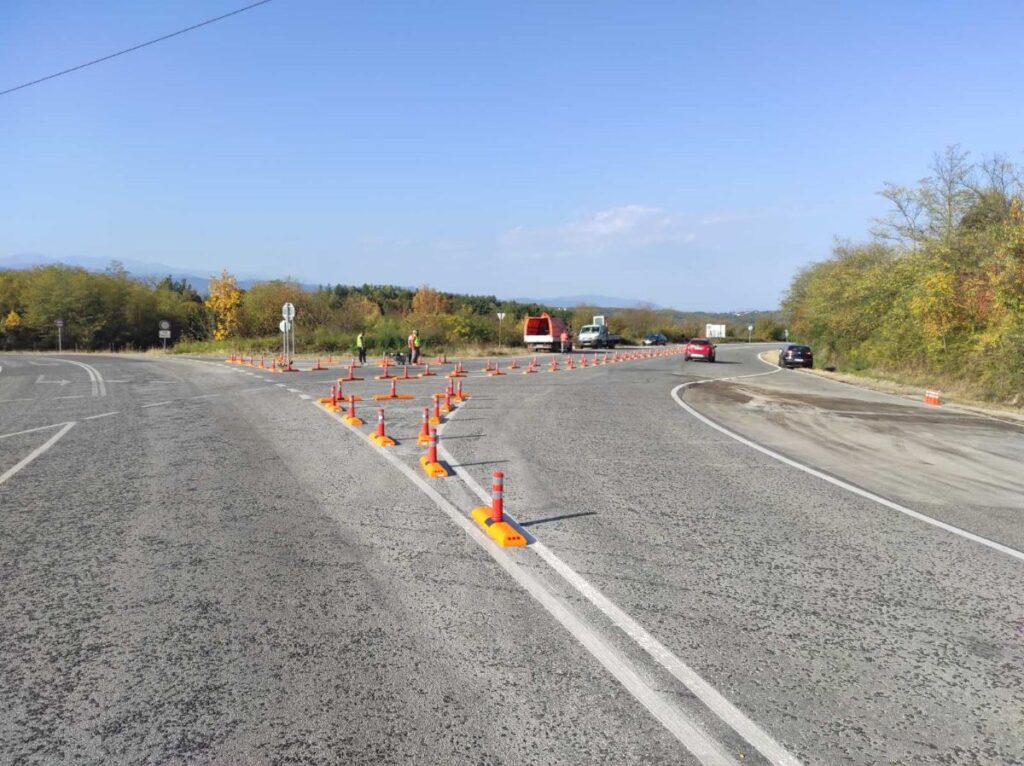
On October 12 of this year, a serious accident occurred on a section of the bypass road around Gabrovo, resulting in the death of four people at the scene and one more later in the hospital. The area is known to be hazardous, and the Road Infrastructure Agency (API) had been aware of this risk two years prior but only took measures to secure it two days after the accident.
From 2021 until October of this year, the Road Police in the Regional Directorate of the Ministry of Interior in Gabrovo sent three warning letters to the Road Infrastructure Agency regarding the hazardous section of the Gabrovo bypass road. The last letter was sent on October 13, 2023—just one day after five individuals lost their lives in a tragic collision between a van and a Romanian-registered truck.
Two Years of Administrative Procedures for Work Completed in Two Days
Did API react swiftly only to the last letter? The day after, on October 14, 2023, they began installing the planned road signage. This happened on the same day that the families buried their deceased loved ones. The safety measures were completed on October 16, which was declared a day of mourning in the municipalities of Gabrovo and Sevlievo.
The work on the hazardous section is part of a project under a contract for the Northeastern region, signed on October 3, 2023, between the Road Infrastructure Agency (API) and the contractor following a two-year procedure for design, coordination, appeals, awarding, and securing funding.
The project includes the enhancement of road signage with the installation of flexible barriers and the enclosure of road islands. It also plans to reduce the speed limit to 60 km/h, which can be achieved simply by installing road signs. All these measures were coordinated with the Road Police in Gabrovo two years ago, but the contract for the execution was signed just one week before the accident that killed five people.
Identified Measures
The police first reported on the hazardous section of the Gabrovo bypass during a briefing after the October 12 accident. They stated that the location was not a site of concentration for traffic accidents but was classified as risky.
In light of this, the Ministry of Interior in Gabrovo sent three letters to API. The Agency did not deny receiving these letters. A spokesperson clarified to “For the Truth” that three warning letters had been recorded by the Regional Road Administration in Gabrovo. The first was sent on October 27, 2021, the second on October 4, 2023—less than two weeks before the accident—and the last on October 13, the day after the accident.
What was API’s response to the first letter?
In typical bureaucratic fashion, the Road Agency conducted an inspection and identified measures. They responded: “A timely inspection was performed at the beginning of November 2021, resulting in measures being identified to enhance traffic safety in the intersection area,” the response states to an information access request. (See the response at the end of this text.)
This pertains to the road from Veliko Tarnovo through Dryanovo to Gabrovo, near the village of Donino.
The identified measures remained dormant for two years—time during which the section continued to pose a risk, while API adhered to procedural rules. Terms like urgency and risk appear to be inapplicable to this situation, especially given that due to protests by energy workers this autumn, who blocked the Republic Pass, heavy trucks were redirected through Shipka.
The second day of protests by miners and energy workers closes key roads in Stara Zagora
It was precisely such a truck with Romanian registration that crashed into a van carrying construction workers from various places in Gabrovo district who were returning from Dryanovo to Gabrovo and Sevlievo. The Romanian driver has been charged in connection with the accident and has been in custody since October 12, under the most severe detention measures. The investigation has continued for two months, and it remains unclear when it will conclude, as multiple expert assessments have been ordered to prove or dismiss the Romanian driver’s fault, according to the prosecutor’s office. Meanwhile, on social media, people have absolved him of blame, while drivers who frequently use the route shared that the location had long been “waiting” for a serious incident.
Unreasonably Long Timeframes
In light of the ensuing events, there is no doubt about API’s inaction, which has been sharply criticized by the regional governor of Gabrovo, Maria Bacheva. At a working meeting regarding the accident that claimed five lives, she stated that she “would insist that API optimize their administrative procedures” as “these are unreasonably long timeframes.”
The subsequent events demonstrate that API can indeed act quickly when necessary. For the five men and their families, however, the agency’s sudden haste makes no difference.