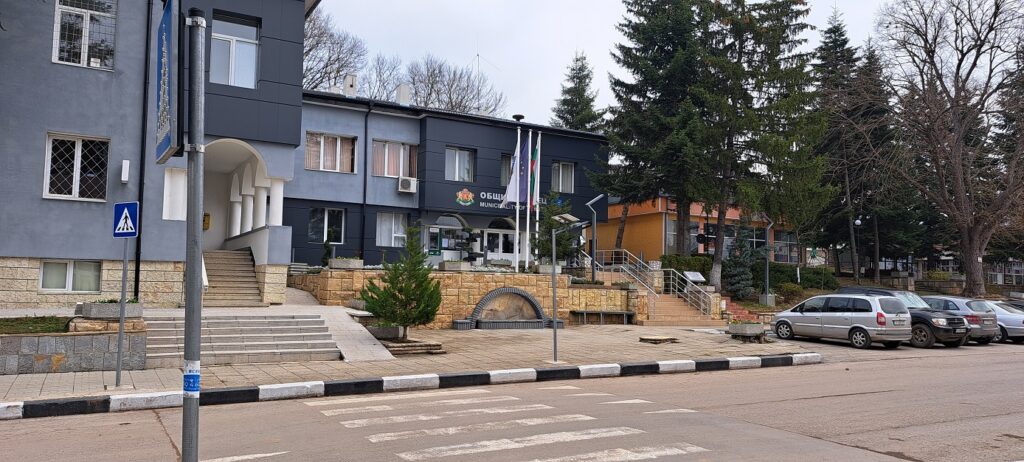
“The Venets, which has serious issues regarding citizens’ awareness of local government operations, surprisingly emerged as a leader in transparency.
The municipality is ranked fifth in the country and first in the Shumen region in the ‘Access to Information Program’ (PDI) ranking for institutional transparency for 2024.
The aim of the PDI survey is to assess how authorities fulfill their obligations under the Access to Public Information Act (APIA) regarding the proactive publication of information online and how they respond to requests for access electronically.
Venets’ classification as ‘the most transparent municipality in Shumen’ has sparked surprise and outright skepticism among local residents, and even among the municipal councilors themselves, who understand the extent of how ‘informed’ decision-making truly is.
For instance, in January, councilors voted on a budget update ‘in the dark,’ as the topic had not been discussed in any committee prior to the session. This addressed the most important law for any municipality – the budget law. In April, municipal councilors futilely attempted to obtain information on how funds were being allocated for community centers but received no concrete response.
‘If we are ranked first in transparency, I can’t imagine how bad the others must be,’ commented a municipal councilor from Venets ironically.”
“The reflects how well municipalities fulfill their obligations under the Access to Public Information Act (APIA) to publish essential information on their websites, such as the organizational regulations, administrative structure, normative acts, registers, annual budgets and reports, access to information, council decisions, and more.
Municipal mayors answer the questions regarding transparency in the PDI survey and are responsible for the accuracy of the information provided.
What Lies Behind the Reports
The question remains whether municipalities truly provide all the information to citizens or merely ‘check off’ their transparency obligations under the APIA. In this regard, the website of the municipality of Venets serves as an example of formalism, particularly concerning the work of the municipal council. But the issues extend beyond that.
On the municipal website, only five news articles are visible, and only three of them are current; the remaining two date back to 2011 and 2008. Of the ‘fresh’ three news articles, two are dedicated to the municipal mayor Nehriban Ahmedova, celebrating her visit to Strasbourg in May and her election as vice-chair of the agricultural committee of the national association of municipalities. That sums up the news transparency.
Formally, the municipality of Venets also complies with the transparency requirements regarding the work of the municipal council.
The activities of local parliaments are among the criteria for transparency, and the PDI survey asks whether the decisions of the municipal council are published, including the dates of their adoption and announcement on the municipality’s website. The municipal office responds with ‘yes,’ thus claiming to meet the transparency criteria. The essential point, however, is what exactly is published—or rather, what is not published by the municipality.”
“Decisions made by the municipal council are only announced with ‘headlines,’ without any substantive content, which often provides no information to citizens.
For example, a decision on one of the most discussed topics in the municipality – regarding the operation of community centers and their funding – was published as follows: ‘The Venets Municipal Council adopts a report on the community activities conducted in 2023.’ And that’s it. The report itself is not published anywhere on the municipality’s website—neither with the decision nor as part of the session invitation. During the session, it became clear that even the municipal councilors could not obtain all the requested information on the topic.
In practice, residents of Venets cannot familiarize themselves with the documents on which decisions in the local parliament are based because these documents are not disclosed on the municipality’s website. In other municipalities, it is common practice to publish the documents from the proposers along with the agenda for the upcoming session, but in Venets, the session invitations are just as formal as the published decisions—only the titles of the agenda items are listed.
Moreover, announcements for upcoming sessions are published on the municipal website at the last moment—2-3 days before the meetings—so few people can get informed and attend the session. Invitations for standing committees, which are also open to citizens, are published only two days before the meetings. In contrast, announcing decisions from sessions is slow; they are reported on the municipal website 10-15 days after the meetings.
Despite the question posed months ago to the mayor of Venets, Nehriban Ahmedova, regarding why information about the work of the municipal council is not accessible, and her promise to ‘speak with the chairman,’ there has been no change in the ‘transparency’ surrounding the work of the local parliament.
Important Topics Remain Clouded
The website of the municipality of Venets also lacks a crucial document—the Strategy for Managing Municipal Property until 2027, i.e., until the end of the mayor’s and council’s term. This strategy was adopted in a session back in January, but it cannot be found anywhere on the municipal website, even with the most diligent search. What will happen to municipal property—whether it will be sold, rented out, or if new property will be acquired—remains unclear to taxpayers.
In fact, the entire substantive topic of municipal property is shrouded in uncertainty. The municipality’s website has a section for municipal property, but the last publication there is from 2023. There is also a register of municipal property, but it is not in the aforementioned section; instead, it is located at the end of all registers, after those for dogs. The register in question is from 2020, and the last update in it is from 2021, according to the entry on the municipal site. What has happened in the missing three years remains an unanswered question.”
“Before February, for example, the municipal council made a decision to sell several municipal properties—yard plots in the village of Chernoglavtsi. From the decision on the sale, it is evident that the properties were recorded with acts of municipal ownership in September 2023, and they were sold just six months later. However, these properties do not appear in the municipal property register. According to the sale decision, they are ‘properties in block 59 according to the current zoning plan,’ but there are no properties listed from block 59 in the village of Chernoglavtsi in the register.
‘How many times have people been upset with me for not announcing the sale of a municipal property, when I neither knew we had such a property nor that we sold it,’ commented a municipal councilor on this matter. Yet, regarding this topic, the municipality is still an ‘honor student’ in transparency – when asked whether registers are published on the website, the administration responds with ‘yes.’”
“The municipality of Venets has been governed for five consecutive terms by the same mayor, Nehriban Ahmedova, and by the same party majority, that of the DPS. This iron symbiosis between the local executive and legislative powers is frequently accused of operating in the dark, which makes the excellent transparency rating evoke particular pride among local officials. This pride would be entirely justified if the municipality had genuinely met the criteria for being a ‘high performer’ in transparency, rather than just fulfilling part of the requirements in a formal manner.”