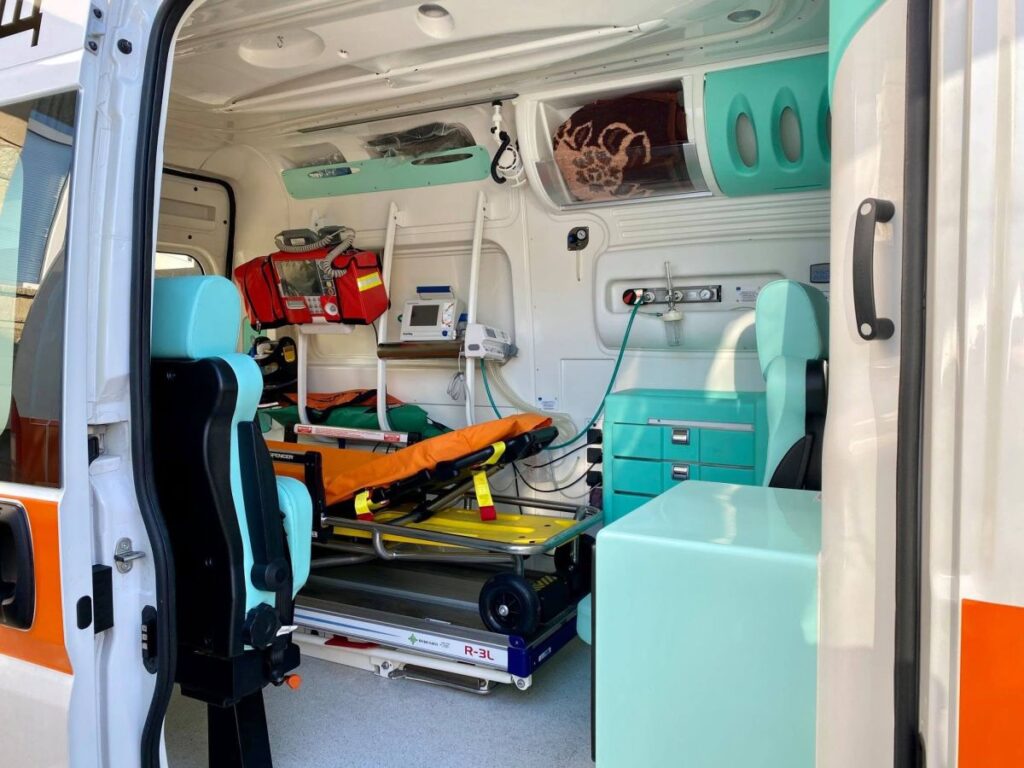
On two out of every three night shifts at the emergency medical service in Sevlievo between February and July this year, there was no doctor on the team. During the day, the situation was less severe: one in every four shifts was without a doctor. Yet the director of the Centre insists that “there are no shifts without a minimum of two mobile teams and one stationary team”. The paradox is that, administratively, he is indeed correct.
For 118 nights, critically ill patients from the 46 settlements in Sevlievo municipality served by the Sevlievo branch of the Gabrovo Centre for Emergency Medical Care (CSMP) had to rely on a paramedic, nurse or midwife. These included patients suffering strokes and heart attacks, people injured in road accidents and others in life-threatening conditions.
The emergency teams in Sevlievo cover an area of 968 sq km with a permanent population of nearly 31,000.
There are teams, but not enough doctors
Against this backdrop, Georgi Shandurkov, director of the Gabrovo Centre for Emergency Medical Care, insists that “the Sevlievo branch is adequately staffed”. According to him, as of 13 July 2026, its staff numbered 38 people. Five were doctors and 19 were healthcare professionals, including one physician assistant, 11 paramedics, four nurses and three midwives.
At the same date, there was “one vacant doctor’s position and half of a vacant position for a healthcare professional”. According to the director, this does not disrupt the work because “the branch operates at full staffing levels and does not experience a shortage of medical professionals”, and because “there are no shifts without a minimum of two mobile teams and one stationary team”. A careful reading of this response reveals an important detail.
Georgi Shandurkov does not say that there are no shifts without a doctor. He says there are no shifts without two mobile teams and one stationary team. These are not the same thing.
What does the emergency medicine standard require?
The Sevlievo emergency medical branch is indeed required to have three teams on duty – two mobile and one stationary. The mobile teams are a resuscitation team and a non-doctor team. These are the teams that respond to calls by ambulance, and each is accompanied by a driver. The stationary team treats patients at the branch.
The resuscitation team must include a doctor and a healthcare professional. This is the staffing structure set out in the medical standard for emergency medicine, and it is also confirmed by Dr Shandurkov’s response to Za Istinata when discussing staffing at the Sevlievo branch.
The other mobile team is a non-doctor team and does not have to include a doctor. It requires only a healthcare professional and a driver.
The stationary emergency team can consist solely of a healthcare professional and a hospital orderly. This is the team the director refers to when saying that the branch is adequately staffed. But he leaves out one important detail: during the first six months of the year, the resuscitation team operated without a doctor 167 times, according to the duty roster obtained by Za Istinata.
Transformation – positions are no longer for doctors
The regulations are structured in such a way that they define the types of emergency teams, but do not require an individual branch to maintain a specific number of doctor-led teams.
The number of established positions – how many doctors and how many healthcare professionals a branch should have – is determined through the National Health Map and the internal staffing structure of the relevant emergency medical centre. The calculations are based on population size and the number of emergency calls.
When there are no candidates for doctor positions, which is common practice across the country, the director has the legal right to transform a vacant doctor’s position into a position for a paramedic, nurse or another healthcare professional, rather than leave the post vacant.
This is precisely what happened in Gabrovo at the beginning of 2025. As of 1 January 2025, the Sevlievo branch had “a minimal shortage of two doctor positions, which were transformed and filled by healthcare professionals”.
In practice, this response means that there is no longer a problem with vacant doctor positions because those positions no longer exist as doctor posts.
It does not, however, answer the question of whether transforming doctor positions into posts for healthcare professionals means that the shortage of doctors has actually been overcome, or whether a different staffing model has simply been adopted.
Growing tensions or friendly support
At the end of June this year, Za Istinata received a report from employees at the Sevlievo emergency medical service alleging tensions within the team following the dismissal of three paramedics. The report, obtained by Za Istinata, claims that this would make it harder to organise and coordinate the work of the teams, increase the workload on remaining staff, raise the risk of delayed or inadequate responses to emergencies and pose a real threat to patients’ health and lives.
While this article was being prepared, one paramedic died, another submitted a notice of resignation, and a third paramedic went on extended sick leave. According to employees at the branch, tensions are “so thick you could cut them with a knife”, as it remains unclear how the work will be organised amid the resulting shortage of medical staff – a problem the director says does not exist.
Dr Shandurkov rejects his colleagues’ concerns, describing the report as “unsigned” and backed by “several friends” of one of the dismissed employees.
The three paramedics were employees who had acquired pension rights and were dismissed “as part of a strategy to renew the workforce and ensure continuity of staffing”, according to the director. He himself has also acquired pension rights.
It was while examining the claims made in this report that Za Istinata came across the staffing data and duty rosters, which paint a different picture from the one presented by Dr Shandurkov.
It is clear that the law allows this staffing model. But when someone calls 112, administrative logic takes a back seat. Because in a heart attack, a stroke or a serious road accident, what matters is not what the staffing chart looks like, but who steps out of the ambulance.