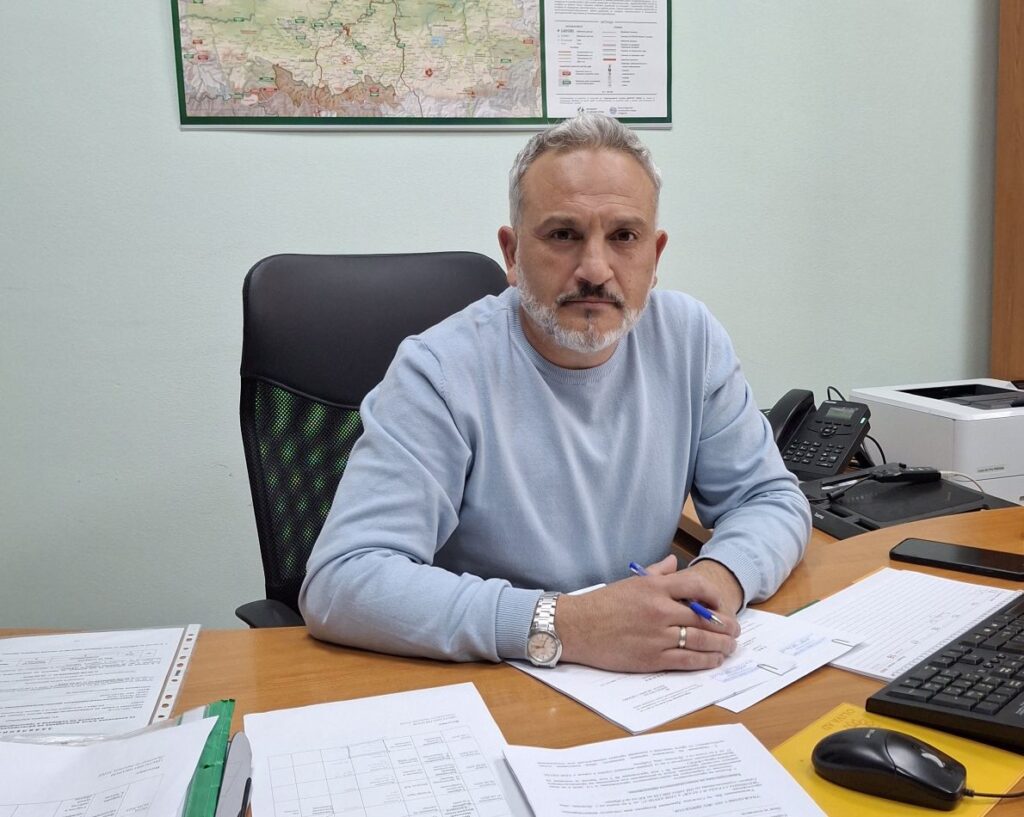
Photo: RIEW
The civil association “You Decide” demanded the resignation of the director of the Regional Inspectorate for Environment and Water (RIEW) in Veliko Tarnovo, Eng. Stanislav Stanchev.
The request came after Stanchev approved a project on January 20 this year for a partial amendment to the General Development Plan (GDP), which changes the designation of nearly 10,000 decares of agricultural land in the territories of the town of Suhindol and the village of Koevtsi to a production zone. The goal is to build a large-scale photovoltaic park. The goal is to build a large-scale photovoltaic park.
The term of the change is 36 years, which is the term of the contract between the investor and the municipality of Suhindol, after which the land can return to its original purpose, according to the statement of the Regional Inspectorate of Environment and Water, which “paved the way for a mega-project that benefits the investor at the expense of nature,” said the association “You Decide” and announced that it would appeal the decision.
Destruction of grass and shrubs, and thus of soil and ecosystems
The planned photovoltaic power plant will destroy grass and shrub habitats, which retain between 4,257 and 5,277 tons of CO₂ per year, thus losing an important function for reducing carbon emissions, according to a statement by Irina Mateeva , an independent expert and member of the additional panel of the Expert Environmental Council at the Regional Inspectorate of Environment and Water in Veliko Tarnovo.
In its opinion, it emphasizes that grasslands produce around 8,316 tons of oxygen per year, which is sufficient for the needs of over 27,000 people, but with the construction of the photovoltaic power plant, all this will be permanently compromised. “The vegetation cover and root system maintain soil health by protecting it from wind and water erosion, a function that will be disrupted. These ecosystems also retain rainwater, regulate water levels, and reduce the risk of flooding. In addition, grassland and shrub habitats help regulate the microclimate, including air humidity and temperatures,” the expert notes.
Land illegally included in the scope of the project
There is also a legal case regarding land ownership in the municipality of Suhindol, according to Mateeva, who sees a discrepancy between the environmental assessment report and the cadastre. According to the report, all properties are municipal property, while the cadastre shows discrepancies in type and management rights. Irina Mateeva emphasizes that public municipal property has a special regime and serves public needs, so it cannot be sold or used commercially without legal procedure. “It is unclear on what basis these territories are included for commercial energy production, nor what rights the municipality has to change the purpose of state property. As a result, there is considerable legal uncertainty regarding the disposal of the properties specified in the partial amendment to the OUP,” she points out.
Entire bat colonies will disappear
The area of the planned photovoltaic park is part of the seasonal migration route of bats, and current data and local observations indicate a real threat to the life and preservation of these colonies. The investor demonstrates a lack of knowledge about key bat habitats and there is an attempt to downplay the importance of these colonies, says Evgeni Koev, chairman of the Dervent Cave Club, in his negative opinion. According to him, there is “a risk of their extinction if the project is implemented” and “for these reasons, we express a categorically negative opinion on the construction of the photovoltaic park.”
When the investor is your sponsor, the opinion is “in favor” of the investment
While experts warn of habitat destruction and potential damage to the ecosystem, the Lozan 1924 football club has expressed its strong support for the investor. In their opinion to the Regional Inspectorate of Environment and Water, they point out that after the investor poured money into the club, “the quality of work with the youth teams improved, and the main men’s team established itself as one of the most financially stable teams in the Veliko Tarnovo region, ranking in the top 3 in terms of financial sustainability.” With these and other arguments along the same lines, the footballers give their positive opinion on the photovoltaic megaproject.
The investors are three foreign companies
Behind the photovoltaic investment near Suhindol is the limited liability company “Wabi Sabi Alpha,” which includes the foreign companies “Green Source” with a share capital of BGN 45,000, Kor Value Capital with the same shareholding, and LSJ Building Solutions with a shareholding of BGN 10,000.
In 2023, Wabi Sabi Alpha submitted its investment proposal to the Municipality of Suhindol for the construction of one of the largest photovoltaic parks in Bulgaria. It is planned to cover an area of almost 10,000 decares of agricultural land, pastures, and forests.
In order to start construction of the park, it is necessary to change the purpose of the land and make partial changes to the General Development Plan of the Municipality of Suhindol. To this end, in October 2024 the mayor of Suhindol, Pavel Chernev, submitted a notification to the Regional Inspectorate of Environment and Water, stating that “the need for the change is due to changes in the economic situation in the country, as well as the growing need to expand the areas designated for harmless production activities.” These are the same activities that, a year later, dozens of experts say will cause harm.
Prior to the submission of this proposal, a decision by the Municipal Council of Suhindol had come into force, giving preliminary consent for the use of the Suhindol land and establishing an easement for a period of 36 years.
On February 6, 2025, the then director of the Regional Inspectorate of Environment and Water Resources, Maya Radeva, stated that an environmental assessment of the investment was mandatory and set the following requirements for it: consultation with the “Basin Directorate” for an assessment of the water resources, isolating the presence of natural water sources and sanitary protection zones; analysis of the likely effects on human health and health risks to people; conducting field studies on the entire area of the properties where the panels will be installed, covering the vegetative period of plant species and the reproductive period of animal species, as well as the spring and autumn migration of birds. It also orders mandatory consultations with the health authorities and the National Institute for Immovable Cultural Heritage.
Meanwhile, Radeva has been dismissed from her post and replaced by Stanislav Stanchev, and on January 13, an Expert Environmental Council was held at the Regional Inspectorate of Environment and Water, which one of its participants, Pencho Pandakov, called “a rigged setup to rubber-stamp an outrageous proposal for a decision.” The council gave the green light for the investment, and just days later this was reinforced by the opinion of the director of the environmental inspectorate.
Citizens: We will not give up
By allowing the preliminary implementation of the change in the Suhindol OUP, the director of the Regional Inspectorate of Environment and Water Resources (RIOSV) in Veliko Tarnovo assumes direct administrative responsibility for the consequences of starting activities on a project that is the subject of fierce public controversy and for which there are serious doubts about the legality of the procedure, according to the civic association “You Decide,” which has already called for Stanislav Stanchev’s resignation.