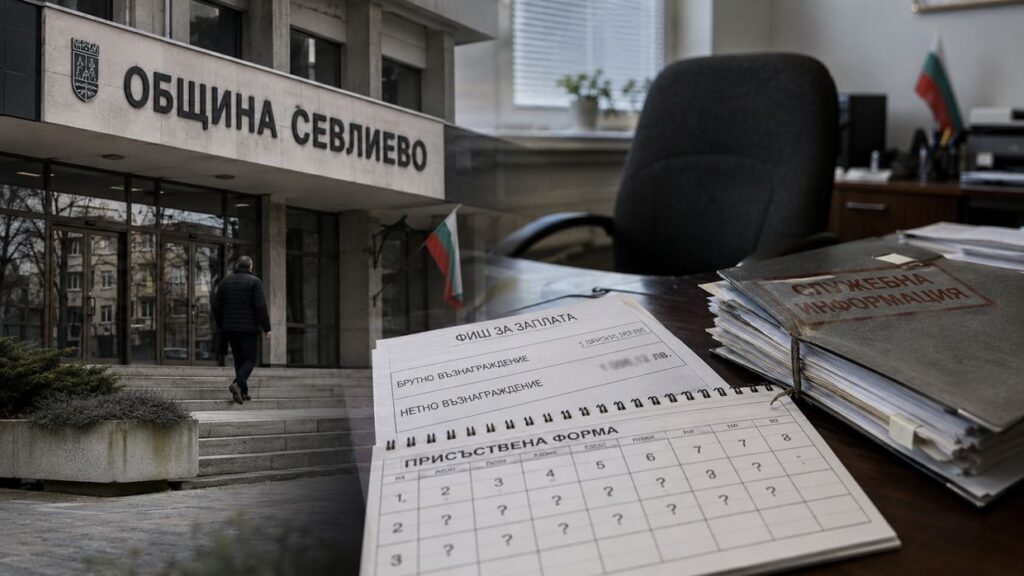
Sevlievo Municipality has refused to disclose how many days its public relations officer was present at work during 2025 and since the beginning of this year. The refusal, sent to “Za Istinata”, cites the possible disclosure of “personal data” and the employee’s “explicit objection” to the information being made public.
According to the municipality, the number of days an employee appointed under an employment contract was actually present at work does not constitute public information.
This is not about private life, but publicly funded work
That argument is difficult to sustain because the issue concerns not someone’s private life but the performance of official duties under an employment contract funded with public money.
Whether a municipal employee actually attends their workplace is directly connected to the way the municipal budget is being spent. It concerns work carried out under an employment contract and a job description and, in itself, does not interfere with anyone’s right to privacy.
That is why “Za Istinata” has challenged the refusal before the Administrative Court in Gabrovo, with the assistance of the Access to Information Programme (AIP).
According to legal experts, the presence of a municipal employee at their workplace is a matter of public interest.
Gone in 60 seconds
The case took an even more unusual turn on 13 May 2026.
A check of the “Contacts” section on Sevlievo Municipality’s website showed that there was no longer any employee listed for “Protocol and Public Relations”.
Until then, the position had been part of the mayor’s office and there had been just one employee in the unit – chief expert for “Protocol and Public Relations”.
The employee was Anelia Skrimova, with an email address and, rather unusually, only a landline telephone number given as contact details.
On 13 May, “Za Istinata” found that the entire “Mayor’s Office” unit had disappeared from the municipal website, along with the employee’s name and contact details.
It is not publicly known exactly when the change was made. An examination of archived pages shows that on 23 April the unit and the employee were still listed on the website, meaning that the information was removed sometime between that date and 13 May.
This happened despite the fact that the “Mayor’s Office” unit had been approved by the Municipal Council when the 2025 municipal budget was adopted and the structure of the municipal administration was approved.
According to information obtained by “Za Istinata”, no proposal to change the structure was subsequently submitted, nor was there a Municipal Council decision formally closing the unit.
The change may be related to the absence of a regular 2026 budget, but one fact remains: the position disappeared without any public explanation, and shortly after the 19 April elections the employee was no longer listed as part of the administration.
The invisible PR officer
Appointed in the first months of 2024 as chief expert for “Protocol and Public Relations”, Sevlievo’s municipal PR officer gradually became an almost invisible presence for local media.
The administration officially confirmed that as of 1 April 2024, Anelia Skrimova was employed by the municipality under an employment contract.
At the same time, in late 2024 and early 2025, she also held a second position – as an adviser in the political cabinet of Agriculture Minister Georgi Tahov in the government of Rosen Zhelyazkov.
The two workplaces are around 180km apart.
In practice, however, her presence in Sofia appears to have been far more visible than in Sevlievo. Throughout 2025 and the first months of 2026, local media remained effectively cut off from the municipality’s official information channels.
Emails sent to the published official address went unanswered, the landline remained silent, and communication with journalists was reduced to brief messages on Viber.
The central question therefore remains: for how long did Sevlievo Municipality pay a salary to an employee whose physical presence at the workplace was virtually invisible?
The answer may lie precisely in the information the administration has refused to disclose.
Because if the attendance records become public, they would show not simply whether the municipal PR officer worked remotely, but whether she actually performed the duties for which she was paid from the local budget.