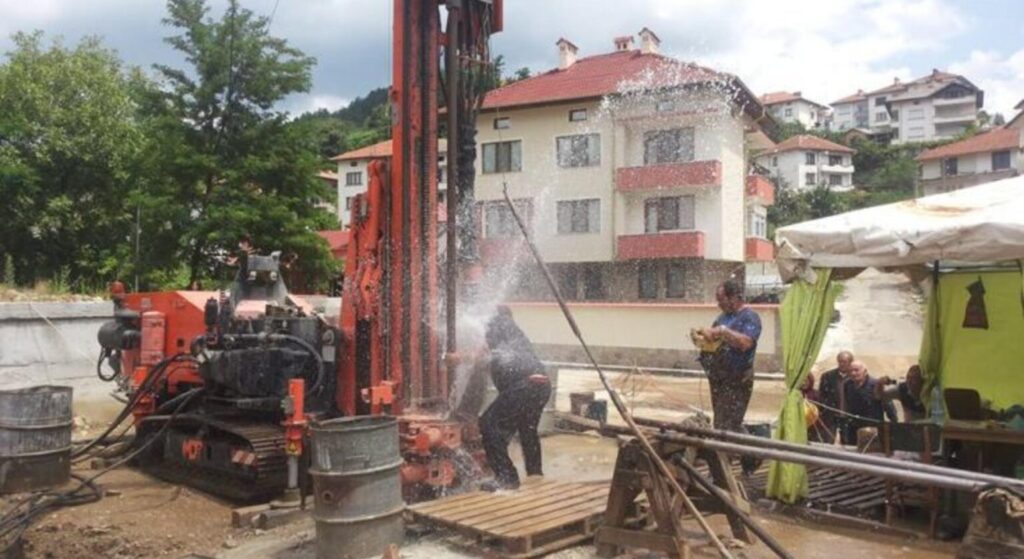
Nedelino Municipality is planning its first exploratory drilling operation, costing more than half a million euros including VAT, to determine whether the ground beneath the town contains a resource that could support future development – or merely an expensive geological hypothesis.
The municipality has reached the next stage of its search for a deep mineral water deposit after only one bid was submitted by the 21 May 2026 deadline for the public procurement procedure. The bid came from GEOPS Ltd, but it has not yet been opened. It therefore remains unclear whether the company will be admitted to the procedure, selected as the contractor and at what price.
The contract covers the “drilling of structural boreholes for the exploration and hydrogeological assessment of a deep mineral water deposit in the territory of Nedelino”. The estimated value is €430,000 excluding VAT.
The technical specification shows that the municipality is seeking an answer to a geological question: whether the area contains a potentially significant deep, high-temperature hydrothermal system with pressurised thermal-mineral waters.
Put more simply, the municipality wants to find out whether there is hot mineral water beneath Nedelino that could eventually become an economic resource.
A 1,800-metre test
The project envisages geological and structural mapping of an area of around 10 sq km, followed by one vertical structural borehole reaching a depth of up to 1,800 metres, with the possibility of extending it to 2,200 metres.
The work will also include geological supervision, logging and preservation of the drill core, geophysical logging, hydrogeological tests and physical, chemical, radiological and microbiological analysis of the water.
The final product will be a comprehensive geological and hydrogeological report.
The most significant part of the technical specification is the geological section expected to be encountered. According to the documentation, the aquifer being targeted lies at a depth of between 1,800 and 2,200 metres, where cavernous marble formations are expected to contain possible pressurised thermal waters.
In other words, the municipality is paying to test a geological hypothesis.
Water – or a very expensive hole?
If the drilling produces a positive result, the borehole is to be preserved so that it can later be converted into an operational or monitoring well.
If, however, the result is negative, or the water manifestations prove too weak to have economic value, the specification provides for the borehole to be decommissioned.
That would involve the installation of cement plugs, the use of a sealing solution and securing the facility.
So with more than half a million euros at stake, Nedelino could take its first step towards developing a mineral water resource. But it could just as easily end up with a borehole that has to be permanently closed.
One bidder
The only bid submitted so far comes from GEOPS Ltd, a company based in Asenovgrad whose business activities include geological exploration, engineering geology and drilling.
Because the bid has not yet been opened, it is too early to say whether the company will ultimately be selected or whether its offer meets all the requirements.
But the central question is not simply whether the sole bidder will win the contract.
It is what, exactly, the municipality will ultimately accept as the result of the project.
Because the final product may not be mineral water.
It may be a report.
And in that case, the most important question will be whether that report provides a clear answer: does Nedelino have a genuine geothermal opportunity, or has the municipality spent a large sum on hope that geology may ultimately fail to confirm?