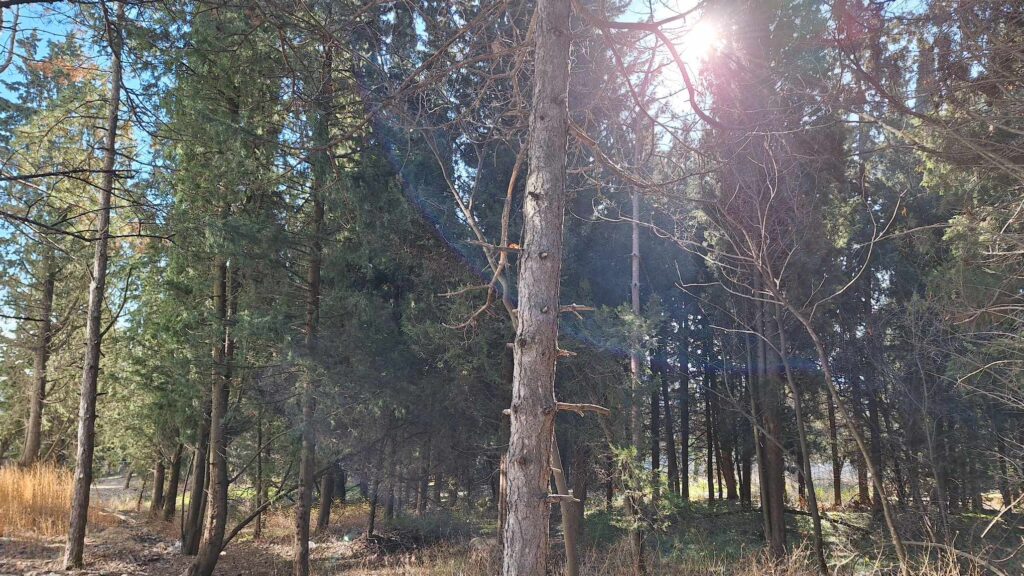
By order from the mayor of Stara Zagora, the felling of 72 trees – half-century-old cypress trees – will begin in a private property owned by the company “Property Start” Ltd. in the “Tri Chuchura” neighborhood. On this site, part of the park adjacent to the former headquarters of the Bulgarian Communist Party (BCP) before 1990, four high-rise buildings and two rows of parking spaces will be constructed.
In his first press conference after the elections, Zhivko Todorov promised that the property would be preserved and that the municipality would adopt a new approach to green spaces in the city.
He also pointed out that, with its publication on May 6, “Za Istinata” contributed to the preservation of the trees on the property in question.
Pavlina Delcheva also shared with “Za Istinata” that she does not want to start her work in Zhivko Todorov’s team as one of the new deputy mayors with the felling of the forest.
A new Detailed Development Plan (DDP) turns the five decares of land, which were afforested more than half a century ago, into a regulated land plot for construction.
The property, originally state-owned, was acquired by the Burgas-based company “EP-Komers” Ltd. (owned by George and Evgenia Popesku) in 2009 at the end of the term of the regional governor Maria Neykova in exchange for another property. Whether the exchange was equitable and what the further fate of the property was remains unknown. It is also unclear on what legal grounds the initial transaction was carried out.
Because green spaces that are public property cannot be sold, transferred, or encumbered with real rights, nor can they be used for other purposes.
According to the law, green spaces that are public property cannot be sold, transferred, or encumbered with real rights, nor can they be used for other purposes. This was most likely the reason why, 12 years later, in 2021, “EP – Comers” LLC sold the land property (with identifier 68850.502.348 on the cadastral map of Stara Zagora) to “Property Start” LLC. But who would buy a property (practically a small forest in an urbanized area), which in the General Spatial Plan (GSP) of the municipality from 2011 is listed as a public service plot, unless they had prior information that its designation would be changed in the new GSP adopted in June 2022?
In March of the same year, the owner submitted a request for the preparation of a new Detailed Spatial Plan (DSP) for the property in the municipality, when the chief architect was Viktoria Grozeva, who was later dismissed from her position due to a sanction imposed by the Anti-Corruption Commission for a conflict of interest.
The new Detailed Spatial Plan (DSP) for the property of “Property Start” LLC was approved by the Expert Council for Territorial Planning (ECTP) in July 2022 – just one month after the adoption of the new General Spatial Plan. However, two and a half years later, it has still not been published on the official website of the municipality. Had this been done within the legal timeframe, the DSP could have been appealed, and there are grounds for such an appeal, as the tree species are not described, and they are also missing from the documentation attached to the plan.
This violates the Territorial Planning Act (Article 63), which requires that projects for detailed spatial plans must be accompanied by a report on the catalogued vegetation and a geodetic survey, certified by the municipal authorities responsible for landscaping.
The case is reminiscent of the “Bedechka” case, where legal disputes between the municipality and the former owners of agricultural land within the park are ongoing.
The new Detailed Spatial Plan (DSP) gives the company the green light to submit a construction plan to the municipality, which does not include the preservation of the tree species. However, to avoid public outrage over the request to cut down all of the more than 100 trees, the investor submitted applications in November and December 2022 solely for the removal of diseased, fallen, and dead trees.
The start of the tree destruction was initiated on April 13 of the previous year when Dejan Georgiev received permission for the felling and uprooting of 34 trees.
At that point, Za Istinata received a tip from citizens and began investigating the case. The municipality of Stara Zagora provided a protocol describing the trees designated for removal, along with photos of some of them, the felling permit, and a sanitary examination presented as a phytosanitary assessment. However, the document lacked a description of the entire permanent vegetation, including species, age, trunk and crown condition, and other attributes it should have contained.
At that time, the owner told Za Istinata that more trees would have to be felled, though without specifying how many exactly.
The request for the removal of the new 72 trees was accompanied by a disputed phytosanitary assessment, which only listed the number of trees in good, poor, and unsatisfactory condition. Naturally, the last two categories predominated. However, this did not reflect their actual condition, which could have been easily observed before the owner fenced off the property and prohibited access.
The current regulation for the protection of green spaces and decorative vegetation stipulates that an Environmental Impact Assessment (EIA) is required for the felling of more than 20 trees. For this reason, the investor requested an opinion from the Regional Inspectorate for Environment and Water (RIOEW). According to the investor, the opinion stated that the felling of the trees would not affect the environment and that an EIA was not necessary.
Referring to the Aarhus Convention, lawyer Alexander Kodzhabashev expressed exactly the opposite opinion, stating that it is legally formal and correct to conduct such an assessment.
The local elections extended the life of the small grove by half a year. However, any moment now, the investor will begin removing the 72 trees, for which he has received permission, signed by Mayor Zhivko Todorov on January 9 of this year.
In May, the investor submits the construction documents to the municipality, and in September, he receives the building permit.
However, the felling of the 72 trees is denied by the mayor.
At that point, Dejan Georgiev meets with municipal councilors and representatives of the administration, who offer to exchange the property for another of equal or even better value.
But with this Detailed Spatial Plan (without trees!) and likely with the promised construction permit, he feels in a strong position and rejects the offer.
He argues that he would need another two or three years to go through the entire process again before starting construction, and he doesn’t have that time to wait. He would be forced to lay off 50 workers.
Deputy Mayor Pavlina Delcheva stated to “Za Istinata” that at this stage, she has no other viable solution. According to municipal councilor Yanko Yankov, there was no public interest in preserving the green spaces: “Only two people complained, and then they sent me a message on Viber saying ‘build,'” he said.
However, the public mediator of Stara Zagora received a written complaint from citizens living near the doomed grove and sent a recommendation to the administration to reconsider the case (whatever that means—editor’s note).
After the investor’s refusal to accept the exchange of the property and the poor imitation of defending the public interest, the mayor signs the permit for the felling of the trees.
However, as of the completion of this article, such a permit has not been published on the municipality’s website. Accordingly, citizens of Stara Zagora cannot familiarize themselves with it and potentially file an appeal. This is because every resident of the city is directly affected by the destruction of green spaces and has a vested interest in submitting a complaint or report.
In an attempt to placate the public, the municipality signs an agreement with the investor, in which he promises to plant 100 new trees on a neighboring municipal plot that also has vegetation. However, it is unclear where exactly these trees will be planted and who will take care of them. In the agreement, which has no legal value, Dejan Georgiev also promises to build a children’s playground.
In a phone conversation, Mayor Zhivko Todorov tried to justify his abrupt change of opinion by arguing that the municipality would lose a lawsuit if the owner decided to seek his rights through legal means. He dismissed the possibility of purchasing the property and changing its designation to preserve the trees. He cited the reason that compensation for the 400 decares of land in the “Bedechka” park had to begin this year.
However, this cannot be true, as legal disputes between the municipality and landowners in the park are ongoing. Only once a lawsuit is completed does the five-year period for compensation begin. This will likely occur during the term of a future mayor, according to legal experts.
Tomorrow, the beautiful cypress trees will be gone, and they will remain in the archives only through photographs. This will happen in other parts of the city as well, the mayor stated during our conversation. However, this shouldn’t be the case. Because the law is written to balance the public and private interests, but only if it is applied with full rigor, and not regularly circumvented or violated, as is the practice, at least in Stara Zagora.