


In October 2019, in the midst of the local election campaign, the residents of Sevlievo, Dryanovo and Suhindol received a bucket containing twenty biodegradable bags and a leaflet with detailed instructions on what to do with them. This was the so-called “free of charge start package”, with which the population in two of the three municipalities was integrated to the new system for separate collection of bio-waste. The aim was, the citizens to become part of the process of turning their household waste into compost.
Eight months later, 15 thousands buckets for nearly BGN 45,000.00, are covered with dust in basements and closets, the project is reported as completed, but no one in Sevlievo, Dryanovo and Suhindol turns the waste into compost and it is difficult to find an explanation for what the BGN 4 million were spent.
BGN 2 million for methodology – “How to dispose of garbage”?
The creation of an entirely new system for separate collection of household waste and its conversion into compost was supposed to be accomplished under the project “Implementation of a decentralized model for bio-waste management in the municipalities of Sevlievo, Dryanovo and Suhindol”, funded under the Operational Program “Environment”. The implementation of the project, presented as a pilot one for the country, started in 2014 by the Ministry of Environment and Water (MOEW) with a budget of BGN 4 million. At that time, the Minister was Stanislav Atanasov (MRF). For one year, MOEW spent half of the budget – about BGN 2 million, for which only a methodology for garbage disposal was developed.
It is possible with half the money
In order to avoid the imposition of financial sanctions and corrections by Brussels, the work had to be completed. Therefore, in August 2018, Minister Neno Dimov transferred its completion to the mayors of Sevlievo, Dryanovo and Suhindol. The new project budget was now only BGN 2.2 million.
However, it turned out that the remaining half of the initial budget was enough to complete the project. Thus, on December 6-th, last year, the European Structural and Investment Funds Information Portal published a notice that the mayors of Sevlievo, Dryanovo and Suhindol have officially declared open the system for separate collection and recycling of biowaste in the municipality of Sevlievo. A reference in the UMIS system – for management and monitoring of European Union funds in Bulgaria, shows that the following is written there: “Completed as of the date of completion”.
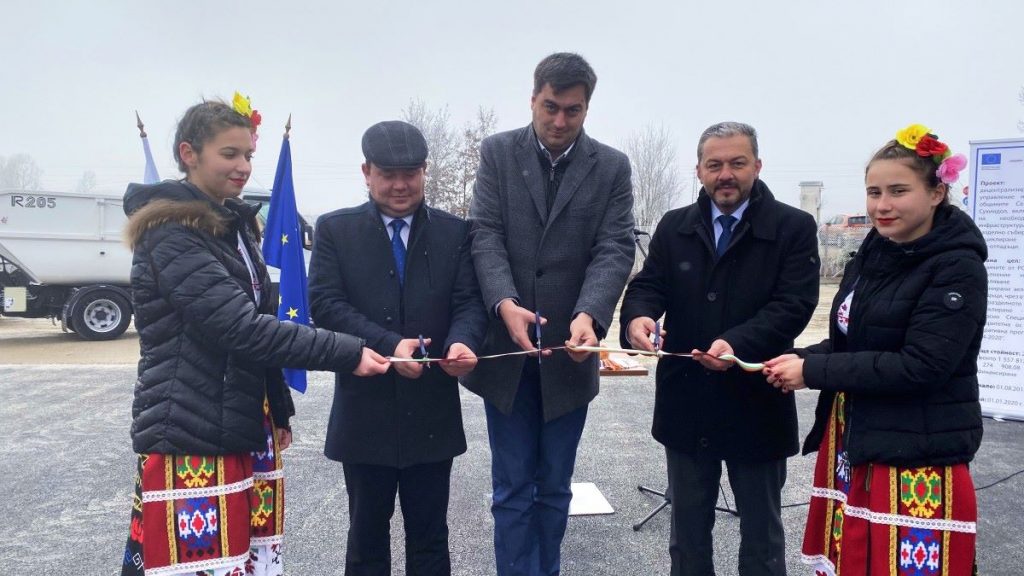
Photo: UMIS 2020
Completed does not mean operational
Today, no one in the three municipalities disposes bio-waste separately. According to the schedule of activities provided by the Municipality of Sevlievo to “Pro Veritas”, this should have started in January 2020, when the term for organization and management of the project has expired.
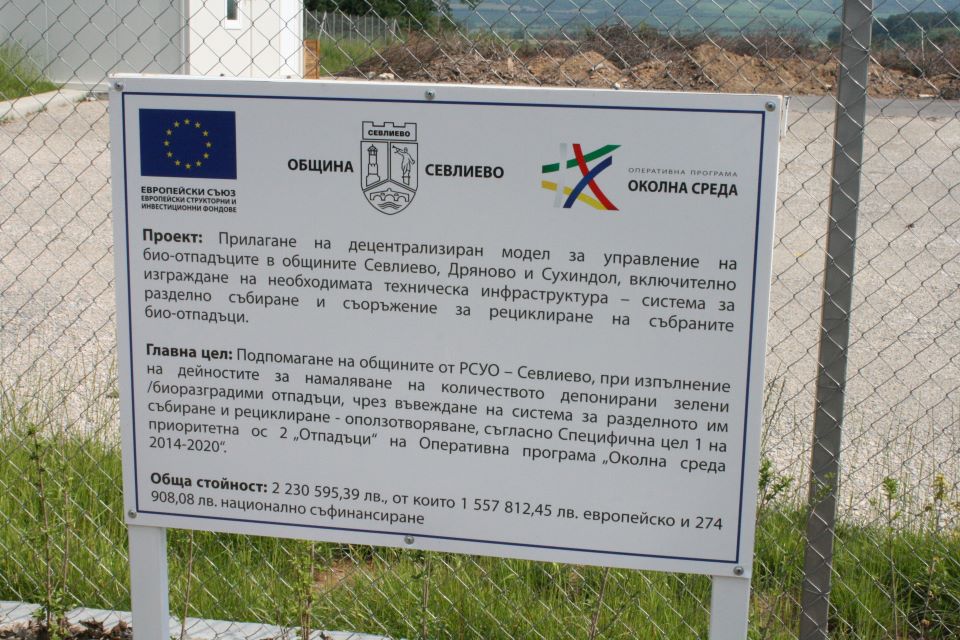
Half a year later, the composting site in Sevlievo, opened in December 2019, is locked with a padlock hanging at the entrance and only the mandatory sign at the entrance indicates that there is a site built under an European Program, worth BGN 2.2 million.
A tour around the fence at the far end of the site shows the existence of an infiltrate tank, a concrete wall and laid pipes, which according to the project documentation are the connection with the air supply facility and the infiltrate tank. There are also facilities, part of the specific equipment for converting green waste into compost.
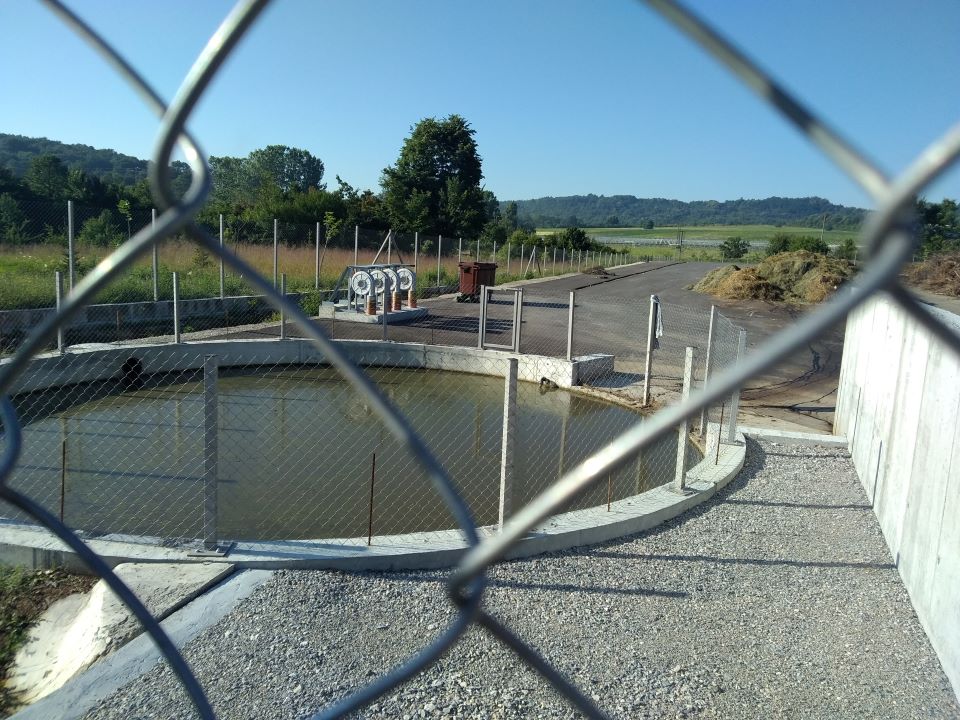
Photo: “Pro Veritas”
The site in Sevlievo was built under a contract between the Municipality of Sevlievo and a company registered under the Obligations and Contracts Act – “Compost 92”, which includes Sevlievo “Infrastroezhi” and Sofia “Patstroy 92”. The value of the contract is just under BGN 526 thousand, VAT included.
… and an empty dog hut
Today, at the far end of the site, huge pile of branches and two chambers of cut grass are piled. They do not appear to be prepared for composting. The branches are thrown as they are cut, and for their processing into compost they are required to be crushed and spread. The same goes for the grass, which, dumped on chambers several meters high, begins to rot.
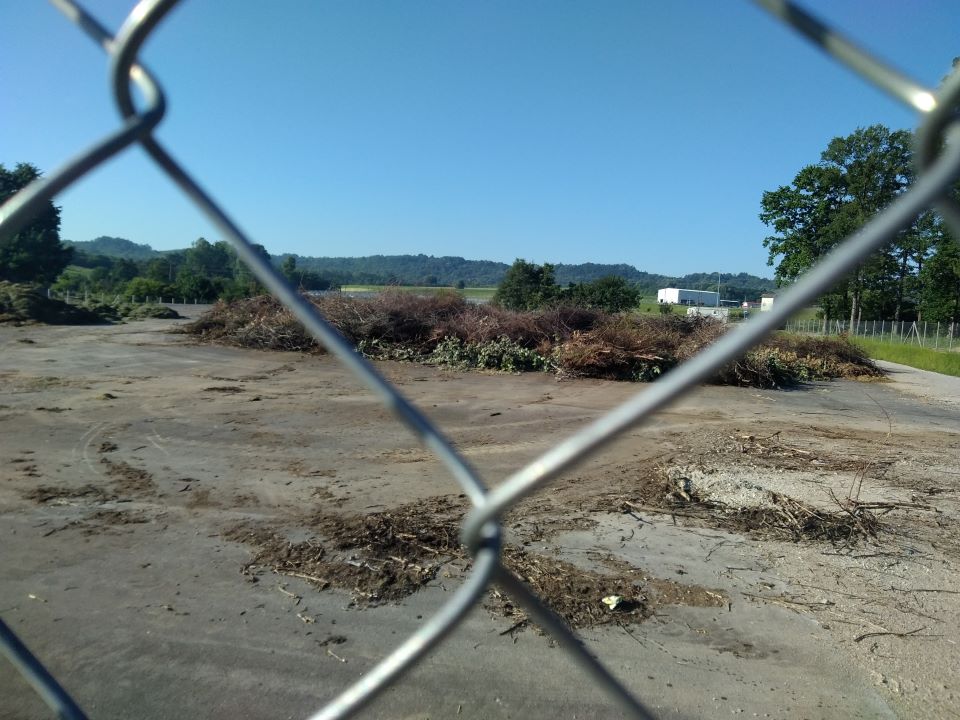
Photo: “Pro Veritas”
In front of the site there is an office van, in which at least at first glance no one has ever worked.
Let’s not forget the empty dog hut at the entrance. Those who were attending the cutting of the ribbon in front of the facility, shared that during the ceremony the dog Rizhko was presented as the guard of the installation. Where Rizhko is today is not the subject of the publication, but the fact that the dog is not there probably means that his services as a security guard are not necessary. Or, that no one steps on the site so taking care of the guard would be an extra effort.
One plastic container is enough
With the exception of one plastic container, the equipment for the site delivered under a contract concluded after winning a public procurement, is not visible. The equipment must comprise, for each of the sites in Sevlievo, Dryanovo and Suhindol, four containers of 120 liters each and a lockable wooden tool box. The box should hold a metal trolley, four forks, four shovels, two plastic watering cans with a capacity of 10 liters, a cover with size 2.50 x 10 m and a thermometer with a measuring range of up to 150 degrees.
The value of this public procurement for the supply of the equipment described above is nearly BGN 11,000.00, VAT included, and the contract has been fulfilled by the Sevlievo company “Infrastroyezhi”. The same company has supplied and installed the office container as well as a mineral water dispenser for the composting plant. This order is for almost BGN 12,000.00. Approximately the same is the value of a public procurement won again by “Infrastroyezhi” for the supply of equipment for the site in Dryanovo. The equipment includes a petrol generator, a submersible waste water pump, a temperature probe for measuring the water temperature, a compost quality test kit and a carbon dioxide measuring probe.
The invisible park
The assumption, that no one has set foot on the site for a long time, has another reason. Near the fence, saplings and pines were once planted, half of which are now dried-up.
This part of the contract for the construction of the composting site is extremely curious. It is called “Park Development and Public Works”. According to this part of the contract, the area around the site should be planted with 12 spruces, two common firs, 30 spherical compass trees (Acer Platanoides Globosum), four acacias, thirteen spherical ash trees (Fraxinus excelsior), sixteen silver lindens, 150 coniferous shrubs and 194 deciduous shrubs of various species. The trees should be protected by three pine pegs each.
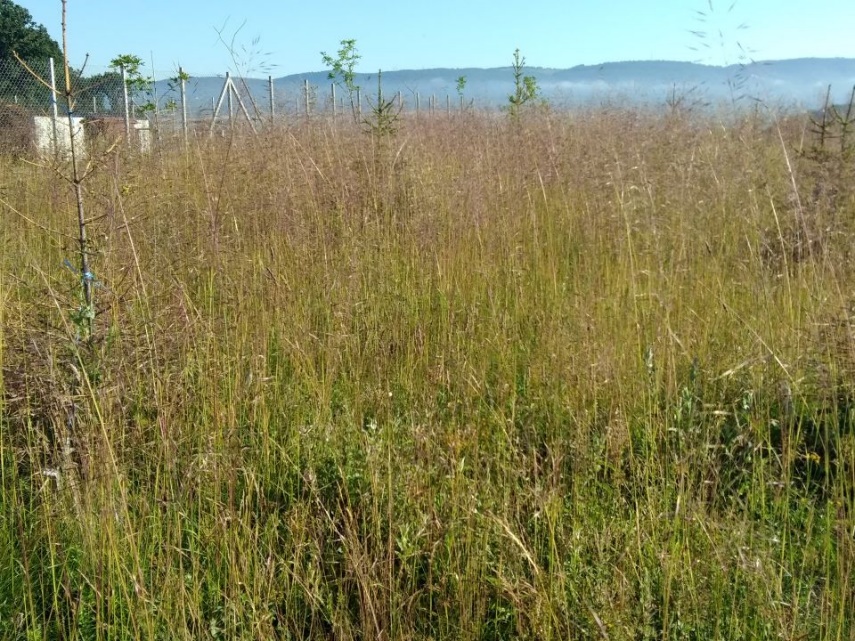
Photo: “Pro Veritas”
However, you will not find the vegetation described above in the tall grass around the site. It is possible that the trees and nearly two hundred shrubs, whose planting in the contract with the contractor is valued at BGN 850, simply did not survive. It can be seen that some of them have dried-up, others have been broken. Apparently, 231 pine pegs, which according to the bill of quantities cost BGN 921, did not work. Today they are thrown near the trees.
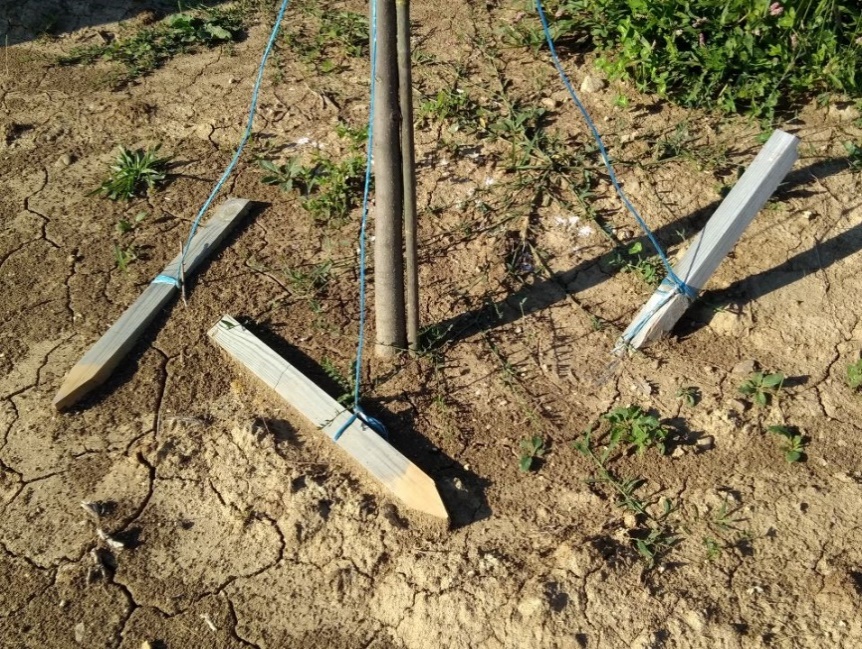
Photo: “Pro Veritas”
The grass is not only around the space that according to the project documentation is a park area”. The weeds also flourished inside, on the site itself. It is not clear whether because of this, it is not possible to see where the 730 sq.m grass area is situated exactly, for which BGN 1,500.00 are written in the Bill-of-Quantity.
Implemening the leading Gabrovo experience
The place really looks deserted and uninhabited. However, Svilen Radkov – Manager of the Regional Landfill site in Sevlievo does not think so.
We understand from him that a month ago, the Regional Landfill was chosen to be the operator of the composting plant. Public information about this cannot be found, there is no announcement for opening a procedure for assignment of the operator’s activity, which raises the question of the order in which the assignment took place.
We also learn from Radkov that the thrown branches are there because they are processed into compost. And also, that it is not true that the installation is not working, on the contrary, compost is currently being made there. However, the question is what kind of waste is processed since the population does not collect biodegradable waste, as should be according to the project?
And how was everything supposed to look like?
The all-new organization for the disposal of biological waste from households, restaurants and shops envisages that the biodegradable waste collected in special containers shall be disposed in suitable containers that will be transported to the composting facilities on a regular basis.
For this purpose, the citizens received kitchen containers and degradable bags. In those bags, they had to dispose only recyclable waste – food, greens, paper and cardboard. At a certain period of time, the collected waste will be thrown away in containers placed at different points in the cities. They in turn shall be poured on the composting site.
In order for this organization to work in Sevlievo and Dryanovo, 775 containers with a capacity of 240 liters, 346 containers of 120 liters each, almost six thousand containers with a capacity of 26.5 liters each, the same quantity of kitchen containers with ventilation openings of 10 liters each, another 3,000 kitchen containers and 265 road containers with a capacity of 660 liters were purchased. This information was provided to “Pro Veritas” under the Access to Public Information Act. The cost of all this is BGN 418 thousand. Another BGN 43 thousand are paid for the biodegradable bags that the citizens received with the containers, or the total bill is BGN 461 thous.
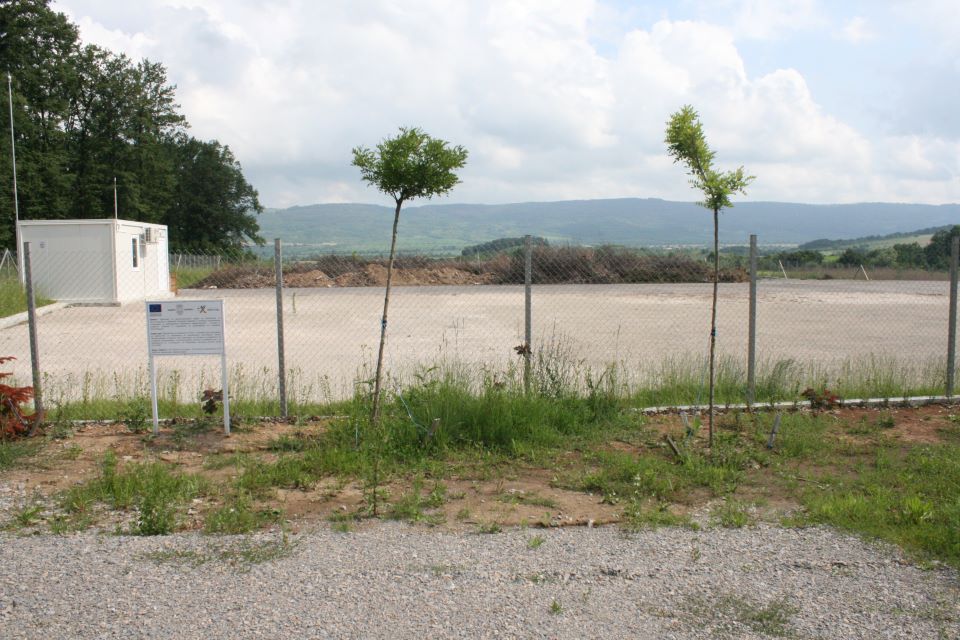
Photo: “Pro Veritas”
The excuse COVID-19
According to Svilen Radkov, this order of work will not be observed, although it is exactly described in the project. An investigation in the neighboring municipality of Gabrovo found that people do not use the containers for their intended purpose, which is why, in order to preserve the containers, they will not be placed on the streets, but will be delivered to restaurants. This has not been done so far because the establishments have been closed due to the state of emergency. The latter is true, but it can hardly be accepted as an excuse, as the project was completed in December 2019, and the state of emergency in our country was imposed on March 13 this year and lasted until May 13, 2020.
The non-functioning project is also explained with the Coronavirus by the Project Manager – the Deputy Mayor of Sevlievo Municipality, Nevena Todorova. To the questions sent by “Pro Veritas”, Todorova explained the following:
“The process of implementation and application of a decentralized model for bio-waste management in the municipalities of Sevlievo, Dryanovo and Suhindol is not limited to the implementation and the time range of the project, but continues over time.”
The implementation of the project has been delayed due to the declared state of emergency and the complicated situation in connection with the distribution of COVID 19 throughout the country. In her answers, Todorova also explains that since July this year, the stage-by-stage disposal of bio-degradable waste bins will start, so she invites citizens who have received buckets with bags to start using them after a container has been delivered near their address. Todorova assures that “activities for processing of biodegradable waste are carried out at the built composting plant since May.”
Why then BGN 4 million had to be spent?
Apparently, Svilen Radkov, head of the landfill in Sevlievo, which, he said, has been approved as the operator of the composting plant a month ago, and the Project Manager Nevena Todorova have different views on how the project will continue to work in practice. As it became clear from above, Radkov does not intend to rely on citizens, Todorova claims the opposite. And from this discrepancy it is not clear at all, what BGN 4 million were spent for.
If Svilen Radkov is right that “at this stage” the citizens will not be included in the system of separate collection, it turns out that the money for bags and small waste containers, which were distributed in October last year, were wasted. The same is true for BGN 193,000.00 spent for an information campaign among the population, part of which campaign was the distribution of the mentioned containers, bags, educational leaflets and meetings for explanations of how people will contribute for the environmental protection by collecting separately kitchen waste that can later be used as a compost.
All this seems like an environmently-friendly attitude. However, the facts show the opposite – the funding for the project was obviously spent, just to make it look as if we care.





